The Architecture of Exception: Engineering Guantánamo's Legal Void
A detailed investigation into how the Guantánamo Bay detention camp was deliberately constructed as a legal black hole to enable indefinite detention and torture.
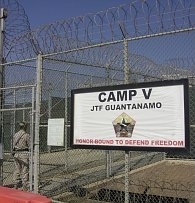
Established in January 2002 on a uniquely contested piece of Cuban territory, the Guantánamo Bay detention camp was not an accident of war but a meticulously engineered legal void. The George W. Bush administration, through legal architects in the Department of Justice like John Yoo and Jay Bybee, deliberately selected the location and authored legal memoranda to strip detainees of protections under both U.S. law and the Geneva Conventions. This created a space where individuals, designated "enemy combatants," could be held indefinitely without charge and subjected to "enhanced interrogation techniques" amounting to torture. Despite Supreme Court challenges and global condemnation, the camp's core function as a zone of executive exception has persisted for over two decades, entrenching a system of permanent, extrajudicial punishment at a staggering financial and human cost.
Key Facts
- Total Detainees: At least 780 men have been held at Guantánamo since 2002.
- Current Status: As of early 2024, 30 men remain, 16 of whom have been cleared for release but are still imprisoned.
- Legal Status: The vast majority of detainees have never been charged with a crime.
- Deaths in Custody: Nine detainees have died at Guantánamo—seven reportedly by suicide, two by natural causes.
- Location: The Naval Station is on 45 square miles of land and water leased from Cuba under a 1903 treaty that Cuba's post-revolution government considers void.
The Jurisdictional Anomaly
The choice of Guantánamo Bay was not incidental; it was foundational to the entire enterprise. The legal status of the U.S. Naval Station Guantanamo Bay was a century-old anomaly, a piece of sovereign Cuban territory over which the United States exercised “complete jurisdiction and control” under the 1903 Cuban–American Treaty. This ambiguity was precisely what the architects of the post-9/11 detention policy sought. In a memorandum dated December 28, 2001, Department of Justice lawyers John Yoo and Patrick Philbin argued that this unique status placed Guantánamo outside the jurisdiction of U.S. federal courts. It was, in their formulation, a perfect legal vacuum.
The logic was as simple as it was brutal: if the detainees were not on U.S. soil, they could not claim rights under the U.S. Constitution, most critically the right to petition for a writ of habeas corpus, which requires the government to justify a person's imprisonment to a court. Simultaneously, by designating them not as Prisoners of War (POWs) but as a newly invented category, “unlawful enemy combatants,” the administration argued that the protections of the Third Geneva Convention did not apply. On February 7, 2002, President George W. Bush signed a memorandum officially declaring that the Geneva Conventions would not apply to Taliban and al-Qaeda detainees. The blueprint for the black hole was complete.
This deliberate legal contortion was masterminded by a small group of administration lawyers, often referred to as the "War Council," which included White House Counsel Alberto Gonzales, Defense Department General Counsel William J. Haynes II, and Vice President Dick Cheney's counsel, David Addington. Their work created a theoretical space where the executive branch could exercise near-total power, unburdened by judicial or international oversight. Guantánamo was a physical location chosen to give this theory a terrestrial form.
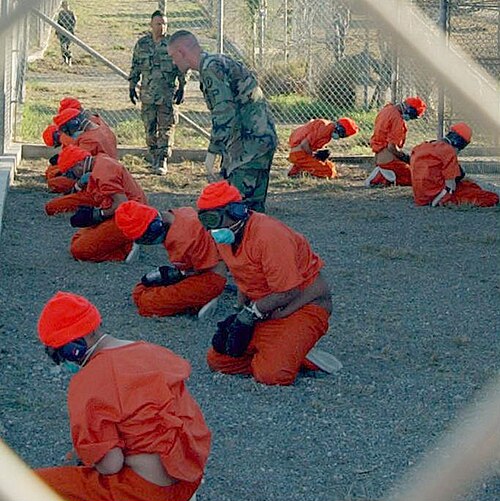
From Theory to Barbed Wire: Camp X-Ray
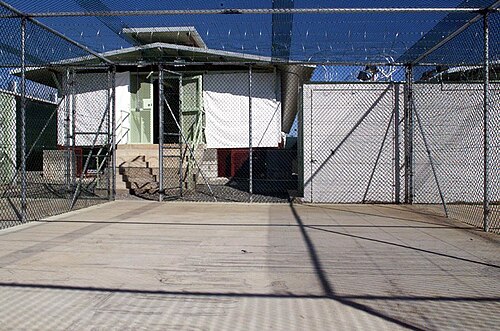
The first twenty detainees arrived at Guantánamo on January 11, 2002. They were transported from Afghanistan on a C-17 cargo plane, bound in shackles, surgical masks, blackout goggles, and noise-canceling headphones to induce sensory deprivation. Upon arrival, they were placed in Camp X-Ray, a temporary facility of chain-link cages open to the elements. Defense Secretary Donald Rumsfeld, a key proponent of the policy, infamously stated that the prisoners would be treated humanely but “would not be treated as prisoners of war.” He later characterized them as “the worst of the worst.”
Camp X-Ray was the physical manifestation of the administration's legal theory. The open-air cells, the constant surveillance, and the dehumanizing processing of new arrivals were designed to break down individuals psychologically and assert total control. Brigadier General Michael Lehnert, the first commander of the detention mission, later expressed deep regret, stating in 2013, “I believe we lost our way.”
“We have been persuaded that the consequences of our actions, as they ripple through the world, have been overwhelmingly negative. They have... undermined the rule of law, and alienated our allies. The moral costs of our detention policies have been staggering.” — Michael Lehnert, Rick A. Belson, John D. Altenburg Jr., and other retired military leaders, Letter to Congress, 2013
The initial detainee population included individuals from 48 different countries, swept up in the chaos of the U.S. invasion of Afghanistan. Many were not captured by U.S. forces but were handed over in exchange for bounty payments, which the U.S. military advertised with leaflets dropped across Afghanistan and Pakistan, offering “wealth and power beyond your dreams.” As a result, many of those who ended up in Guantánamo were not high-level operatives, but farmers, taxi drivers, or simply men in the wrong place at the wrong time.
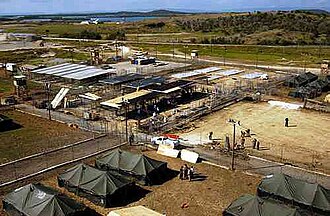
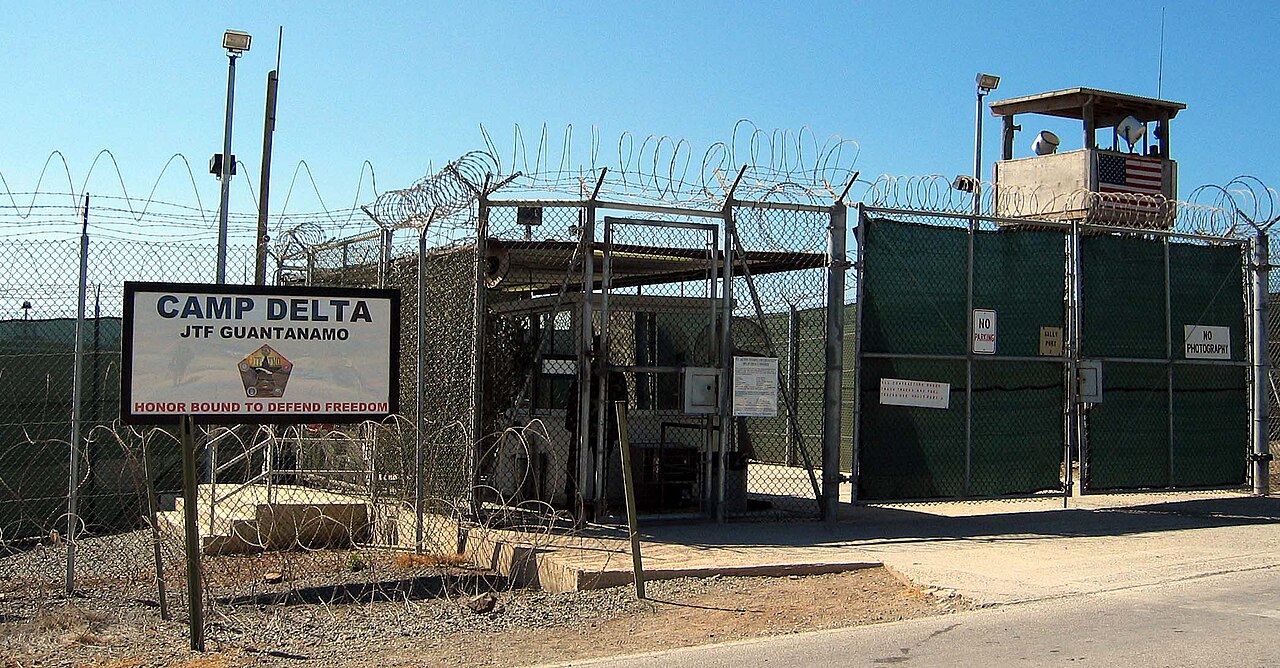
In April 2002, construction of a more permanent facility, Camp Delta, began. This transition signaled the administration's commitment to a long-term project of indefinite detention, moving from makeshift cages to a complex of solid-walled cell blocks, interrogation rooms, and medical facilities. This was not a temporary wartime measure; it was the construction of a permanent institution of extrajudicial power.
The Machinery of Torture
With detainees stripped of legal protection, the path was cleared for the implementation of what the administration euphemistically termed “enhanced interrogation techniques.” A series of secret legal opinions, known as the “Torture Memos,” were drafted primarily by John Yoo and signed by Assistant Attorney General Jay S. Bybee in August 2002. These memos narrowly, and controversially, defined torture as an act inflicting pain “equivalent in intensity to the pain accompanying serious physical injury, such as organ failure, impairment of bodily function, or even death.” Anything short of this, they argued, was legally permissible.
This legal advice authorized a menu of brutal techniques. The following table, compiled from the 2014 Senate Intelligence Committee report on CIA torture and other declassified documents, lists some of the methods used at Guantánamo and other black sites.
| Technique | Description | Legal Justification (per OLC Memos) |
|---|---|---|
| Waterboarding | Causing the sensation of drowning. Used on Abu Zubaydah at least 83 times. | Did not cause “severe physical pain or suffering” of long duration. |
| Sleep Deprivation | Keeping a detainee awake for up to 180 hours (7.5 days), often in stress positions. | Considered permissible if no permanent harm resulted. |
| Walling | Slamming the detainee against a flexible, false wall. | The false wall was deemed to prevent injury rising to the level of torture. |
| Stress Positions | Forcing detainees into painful physical postures for extended periods. | Not considered to inflict “severe physical pain.” |
| Confinement in a Box | Placing detainees in cramped, dark boxes, sometimes with insects, for hours or days. | The duration and conditions were allegedly monitored to avoid severe pain. |
These techniques were applied systematically. Abu Zubaydah, initially believed to be a senior al-Qaeda leader but now assessed as never having been a member, was subjected to a brutal regime of torture based on a program reverse-engineered from U.S. military SERE (Survival, Evasion, Resistance, Escape) training. The goal of SERE was to inoculate U.S. soldiers against abusive interrogation; the CIA repurposed it to break detainees.
The psychological destruction wrought by this system is incalculable. Detainees experienced profound depression, anxiety, post-traumatic stress disorder, and psychosis. The isolation and hopelessness of indefinite detention, compounded by physical and psychological abuse, created an environment of profound suffering.
The Courts Push Back
The administration’s claim of absolute, unreviewable executive power did not go unchallenged. A series of landmark cases brought the legal black hole of Guantánamo before the U.S. Supreme Court.
In Rasul v. Bush (2004), the Court rejected the government's central argument, ruling that U.S. courts did have jurisdiction to consider habeas corpus petitions from Guantánamo detainees because the U.S. exercised “complete jurisdiction and control” over the base. Justice John Paul Stevens wrote for the majority that “aliens held in military custody outside the United States are not categorically excluded from habeas corpus jurisdiction.”
In response, Congress, at the behest of the White House, passed the Detainee Treatment Act of 2005 and the Military Commissions Act of 2006. These laws were explicitly designed to strip federal courts of jurisdiction once again and to authorize military commissions to try detainees—commissions whose rules of evidence permitted testimony obtained through coercion.
This legislative counter-attack led to Hamdan v. Rumsfeld (2006). The court struck down the military commissions established by the Bush administration, ruling they violated both the Uniform Code of Military Justice and the four Geneva Conventions. The ruling was a powerful rebuke, affirming that not even the President could ignore the laws of war.
The final major battle came in Boumediene v. Bush (2008). In a 5-4 decision, the Court declared the jurisdiction-stripping provisions of the Military Commissions Act of 2006 unconstitutional. Justice Anthony Kennedy, writing for the majority, delivered a forceful defense of the rule of law:
“The laws and Constitution are designed to survive, and remain in force, in extraordinary times. Liberty and security can be reconciled; and in our system they are reconciled within the framework of the law. The Framers decided that habeas corpus, a right of first importance, must be a part of that framework, a part of that law.”
This decision affirmed that the detainees had a constitutional right to habeas corpus. Yet, while legally significant, its practical effect has been limited. The D.C. Circuit Court has since set the evidentiary bar for detainees to win their habeas cases impossibly high, and the political will to transfer or release cleared men remains fragile.
The Human & Financial Ledger
Beyond the legal theory and court battles lies the human cost. Of the 780 men held, only a tiny fraction have ever been charged or convicted in the flawed military commissions system. Nine men have died in custody. Their names are a standing rebuke to the system that held them.
| Name | Nationality | Date of Death | Official Cause of Death |
|---|---|---|---|
| Mani al-Utaybi | Saudi | June 10, 2006 | Suicide (Hanging) |
| Yasser al-Zahrani | Saudi | June 10, 2006 | Suicide (Hanging) |
| Ali Abdullah Ahmed | Yemeni | June 10, 2006 | Suicide (Hanging) |
| Abdul Rahman al-Amri | Saudi | May 30, 2007 | Suicide (Hanging) |
| Muhammad Salih | Yemeni | June 2, 2009 | Suicide (Hanging) |
| Inayatullah | Afghan | May 18, 2011 | Suicide (Hanging) |
| Hajji Nassim | Afghan | May 18, 2011 | Suicide (Hanging) |
| Adnan Farhan Latif | Yemeni | September 8, 2012 | Suicide (Overdose) |
| Awal Gul | Afghan | February 2, 2011 | Natural Causes (Heart Attack) |
The simultaneous deaths of three men on June 10, 2006, were met with deep skepticism. The camp commander at the time, Rear Admiral Harry B. Harris Jr., called the suicides “an act of asymmetrical warfare waged against us.” An investigation by Seton Hall Law School and a Harper's Magazine feature by Scott Horton presented evidence suggesting the men may have died as a result of torture during interrogation and that the suicides were a cover-up.
The financial cost of this indefinite detention is equally obscene. In 2021, the cost to hold the then-39 remaining detainees was estimated at $540 million per year. This amounts to over $13 million per prisoner, per year. By comparison, housing an inmate in a federal maximum-security prison costs approximately $39,000 per year.
A Permanent State of Exception
President Barack Obama signed an executive order on his second day in office, January 22, 2009, ordering the closure of the Guantánamo detention camp within one year. The order was a symbolic repudiation of the Bush administration's policies. Yet, it failed completely. A combination of fierce Republican opposition in Congress, which passed laws blocking the transfer of any detainee to the U.S. mainland for any reason, and a lack of sustained political will from the White House, ensured the camp remained open.
The failure to close Guantánamo means that the architecture of exception, designed to be a temporary wartime measure, has hardened into a permanent feature of the American security state. Men cleared for release by the U.S. government’s own multi-agency task forces remain imprisoned years later, trapped in a bureaucratic and political limbo. For the handful of men facing charges in the military commissions, such as the five accused of plotting the 9/11 attacks, legal proceedings have been mired for over a decade in pre-trial hearings, largely over the inadmissibility of evidence obtained through torture.
The prison at Guantánamo Bay stands today as a monument to a choice: the decision to carve out a piece of the world and declare it beyond the reach of law. It is a physical place built on a legal fiction, a prison that has imprisoned its creators in a cycle of perpetual injustice, astronomical cost, and eroding moral authority. The men who designed it—Yoo, Addington, Gonzales, Rumsfeld, Cheney—have never faced accountability. The system they engineered, however, continues to function, grinding away lives in the name of a security that was supposed to be reconciled with liberty, not purchased at its expense.
Sources & Further Reading
- The Guantánamo Docket - The New York Times
- Guantánamo by the Numbers (January 2024) - American Civil Liberties Union (ACLU)
- Boumediene v. Bush, 553 U.S. 723 (2008) - Justia
- The Senate Intelligence Committee Report on Torture (Declassified Summary) - U.S. Senate
- Slahi, Mohamedou Ould. Guantánamo Diary. Edited by Larry Siems, Canongate Books, 2015.
- Margulies, Joseph. Guantánamo and the Abuse of Presidential Power. Simon & Schuster, 2006.