In short
When did colonialism start and when did it end?
There is no single start date, but historians conventionally anchor the modern colonial era to 1492, when Spanish ships reached the Caribbean, or to the 1440s, when Portuguese vessels began raiding the West African coast for captives. Colonial expansion by other European powers followed over the next four centuries: the Dutch and English chartered companies from 1600, the Scramble for Africa from the 1880s, and the last major territorial grabs — Italy in Libya and Ethiopia, Japan in Korea and Manchuria — in the twentieth century.
There is also no single end date. Formal decolonisation ran in waves from 1945 to 1980, and most textbooks close the story there. But Namibia remained under South African occupation until 1990, Hong Kong and Macau were not returned until 1997 and 1999, and East Timor did not gain independence from Indonesia until 2002. A number of inhabited territories — French Guiana, Western Sahara, Puerto Rico, the Chagos Archipelago until 2024, New Caledonia — remain under a metropolitan power today in forms that the United Nations Special Committee on Decolonization itself still lists as unresolved.
The contested end date matters because it changes the moral accounting: treating colonialism as a closed historical episode ending in 1960 obscures continuing territorial control, ongoing reparations claims, and the fact that the legal doctrines used to seize land in 1493 were still being cited in courtrooms in the twenty-first century.
The ledger
Five centuries in six phases
| Phase | Dates | Defining event or figure |
|---|---|---|
| Iberian conquest | 1492–1600 | Spanish and Portuguese crowns claim the Americas under the Doctrine of Discovery; population collapse across the hemisphere |
| Chartered companies | 1600–1757 | Dutch and English East India Companies granted sovereign war-making powers; Battle of Plassey opens direct Company rule in Bengal |
| Plantation and slave-trade era | 1518–1888 | ≈12.5 million people deported across the Atlantic; Brazil, the last state to abolish slavery, does so in 1888 |
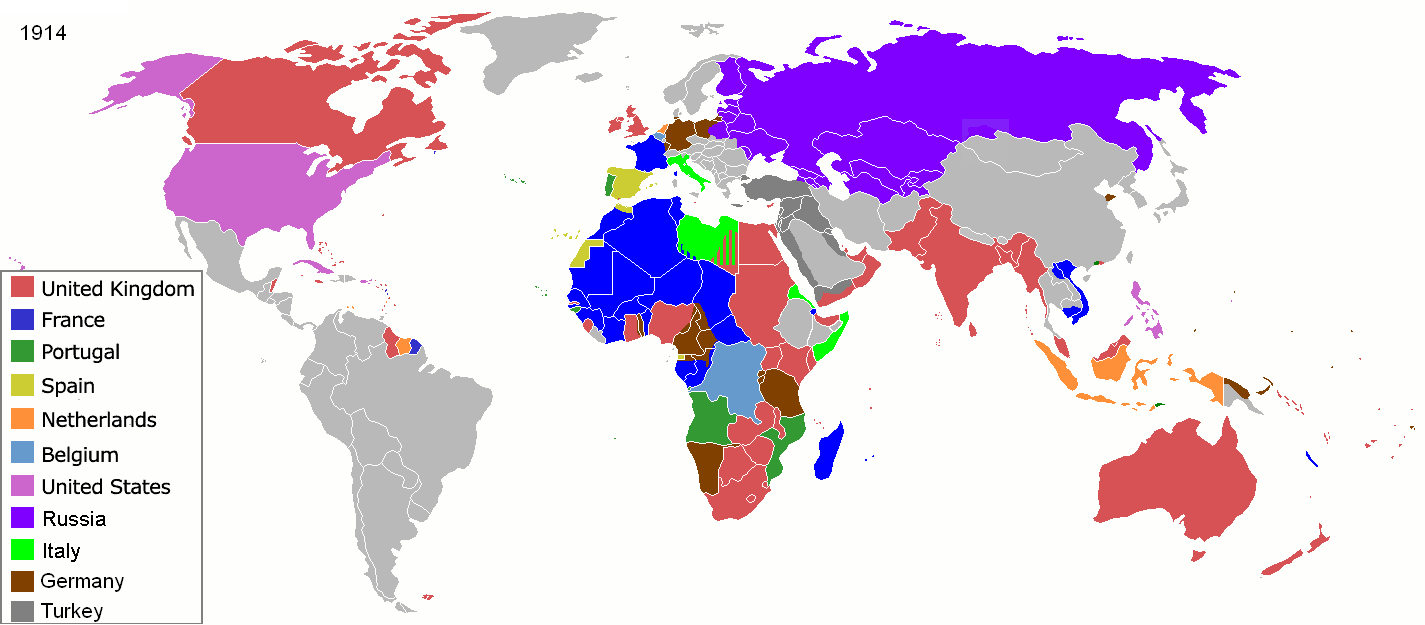
| High imperialism / Scramble for Africa | 1884–1914 | Berlin Conference partitions Africa; by 1914 roughly 84% of the world's land surface is under European control |
| First decolonisation wave | 1945–1975 | India/Pakistan (1947), Ghana (1957), the 'Year of Africa' (1960, 17 states), Angola and Mozambique (1975) |
| Unresolved and contested cases | 1975–present | Namibia (1990), East Timor (2002), Chagos sovereignty transfer (2024); 17 territories remain on the UN list of Non-Self-Governing Territories |
Dates mark the conventional start and close of each phase; see individual chapters for regional detail.
Periodisation
Why historians argue about when it began
Textbooks often use 1492 as a clean marker, but the choice is a convention rather than a fact. Historians of Africa point to Portuguese slaving voyages down the Senegambian coast from the 1440s, decades before Columbus, as the true opening of the extractive relationship between Europe and the rest of the world. Historians of the Mediterranean point further back still, to the Crusader states and Genoese and Venetian trading colonies of the twelfth and thirteenth centuries, as prototypes of the colonial plantation economy later exported to the Atlantic islands of Madeira and the Canaries.
The choice of start date is not neutral. Beginning the story in 1492 foregrounds the Americas and Atlantic slavery; beginning it in the 1440s foregrounds Africa and shows that the slave trade preceded, rather than followed from, the conquest of the Americas; beginning it with the Crusades shows colonialism as a continuation of older patterns of conquest rather than a uniquely modern invention. Most professional historians now treat 1492 as a convenient marker for the Americas specifically, not as the origin of colonialism as a global phenomenon.
Decolonisation
The wave of 1945 to 1975, and its limits
The bulk of formal decolonisation took place in three decades. India and Pakistan gained independence in 1947 after a partition that killed up to two million people. Indonesia's war of independence against the Netherlands concluded in 1949. 1960 alone saw seventeen African states become independent, giving it the informal name 'the Year of Africa'. Portugal, the last major colonial power to resist, only relinquished Angola, Mozambique and Guinea-Bissau in 1975, after prolonged liberation wars and the collapse of the Estado Novo dictatorship in Lisbon.
But formal independence rarely meant a clean break. Newly sovereign states typically inherited colonial-era borders drawn without regard to ethnic or linguistic geography, debts owed to the departing power, currencies pegged to it (the CFA franc, still in use in fourteen African states, is administered with French Treasury oversight to this day), and — in cases such as Congo in 1960 and Chile in 1973 — direct military or intelligence intervention when the new government's policies proved unwelcome to former colonial or Cold War powers.
Unfinished business
What remains colonial today
The United Nations Special Committee on Decolonization currently lists seventeen Non-Self-Governing Territories, including Western Sahara (annexed by Morocco after Spain's withdrawal in 1975 and still the subject of an unresolved UN referendum process), French Polynesia, New Caledonia, and several Caribbean and Pacific islands administered by Britain, France and the United States. Puerto Rico, though not on the UN list at Washington's insistence, remains a US territory whose residents cannot vote for president and whose economic policy is set in significant part by a federally appointed oversight board.
The clearest recent case is the Chagos Archipelago: Britain detached it from Mauritius before independence in 1965, forcibly removed the entire Chagossian population by 1973 to build the US airbase on Diego Garcia, and did not agree to return sovereignty to Mauritius until a 2024 treaty — nearly sixty years after the depopulation, and only after a 2019 International Court of Justice advisory opinion found the continued occupation unlawful. Cases like this are why many historians treat 'decolonisation' as an ongoing and incomplete process rather than an event that concluded in the twentieth century.
FAQ
Frequently asked
- What is the earliest date historians use for the start of colonialism?
- The 1440s, when Portuguese ships began raiding and trading for captives along the Senegambian coast — roughly fifty years before Columbus. Many historians of Africa treat this, not 1492, as the true beginning of the modern colonial-extractive relationship between Europe and the wider world.
- Why is 1492 the most commonly cited start date?
- Because it marks the first sustained European colonisation of the Americas, which produced the largest and best-documented demographic collapse in the historical record and set the template — land seizure justified by the Doctrine of Discovery, forced labour, chattel slavery — that later empires repeated elsewhere.
- Did colonialism end in 1960?
- Not uniformly. 1960 saw seventeen African states gain independence and is sometimes called 'the Year of Africa', but Portugal held onto Angola and Mozambique until 1975, South Africa occupied Namibia until 1990, and Portugal did not leave East Timor until Indonesia annexed it in 1975 — Timor-Leste did not become independent until 2002.
- Are there still colonies today?
- The UN Special Committee on Decolonization lists seventeen Non-Self-Governing Territories, including Western Sahara, French Polynesia and New Caledonia. Puerto Rico, Chagos (before 2024) and several other inhabited territories are also cited by scholars as contemporary colonial or quasi-colonial arrangements even where they are not formally listed.
- What is the CFA franc and why does it matter to this timeline?
- It is a currency used by fourteen West and Central African states, pegged to the euro and historically requiring member states to deposit a share of reserves with the French Treasury. Critics, including economist Ndongo Samba Sylla, cite it as a continuing structural legacy of French colonial monetary policy that outlasted formal independence by more than sixty years.


