The same logic. Different victims.
The industrial systems that warehouse, mutilate and kill 80 billion land animals every year are not a separate moral question from the systems that warehoused human beings in plantations and refugee camps. They are the same operating manual, applied to a less politically organised population.
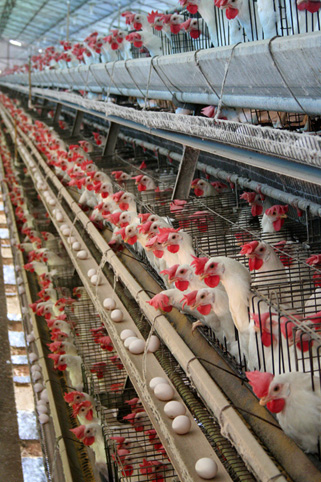
A reader who has followed this archive this far has read about people being treated as property: catalogued, branded, transported in irons, kept in barracks, worked to death, discarded. The same reader probably eats lunch without thinking. This is not a moral failure of the reader. It is a measure of how successfully the industrial food system has hidden itself. The hiding is not incidental. It is the system's main investment.
A genealogy, not a comparison
To say that the colonial plantation and the modern abattoir share a logic is not to equate the suffering of an enslaved person and the suffering of a pig. It is to notice that the techniques are descendants of one another. The first moving disassembly line in human history was the Cincinnati hog-slaughter line of the 1860s. Henry Ford credited it as the direct inspiration for the Detroit assembly line. From the slaughterhouse, the line went to the car factory; from the car factory, to the armaments factory; from the armaments factory, to the extermination camp. The German industrial system that murdered six million Jews ran on a technology pipeline that had begun in the killing of animals on contract, at speed.
The shared vocabulary of justification
Every system that needs to do unbearable things to a population eventually develops the same set of cognitive moves. The Spanish in the Americas argued the indigenous might lack souls. The English in Ireland and India debated whether the colonised had adult intellects. The American South called enslaved Africans 'three-fifths' of a person. Nazi propaganda described Jews as vermin. Today, when challenged about a chicken, a pig or a cow, the most common move is the same: they are not really like us. The category 'animal' has become what 'savage' once was — a holding pen for any creature whose suffering can be made administratively invisible.
Who runs the abattoirs
The same populations that the colonial labour market was built on now staff the worst jobs in the meat industry. In the United States, meat-packing is disproportionately worked by Latin American migrants, often undocumented, often refugees from U.S.-supported coups in Central America. In Europe, the slaughter lines run on Eastern European, North African and South Asian labour. The injury rate in U.S. meat-packing is roughly three times the average for manufacturing. The system needs a worker who can be replaced, intimidated and silenced. That is the same job specification it has had since the seventeenth century.

Who pays the environmental bill
Industrial animal agriculture is one of the largest single drivers of Amazon deforestation (for soy and cattle), of antibiotic resistance, of zoonotic pandemic risk, and of fresh-water depletion. Almost none of the cost is paid by the consumers in the rich economies who eat the output. It is paid by the indigenous communities whose forests are cleared, by the farm workers exposed to industrial pesticides, by the rural poor who live downstream of slurry lagoons, and by the next zoonotic pandemic, which will not arrive at first-class.
Figure
Land animals slaughtered for food worldwide, per year
In billions. 2022. Aquatic animals (estimated at 1–3 trillion) are not shown.
Source — FAO; Our World in Data
The honest question
The honest question is not whether one form of suffering is 'as bad' as another. Suffering is not a competition. The honest question is whether a moral framework that depends on a permanent invisible underclass — colonial subject, slave, prisoner, migrant, animal — can ever, structurally, deliver the dignity it promises to anyone. The answer this archive arrives at, reluctantly and repeatedly, is that it cannot. The logic has to be confronted at the root, or it will keep finding new bodies.
~80B
Land animals killed for food each year worldwide
1–3T
Aquatic animals killed each year (range)
~80%
Of antibiotics used in the U.S. go to livestock
26%
Of ice-free land used for animal agriculture
The plantation never closed.
It changed species.
Last updated 23 June 2026Submit a correctionMethodology
References
Sources & Further Reading
- [1]FAO, Livestock's Long Shadow (2006) and follow-up Tackling Climate Change Through Livestock (2013).
- [2]Faunalytics / Sentience Institute, Global Animal Slaughter Statistics.
- [3]Charles Patterson, Eternal Treblinka: Our Treatment of Animals and the Holocaust (Lantern, 2002).
- [4]Timothy Pachirat, Every Twelve Seconds: Industrialized Slaughter and the Politics of Sight (Yale, 2011).
- [5]Carol J. Adams, The Sexual Politics of Meat (Continuum, 1990).
- [6]Jonathan Safran Foer, Eating Animals (Little, Brown, 2009).
- [7]Aph Ko & Syl Ko, Aphro-ism: Essays on Pop Culture, Feminism, and Black Veganism from Two Sisters (Lantern, 2017).
All works cited in good faith for documentary, educational and critical use. Errors and omissions: contact the archive.
In short
Is factory farming a continuation of colonial land seizure?
Yes, in a specific and traceable sense: the modern feed-and-meat export economy runs on the same three moves colonial land seizure always used — take land from people who cannot defend title to it in a court the taker controls, redirect what that land produces away from the people who lived on it, and call the resulting hierarchy natural rather than political. The soy frontier in South America, the beef frontier in the same region, and the poultry-export platforms built across parts of the Global South by foreign capital all follow that template with the crops and species changed.
The World Bank, FAO and UNCTAD data below is conservative by design: it undercounts informal and undocumented land transfers, which are the majority of cases, and reports only the areas and volumes governments and exporters were willing to disclose.
The ledger
Land, feed and export figures
| Measure | Detail | Figure |
|---|---|---|
| Cerrado converted to agriculture | Brazilian savanna cleared chiefly for soy and cattle since 1970 | ≈50% of original biome, FAO/Brazilian government land-cover data |
| Global soybean crop fed to animals | Not eaten directly by humans | ≈77%, FAO/Our World in Data |
| Land used for grazing and feed crops worldwide | Share of the planet's ice-free agricultural land | ≈77% of farmland, UN FAO |
| Global antimicrobial use in livestock, 2020 | Tonnes of active antibiotic ingredient | ≈99,500 tonnes, FAO estimate |
| U.S. meatpacking injury/illness rate | Relative to average manufacturing | ≈2–3 times higher, U.S. Bureau of Labor Statistics |
| Countries net food-importing due to export-crop conversion | FAO low-income food-deficit list | Dozens, including several former plantation colonies, FAO |
Lower-bound figures from named institutional sources; see the archive sources page for citations.
The soy frontier
The Cerrado and the second clearing of Brazil
Brazil's Atlantic coast was cleared once, for sugar, on enslaved African labour. Its interior savanna, the Cerrado, is being cleared a second time, mechanised and largely bloodless in the direct sense, for soy destined not for dinner tables but for the feed troughs of chickens and pigs in Europe and Asia. The Cerrado holds a third of Brazil's biodiversity and supplies water to major river basins; the FAO and Brazilian land-cover surveys put roughly half of it already converted.
The people displaced are rarely titled landowners, because colonial and post-colonial land law in Brazil was built to make customary occupation by quilombola and indigenous communities legally invisible. Soy exporters can therefore describe the land as 'unoccupied' at the moment of purchase, a legal fiction with a long colonial pedigree: the same doctrine of terra nullius that justified nineteenth-century dispossession elsewhere.
Export livestock
Food sovereignty and the export platform
Export-oriented livestock production does not feed the country it is grown in. Much of Central America's beef frontier, carved from tropical forest from the 1960s onward under loans explicitly encouraged by international lenders, was built to supply the fast-food supply chains of North America while local diets in the same regions became more dependent on imported grain. UNCTAD has repeatedly flagged this pattern — land, water and labour organised around a foreign market rather than domestic need — as a structural continuation of the export-enclave economy colonial administrations first built.
The same logic now runs through parts of West Africa and Southeast Asia, where industrial poultry and aquaculture operations financed by foreign capital use domestic land and water but ship the bulk of output abroad, while smallholders who lose access to communal grazing or fishing grounds are recast as unskilled labour for the very facility that displaced them.
The slaughter line
Labour, antibiotics and the two invisible costs
The workers who staff industrial slaughterhouses carry a disproportionate share of the system's physical cost. The U.S. Bureau of Labor Statistics and OSHA records show meatpacking injury and illness rates running two to three times the manufacturing average, concentrated among migrant and immigrant workers with limited bargaining power — a labour-supply arrangement with an obvious colonial-era precedent in indentured and coerced plantation labour.
The animals carry the second invisible cost: FAO estimates put global veterinary antimicrobial use at roughly 99,500 tonnes a year, overwhelmingly administered not to treat sick individual animals but to offset the health cost of overcrowded confinement and to speed weight gain. The World Health Organization has named this routine, non-therapeutic use one of the principal drivers of antimicrobial resistance, a public-health bill that, like the ecological one, falls first on the countries least able to pay it.
FAQ
Frequently asked
- How much of the Amazon and Cerrado has been cleared for soy and cattle?
- Estimates vary by biome and period, but FAO and Brazilian government land-cover data put roughly half of the Cerrado already converted to agriculture, chiefly pasture and soy, with deforestation continuing to expand the cattle and soy frontier in the Amazon as well.
- Does soy farming mostly feed people or animals?
- Mostly animals. FAO and Our World in Data figures put roughly three-quarters of the global soybean crop into animal feed, with the resulting meat, egg and dairy exports going largely to wealthier importing countries rather than to the communities where the soy is grown.
- Why do food-exporting countries sometimes have food insecurity?
- Because export-crop and export-livestock production is organised around foreign demand and foreign capital rather than domestic diets, a pattern FAO classifies among 'low-income food-deficit countries' and which UNCTAD traces directly to colonial-era export-enclave economies that were never restructured after independence.
- How dangerous is slaughterhouse work?
- U.S. Bureau of Labor Statistics data consistently show meatpacking injury and illness rates two to three times the average for all manufacturing, and the workforce performing this work is disproportionately migrant and immigrant labour with limited legal protection.
- Why are antibiotics used so heavily on factory farms?
- FAO estimates global livestock antimicrobial use at roughly 99,500 tonnes a year, most of it used routinely to offset the disease risk of crowded confinement and to speed growth rather than to treat diagnosed illness — a practice the World Health Organization identifies as a leading driver of antimicrobial resistance.