The empire was different. The excuse is exhausted.
Yes, there were empires before. No, that does not make this one a footnote. The defence that 'all of history is conquest' is a sleight of hand — and once you slow it down, it falls apart.
When the conversation turns to colonialism, a particular sentence tends to appear, usually with a sigh of historical patience: but every civilisation has conquered others. The Persians did it. The Romans did it. The Mongols did it. The Ottomans did it. Why single out Europe? The sentence is meant to close the discussion. It should open it.
1. Scale
The Achaemenid empire at its height covered roughly 5.5 million square kilometres. Rome at its peak: about 5 million. The Mongol empire — the largest contiguous land empire in history — reached approximately 24 million. The British empire of 1920 governed 35.5 million square kilometres on every inhabited continent, and the European colonial system as a whole, at one point or another, claimed sovereignty over roughly 84% of the earth's land surface. No previous empire was planetary. This one was.

2. Race as a permanent legal category
The Persian, Roman and Mongol orders absorbed the conquered. A Greek could become a Roman senator; a Christian could rise in the Ottoman administration; the Mongols ruled China through Chinese officials. These empires were violent and extractive, but they did not invent a biological caste that travelled with you for life, was inherited by your children, and remained legally enforceable in the metropole as well as the colony. The European project did. Race, in the modern sense — a fixed, heritable, subhuman status used to organise labour, property, and citizenship — is a colonial invention, refined in the Atlantic system and exported worldwide.
3. Chattel slavery on an industrial scale
Slavery existed in many earlier societies. It was usually a punishment, a war consequence, or a debt status, and it was almost never hereditary in perpetuity for an entire defined population. The transatlantic slave trade did something new: it forcibly deported roughly 12.5 million people across an ocean, stripped them of any legal personhood for life, declared the same condition heritable for their children and their children's children, and built the financial, insurance, shipbuilding and banking sectors of half of Europe and North America on the cash flow. The Code Noir, the Atlantic plantation, and the cotton-finance complex have no real precedent in earlier empires.

4. Capitalism made it a permanent engine
Ancient conquest mostly took tribute and moved on. Colonial conquest restructured the conquered country's economy to serve the conqueror's, indefinitely. Indian textile production was deliberately strangled so Manchester could sell cloth back to India. Congolese rubber, Caribbean sugar, West African cocoa, Bolivian silver, Iranian oil, Indonesian spices — entire continents were reorganised into single-commodity suppliers for European industries. When the formal flags came down, the trade structure stayed. That is why the wealth never went home with the soldiers.
5. It is, in living memory, ongoing
The Persian empire collapsed in 330 BCE. Rome in the West fell in 476 CE. The Mongol khanates fragmented in the 14th century. Algeria became independent in 1962. Angola in 1975. Zimbabwe in 1980. Namibia in 1990. South African apartheid was repealed in 1994. The Chagossians were expelled from their islands by Britain in 1973 and have not been allowed home. France still uses the CFA franc to manage the monetary policy of fourteen African countries. The empire is not ancient history. It is your grandparents' lifetime, and in many cases your own.

6. They knew it was wrong at the time
One of the favourite escape hatches is the phrase "by the standards of their time." By whose standards? Bartolomé de las Casas was writing against the destruction of the Indies in 1542. Equiano was publishing in 1789. The Haitian revolutionaries declared, in 1804, that no human being could be property. Edmund Dene Morel was documenting the Congo atrocities in real time, in English, for a British readership. The Quakers, the abolitionists, the colonised themselves — they knew, they said so, and they were ignored, jailed, or killed. The "standards of the time" included loud objections. The colonisers chose not to listen. That is a moral choice, not a historical inevitability.
7. The wealth is still here
The Roman aqueducts are ruins. The Persian apadana is an archaeological site. The Mongol postal network is a paragraph in a textbook. The wealth from colonialism is a living balance sheet. It is in the endowments of British and American universities built on slave money. It is in the Lloyds insurance market that insured the slave ships. It is in the museums that still hold the Benin bronzes, the Parthenon marbles, and ten thousand other objects. It is in the family trusts of descendants of plantation owners and merchant houses. It is in sovereign debts owed by the formerly colonised to the institutions of the formerly colonising. You cannot say "that was a long time ago" while still living off the dividend.
8. The justification still circulates
Caesar did not write op-eds for The Times defending the conquest of Gaul as a "burden we reluctantly took up to civilise the natives." Niall Ferguson does. Roman senators did not give TED talks on why Carthage's destruction was, on balance, good for global development. Contemporary European politicians do, about Africa, about the Middle East, about the Indian subcontinent. As long as the alibi is still being recited in the present tense, the crime is also in the present tense.
5.5M km²
Persian empire at maximum extent
5M km²
Roman empire at maximum extent
24M km²
Mongol empire at maximum extent
35.5M km²
British empire alone, 1920
In sum
Every empire was cruel.
Only one industrialised the cruelty, made it racial, made it global, and is still collecting on the loan.
The counter-example
There was another way to hold an empire. Persia held it.
The claim that conquest always looks the same collapses on contact with the Achaemenid record. Between 550 and 330 BCE the largest state the world had yet seen governed some 44 percent of humanity — and did it by underwriting the languages, laws, gods and temples of the conquered rather than erasing them. The documents are not folklore. They are cuneiform, hieroglyph, Aramaic and Old Persian, and they can be read today.
01
Religion left standing
Cyrus entered Babylon in 539 BCE and had himself proclaimed in the name of Marduk, the city's own god, not his. He ordered the restoration of sanctuaries emptied by Nabonidus and sent the captive gods of Sumer and Akkad home to their shrines. Under Darius I, Egyptian temple building continued at Hibis in the Kharga oasis; the naophorous statue of the Egyptian physician Udjahorresnet records a Persian king authorising him to restore the House of Life at Sais. Compare the papal bull Dum Diversas (1452), which authorised perpetual enslavement of non-Christians as a matter of doctrine.
02
The exiles sent home
The Hebrew Bible preserves the administrative version of the same policy: Ezra 1:2–4 and 6:3–5 record Cyrus authorising the return of the Judean deportees from Babylon, the rebuilding of the Temple in Jerusalem at royal expense, and the restitution of the looted temple vessels. Isaiah 45:1 calls a foreign king 'anointed' — the only gentile ruler in the text to receive the title. Rebuilding a conquered minority's holy site at the conqueror's cost has no equivalent in the European colonial archive, which shipped the Benin bronzes to London instead.
03
Language as policy, not target
Achaemenid administration was deliberately multilingual. The Behistun inscription of Darius I was cut in Old Persian, Elamite and Babylonian, and circulated in Aramaic copies as far as Elephantine in Egypt. Imperial Aramaic served as the working chancery language precisely because it was nobody's imposition, and satrapal archives operated in Elamite, Akkadian, Egyptian, Greek and Lydian. Contrast Macaulay's 1835 Minute on Indian education, which set out to produce clerks who despised their own literature, or the French law of 1938 restricting Arabic instruction in Algeria.
04
Paid labour, not chattel slavery
The roughly 30,000 Persepolis Fortification Tablets (c. 509–494 BCE) are ration lists. The kurtaš — the state workforce that built Persepolis — appear in them receiving measured allocations of grain, beer, wine and livestock, along with travel rations and provision for mothers after childbirth. Historians including Muhammad Dandamayev and Heidemarie Koch read this as a compensated, administered labour force rather than a chattel-slave economy. There is no Achaemenid analogue to the Barbados slave code of 1661 or the Code Noir of 1685: no statute made bondage racial, lifelong and heritable.
05
Women in the record, with property and pay
Persepolis tablets list women workers by craft and grade, and in skilled categories the ration equals or exceeds that of men doing the same work; new mothers received a supplementary allowance, with a larger one recorded for the birth of a son. Royal women held estates and issued sealed orders in their own names: Irdabama and Artystone appear directing their own workers and storehouses. Herodotus and Ctesias attest to Atossa's political weight; later Sasanian precedent extended to two reigning queens, Boran and Azarmidokht. This is not modern equality, but it is documented economic personhood, centuries before Athenian women were confined to guardianship under a kyrios.
06
Local law kept, not replaced
Satraps collected tribute and kept the peace; they did not rewrite civil life. Babylonian contract law, Egyptian temple law and Judean religious law all continued to be practised under Persian sovereignty, and Darius I ordered the codification of existing Egyptian law rather than substituting Persian statute. This is the structural opposite of the indigénat in French Africa or the Portuguese indigenato of 1929, which built a separate, inferior legal identity for the colonised and made it inheritable.
The ledger
Same act of conquest, opposite policy
| Question | Achaemenid Persia (550–330 BCE) | European colonial empires (1452–1975) |
|---|---|---|
| The conquered religion | Sanctuaries restored, local gods honoured, deported cult objects returned | Dum Diversas (1452) licensed perpetual enslavement of non-Christians; forced conversion and temple destruction |
| The conquered language | Trilingual royal inscriptions; Aramaic as neutral chancery language | Macaulay's Minute (1835); Arabic restricted in Algeria; Indigenous languages punished in residential schools |
| Deported populations | Judean exiles returned to Jerusalem at royal expense (Ezra 6:3–5) | 12.5 million Africans deported across the Atlantic; Chagossians expelled in 1973 and still barred |
| Labour | Rationed and provisioned state workforce recorded in c. 30,000 Persepolis tablets | Chattel slavery made heritable by statute: Barbados 1661, Virginia 1705, Code Noir 1685 |
| Women | Equal or higher rations in skilled grades; royal women holding estates and issuing sealed orders | Enslaved women's children defined as property through the mother; colonial concubinage regimes |
| Legal status of the subject | Existing local law retained and codified | Sistema de castas, indigénat, indigenato, apartheid pass laws — inferiority written into statute |
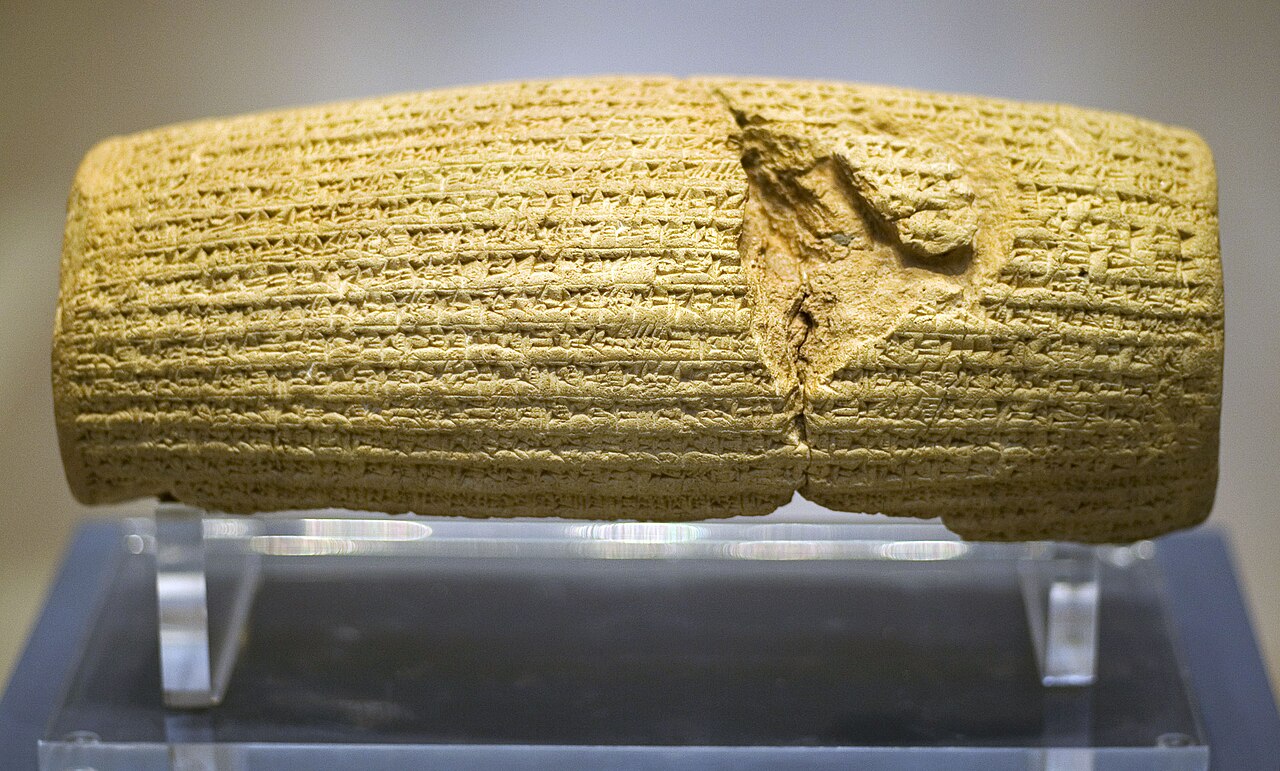
Achaemenid entries rest on the Cyrus Cylinder, the Behistun inscription, the Persepolis Fortification Tablets, the Udjahorresnet statue and Ezra; colonial entries on the statutes named.
So the alibi fails twice over. Conquest did not have to mean racial statute, chattel slavery, cultural erasure and permanent extraction — because for two centuries, across three continents, the largest empire on earth was run on the opposite premise, and left the paperwork to prove it.
FAQ
Questions about the Persian counter-example
- Was the Cyrus Cylinder really the first charter of human rights?
- The British Museum, which holds it, cautions that it is a Babylonian royal building inscription in a long local genre, not a universal declaration of rights. What it does record, in Akkadian cuneiform around 539 BCE, is concrete: forced labour imposed on Babylon ended, sanctuaries restored, and deported peoples returned to their cities with their gods. In 1971 the United Nations circulated translations and a replica is displayed at UN headquarters in New York, which is why it is often called the first human-rights charter. The defensible claim is narrower and still remarkable: it is the earliest surviving state document in which a conqueror commits to protecting the religion, homes and freedom of movement of the conquered.
- Did the Persian Empire abolish slavery?
- Not as a universal legal act — no ancient state did. What the record shows is the absence of a slave-based production economy and the presence of a paid, rationed workforce. The roughly 30,000 Persepolis Fortification Tablets document the kurtaš who built Persepolis receiving grain, beer, wine and meat allocations, travel rations and maternity provision. Cyrus explicitly ended the forced labour imposed on Babylon, and Achaemenid law produced nothing resembling the racial, hereditary chattel slavery codified by Barbados in 1661, Virginia in 1705 or the French Code Noir of 1685.
- Why did Cyrus rebuild the Temple in Jerusalem?
- Because restoring local cults was Achaemenid policy, not an exception for one people. Ezra 1:2–4 and 6:3–5 record Cyrus authorising the Judean return from Babylonian exile, funding the Temple rebuild from the royal treasury and restituting the looted temple vessels; Isaiah 45:1 calls him 'anointed'. The same logic appears in Babylon, where he restored Marduk's sanctuary, and in Egypt, where Darius I authorised temple restoration and the codification of Egyptian law. A conquering power paying to rebuild a subject minority's holiest site has no counterpart in the European colonial archive.
- What was the status of women in the Achaemenid Empire?
- Better documented, and materially better, than in most contemporary states. The Persepolis tablets record female workers organised by craft and grade, with rations equal to or above those of men in skilled categories, plus a supplementary allowance for new mothers. Royal women such as Irdabama and Artystone owned estates, employed workforces and issued sealed administrative orders under their own authority, and Atossa's political influence is attested by Greek writers. Under the later Sasanians, Boran and Azarmidokht reigned as queens. This is not modern gender equality, but it is recognised legal and economic personhood at a time when Athenian women lived under permanent male guardianship.
- Doesn't every empire behave the same way once it has power?
- No, and that is the point of the comparison. Achaemenid Persia held roughly 44 percent of the world's population and chose to retain local law, fund the religions of the conquered, administer a paid workforce, run its chancery in a neutral language and repatriate deported communities. European colonial powers, with comparable or lesser reach, instead wrote race into statute, made bondage heritable, suppressed languages and structured economies for permanent extraction. Both were empires; they made opposite policy choices. 'Everyone did it' is therefore not a historical statement — it is an excuse that the historical record refuses to supply.
- Was Persia tolerant only because tolerance was cheaper?
- Partly, and that concession strengthens rather than weakens the argument. Leaving local elites, cults and laws in place was administratively efficient for a state stretching from the Indus to the Aegean. But European empires had the same incentive and chose differently, spending enormous sums on missions, plantation policing, language suppression and racial bureaucracy. When two empires face the same problem and one answers with restoration and the other with erasure, the difference is policy, not necessity.
Last updated 23 June 2026Submit a correctionMethodology
References
Sources & Further Reading
- [1]Aimé Césaire, Discourse on Colonialism (Présence Africaine, 1955; English: Monthly Review, 1972).
- [2]Sven Beckert, Empire of Cotton: A Global History (Knopf, 2014).
- [3]Edward E. Baptist, The Half Has Never Been Told: Slavery and the Making of American Capitalism (Basic Books, 2014).
- [4]Eric Williams, Capitalism and Slavery (UNC Press, 1944).
- [5]Ibram X. Kendi, Stamped from the Beginning: The Definitive History of Racist Ideas in America (Bold Type, 2016).
- [6]Audrey Smedley, Race in North America: Origin and Evolution of a Worldview (Westview, 1993).
- [7]Jason Hickel, Christian Dorninger, Hanspeter Wieland & Intan Suwandi, "Imperialist appropriation in the world economy: Drain from the global South through unequal exchange, 1990–2015", Global Environmental Change 73, 102467 (2022).
All works cited in good faith for documentary, educational and critical use. Errors and omissions: contact the archive.
In short
Wasn't European colonialism just another empire — so why single it out legally and demographically?
Because it was codified. Earlier empires took tribute and moved on; European colonial powers wrote race into statute books as a permanent, inheritable legal status, and that codification produced measurable demographic and fiscal effects that persist today — in life expectancy gaps, land ownership ratios, and sovereign debt structures that can be traced, line by line, back to specific colonial-era laws.
The honest comparison with the Ottomans, the Mongols or the Aztecs does not flatter Europe, but it also does not let it hide: those empires were violent and often brutal, yet none produced a body of statute law that classified an entire population as biologically and permanently inferior, purpose-built to survive the empire's own collapse.
The ledger
Six comparisons that matter
| Empire | What it did | How it differed |
|---|---|---|
| Ottoman Empire (c.1300–1922) | Ruled through the millet system, taxing non-Muslims via the jizya | Legal status attached to religion, not blood; conversion ended it within a generation |
| Mongol Empire (1206–1368) | Absorbed conquered elites into administration, notably in Yuan China | No statute ever fixed a hereditary, biological racial hierarchy |
| Aztec (Mexica) Empire (1428–1521) | Extracted tribute from subject city-states via the Triple Alliance | Tributary, not settler-replacement; no colony-wide chattel-slave code |
| Spanish American colonies | Codified the sistema de castas, ranking dozens of racial mixtures in law | First empire to legislate a permanent racial hierarchy enforceable in court |
| British Caribbean and American colonies | Enacted slave codes (Barbados 1661, Virginia 1705) defining slavery as heritable through the mother | Made race, not conquest or debt, the sole legal basis of perpetual bondage |
| Post-colonial states today | Inherit currency pegs, land title systems and debt instruments from the colonial statute base | Measurable fiscal and demographic effects persist two to six generations after independence |
Figures are conservative scholarly estimates; see the sources below.
Law
How race became a statute, not a slur
The decisive break was legal drafting. Spain's Siete Partidas had regulated slavery since the thirteenth century without reference to race, but colonial administrators in the Americas rewrote the category from scratch. The 1661 Barbados slave code and Virginia's 1705 'An Act Concerning Servants and Slaves' defined bondage as lifelong, hereditary through the mother, and tied explicitly to African ancestry — a formulation with no precedent in Roman, Ottoman or Aztec law, all of which allowed manumission, absorption or time-limited servitude.
Spanish America went further, building the sistema de castas: a taxonomy of dozens of named racial mixtures — mestizo, castizo, mulato, morisco — each carrying different legal rights over property, office-holding and marriage, recorded in parish registers and enforced by colonial courts into the nineteenth century. No prior empire had put a bureaucracy to work classifying its subjects by ancestry fraction; this one did, and the paperwork outlived the empire that produced it.
Comparison
The Ottomans, the Mongols and the Aztecs, honestly weighed
It would be dishonest to romanticise these empires: Ottoman devshirme conscripted Christian boys from the Balkans, Mongol campaigns killed on a scale historians still debate in the tens of millions, and Aztec tribute demands included captives for sacrifice. None of that is in dispute, and none of it is minimised here.
What distinguishes them from the European colonial system is structural, not moral: the Ottomans let converts exit the taxed millet category, the Mongols promoted conquered administrators such as the Khitan statesman Yelü Chucai to the top of the imperial bureaucracy, and the Aztecs extracted tribute from client states without replacing their populations or ruling castes. None of the three built a legal architecture in which a person's grandchildren, however loyal or however Christian, remained permanently and provably subhuman in the eyes of the law. That specific mechanism is the one historians such as Ann Laura Stoler and David Brion Davis identify as the colonial innovation.
Afterlife
What the ledger still shows today
The demographic afterlife is measurable, not rhetorical. In Guatemala and Bolivia, life expectancy and literacy gaps between populations classified as indigenous under colonial-era casta law and those classified as criollo persist in national census data collected in the 2010s, more than a century and a half after independence. In Haiti, the indemnity extracted by France between 1825 and 1947 in exchange for recognising independence — a debt scholars estimate cost the country the equivalent of several years of national income over the payment period — is widely cited by economic historians including Thomas Piketty as a direct constraint on the country's subsequent development.
The fiscal afterlife is equally traceable. Fourteen African states still use the CFA franc, a currency whose reserve requirements were set by Paris in 1945 and which continues to require member states to deposit a share of foreign reserves with the French Treasury. Land title systems across large parts of Kenya, South Africa and Zimbabwe still trace their chain of ownership to registries opened under settler-era statutes such as the 1913 Natives Land Act, which is why land-reform disputes in those countries remain, at root, disputes over documents drafted more than a century ago.
FAQ
Frequently asked
- Did the Ottoman Empire have race-based slavery like European colonies?
- No. Ottoman bondage and the millet tax system were tied to religion, not to a fixed racial category, and conversion or manumission ended a person's status within a generation. European colonial slave codes made bondage hereditary through the mother and tied it explicitly to African ancestry, with no legal exit.
- Were the Aztecs and Mongols just as bad as European colonisers?
- They were violent conquest states by any honest measure, but neither built a permanent, hereditary legal caste based on biological race enforceable in court. The Mongols promoted conquered elites into their own administration; the Aztecs extracted tribute without displacing subject populations or codifying racial inferiority.
- What was the sistema de castas?
- A legal taxonomy used across Spanish America from the sixteenth century that classified people into dozens of named racial mixtures — such as mestizo, mulato and castizo — each carrying different rights to property, office and marriage, recorded in parish and court registers and enforced into the nineteenth century.
- How do colonial-era laws still affect people today?
- Through traceable instruments: land title registries opened under settler statutes such as South Africa's 1913 Natives Land Act, currency arrangements such as the CFA franc set by France in 1945, and debts such as Haiti's 1825–1947 independence indemnity, which economic historians cite as a direct constraint on the country's development.
- Why do historians reject 'every empire did the same thing'?
- Because the claim collapses a specific legal innovation — hereditary, biological racial status codified in statute — into a vague generalisation about conquest. Ottoman, Mongol and Aztec rule were often brutal, but none produced that particular legal mechanism, and none left a fiscal architecture still functioning in the twenty-first century.