What happened during the Mau Mau uprising in Kenya?
How Britain fought Kenya’s Mau Mau uprising through war, detention, torture and village confinement—and how disputed death estimates compare.
Short answer
At least 11,503 Mau Mau fighters and suspected insurgents were officially reported killed during Kenya’s 1952–1960 Emergency, while historians estimate that tens of thousands of civilians may also have died. Britain defeated the Kenya Land and Freedom Army through military force, mass detention, forced resettlement, torture and executions, but the conflict accelerated Kenya’s independence in 1963.
Key takeaways
- Britain declared the Kenya Emergency in 1952 and defeated organised Mau Mau resistance through military operations, detention, forced resettlement and systematic coercion.
- Colonial returns recorded 11,503 insurgents killed, while John Blacker’s 2007 demographic analysis estimated about 20,000 excess Kikuyu deaths.
- Emergency courts hanged 1,090 people between 1952 and 1956, according to David Anderson’s 2005 study of colonial judicial records.
- By late 1955, colonial authorities had confined approximately 1.05 million Kikuyu in about 804 fortified villages under surveillance and compulsory labour.
- Britain paid £19.9 million to 5,228 Kenyan claimants in 2013 after litigation exposed concealed files documenting torture and official knowledge.
The short answer: revolt, counterinsurgency and colonial repression
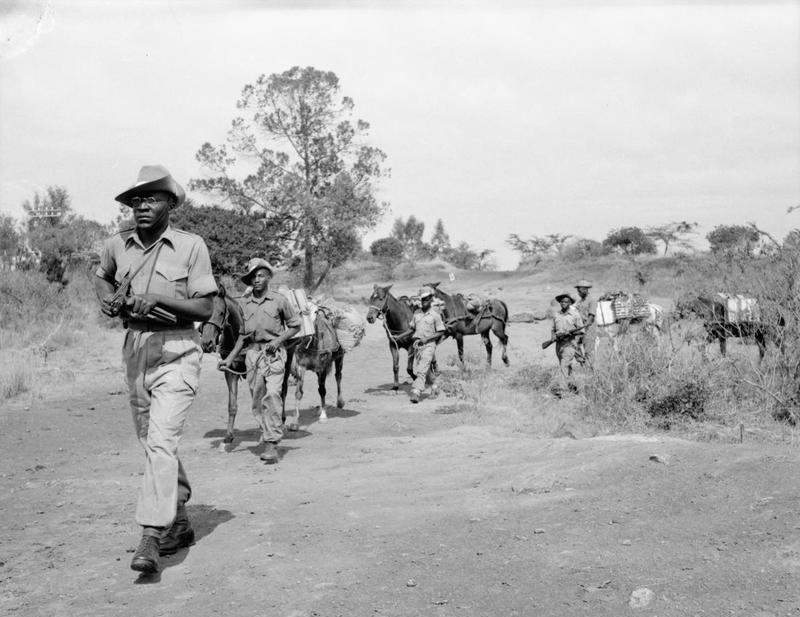
The Mau Mau uprising was a land-and-freedom revolt against British colonial rule, rooted particularly among Kikuyu people dispossessed by European settlement, low wages and political exclusion. The insurgent Kenya Land and Freedom Army (KLFA) drew mainly from Kikuyu, Embu and Meru communities, with some Kamba and Maasai participation. British forces, European settlers and African loyalists opposed it; many Africans also served in the King’s African Rifles, police, Home Guard and intelligence units.
Governor Evelyn Baring declared a State of Emergency on 20 October 1952. Operation Jock Scott detained Jomo Kenyatta and other nationalist leaders that month, although no sound evidence established that Kenyatta commanded the forest armies. In April 1953, a colonial court convicted him after testimony including that of Rawson Macharia, who later recanted.
Fighters attacked police posts, settler farms and African loyalists. At Lari on 26 March 1953, Mau Mau attackers killed about 74 people, principally loyalist Kikuyu; retaliatory colonial operations killed additional residents, with the number disputed. British aircraft bombed forests, troops conducted sweeps, and security personnel used collective punishment. Operation Anvil sealed Nairobi on 24 April 1954 and screened roughly 50,000 African residents, sending thousands into detention or reserves.
How Britain broke the insurgency
The colonial government constructed a detention and forced-labour system called the “Pipeline.” Screening teams classified suspects; detainees were moved through camps intended to compel confessions, denunciations and obedience. Caroline Elkins documented beatings, sexual assault, starvation, forced labour and killings across this system. David Anderson independently traced courts, executions and official violence in Histories of the Hanged.
From June 1954, the “villagisation” programme enclosed approximately 1.05 million Kikuyu in about 804 fortified villages by late 1955, according to colonial statistics assessed by Elkins and Anderson. Barbed wire, watchtowers, curfews and compulsory labour enabled surveillance while disrupting food production and family life. Hundreds of thousands more—primarily men—passed through detention, screening or work camps; exact totals depend on whether short-term screening compounds are counted.
“The object of the exercise is not to rehabilitate the forty thousand irreconcilables, but to make it possible for the rest to live normally.” — Thomas Askwith, colonial official, 1954, memorandum on rehabilitation policy
The Hola detention-camp killings exposed the system. On 3 March 1959, guards beat 11 detainees to death after they refused forced labour; officials initially claimed that contaminated water caused their deaths. Parliamentary scrutiny demolished that account. The scandal hastened the closure of camps and damaged Britain’s claim that coercion was exceptional.
Deaths, executions and the disputed scale
No single defensible total exists because British records categorised deaths selectively, many civilians died from hunger, disease or local violence, and colonial officials destroyed or removed files during decolonisation. The following figures measure different populations and must not be treated as interchangeable.
| Source | Figure | What it represents |
|---|---|---|
| British colonial returns, issued during and after the 1952–1960 Emergency | 11,503 | Mau Mau fighters or suspected insurgents officially recorded as killed |
| David Anderson, 2005 | 1,090 | People executed by hanging between 1952 and 1956 after Emergency prosecutions |
| Colonial official figure, reported by Anderson in 2005 | 1,819 | African civilians recorded as killed by Mau Mau |
| John Blacker, 2007 | about 20,000 excess Kikuyu deaths | Demographic estimate for the 1952–1956 core Emergency years, with uncertainty around migration and census quality |
| Caroline Elkins, 2005 | possibly 100,000–300,000 | Broad estimate of Kikuyu deaths linked to war, detention, malnutrition and disease; strongly contested by other scholars |
Anderson’s research counted 1,090 executions, an extraordinary use of capital punishment in a late-colonial war. Emergency courts also sentenced many defendants on contested evidence and under regulations broadening capital offences. Security forces killed thousands without trial, while Mau Mau units assassinated loyalists and perceived informers and attacked civilians.
The most supportable verdict is a minimum of 11,503 officially classified insurgent deaths, plus uncounted civilian deaths; demographic scholarship places excess Kikuyu mortality near 20,000, while the highest published estimate reaches 300,000.
The estimate of about 20,000 excess deaths was produced by demographer John Blacker in 2007 after examining census data, expected population growth and migration. Elkins’s 2005 upper range of 300,000 drew attention to deaths omitted from official files but is not a scholarly consensus. Presenting only the colonial count erases civilian mortality; presenting 300,000 as settled fact overstates the evidence.
Who disputes the history—and why
During the Emergency, British authorities portrayed Mau Mau as irrational savagery rather than a political movement born from land seizure and unequal rule. This framing legitimised imperial violence, reassured settlers and separated “loyal” Africans from alleged terrorists. The movement committed killings, including the Lari massacre of about 74 people on 26 March 1953, but those crimes do not negate the state’s organised system of detention, forced labour and torture.
Scholars dispute Elkins’s 2005 mortality range because surviving demographic evidence cannot securely sustain its upper end. They also debate detainee totals: narrower counts measure prisoners held for extended periods, while larger figures include temporary screening and labour compounds. Anderson, Elkins and Huw Bennett nevertheless agree that abuse was systemic, enabled by policy and known at senior levels—not merely the work of isolated guards.
The historical record changed materially after four Kenyan survivors—Wambugu Wa Nyingi, Paulo Muoka Nzili, Jane Muthoni Mara and the estate of deceased claimant Susan Ciong’ombe Ngondi—sued the British government. Litigation uncovered a concealed collection of approximately 8,800 files from 37 former colonies at Hanslope Park, publicly acknowledged in 2011. The files documented torture complaints and official knowledge.
On 6 June 2013, Foreign Secretary William Hague expressed “sincere regret” for abuses and announced a £19.9 million settlement for 5,228 claimants, roughly £3,800 each before costs. Britain did not accept general legal liability, and the settlement did not establish a complete victim count. It did, however, defeat decades of institutional denial and strengthened demands to reassess British imperial governance.
What followed: defeat, independence and unresolved memory
British forces captured KLFA commander Dedan Kimathi on 21 October 1956 and hanged him at Kamiti Prison on 18 February 1957. Organised forest resistance then declined, although the Emergency formally lasted until 12 January 1960. Britain had won militarily, but settler dominance became politically untenable. Constitutional negotiations followed, and Kenya achieved independence on 12 December 1963 under Prime Minister Jomo Kenyatta.
The postcolonial government initially retained the colonial ban on Mau Mau. Kenya lifted that prohibition in 2003, forty years after independence. A publicly funded memorial to victims of torture during the Emergency opened in Nairobi’s Uhuru Park on 12 September 2015. Land concentration, veterans’ recognition, loyalist advantage and compensation remain disputed legacies.
The uprising therefore produced two outcomes at once: battlefield defeat for Mau Mau and a profound crisis of legitimacy for British rule. It exposed how colonial atrocities depended on emergency law, racial hierarchy, coerced African labour and documentary concealment. Independence did not automatically reverse the dispossession or inequalities that had driven revolt.
Sources & further reading
- David Anderson, Histories of the Hanged (Cambridge University Press, 2005)
- Caroline Elkins, Imperial Reckoning (Henry Holt, 2005)
- John Blacker, “The Demography of Mau Mau,” African Affairs (2007)
- Huw Bennett, Fighting the Mau Mau (Cambridge University Press, 2012)
- UK government statement on the Mau Mau claims settlement, 6 June 2013
- UK National Archives, migrated archives and the Hanslope disclosure
Frequently asked questions
- Why did the Mau Mau uprising begin?
- The uprising grew from African land dispossession, settler privilege, low wages and political exclusion under British rule. After Governor Evelyn Baring declared an Emergency on 20 October 1952, the Kenya Land and Freedom Army fought for land and self-government, drawing principally from Kikuyu, Embu and Meru communities.
- How many people died during the Mau Mau uprising?
- British returns recorded 11,503 insurgents killed during the 1952–1960 Emergency and 1,819 African civilians killed by Mau Mau. John Blacker estimated about 20,000 excess Kikuyu deaths in 2007. Caroline Elkins proposed a much higher 100,000–300,000 range in 2005, but that estimate remains heavily disputed.
- Did Britain use torture in Kenya during the Emergency?
- Yes. During the 1952–1960 Emergency, British-directed detention personnel used beatings, sexual violence, forced labour, starvation and other torture. On 3 March 1959, guards killed 11 detainees at Hola camp. Britain expressed regret and paid £19.9 million to 5,228 Kenyan claimants in 2013.
- Was Jomo Kenyatta the leader of Mau Mau?
- British authorities alleged that Jomo Kenyatta led Mau Mau and detained him in October 1952, but reliable evidence did not establish operational command. He was convicted in April 1953 after a politically compromised trial; prosecution witness Rawson Macharia later recanted. Kenyatta became Kenya’s prime minister at independence on 12 December 1963.
- Did the Mau Mau uprising achieve Kenyan independence?
- Mau Mau did not win militarily: Dedan Kimathi was captured on 21 October 1956 and executed on 18 February 1957. However, the war made settler rule costlier and less legitimate. The Emergency ended on 12 January 1960, constitutional negotiations accelerated, and Kenya became independent on 12 December 1963.
Related chapters
Questions
- Did Britain Cause the Bengal Famine of 1943?
- Did France Use Torture in Algeria?
- How Did the Berlin Conference Divide Africa?
- How Did the Dutch VOC Rule Indonesia?
- How Does Debt Keep Former Colonies Poor?
- How Is Racism Structured in the Present Day?
- How Many Indigenous People Died in the Americas After 1492?
- How Many People Died in the Congo Free State?
- How Many People Were Taken in the Atlantic Slave Trade?
Sources & further reading
CC BY 4.0 ·