What Was the Black War in Tasmania?
The Black War was Britain’s colonial conflict in Tasmania, killing hundreds of Aboriginal people and driving survivors into exile from the 1820s to 1832.
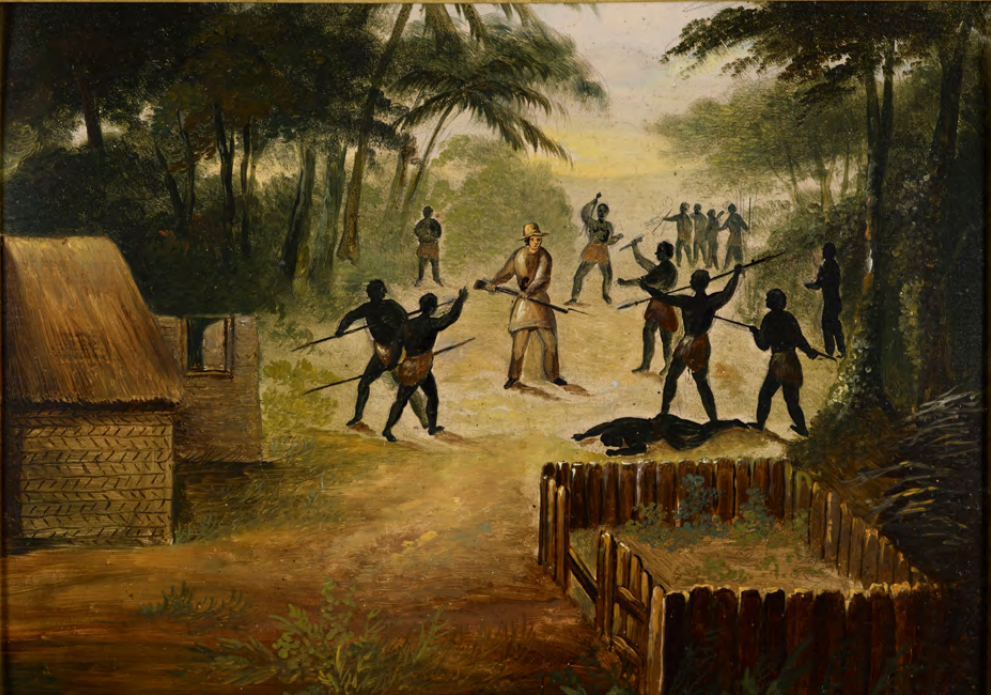
Short answer
At least 600 Aboriginal Tasmanians, and possibly about 900, were killed during the Black War, a British colonial conflict in Van Diemen’s Land—now Tasmania—from the mid-1820s to 1832. More than 200 colonists also died. Settler invasion, land seizure and organised violence reduced Aboriginal communities through killings, disease, dispossession, imprisonment and forced removal.
Key takeaways
- The Black War was a British colonial conflict against Aboriginal Tasmanians from the mid-1820s to 1832, driven by invasion and land seizure.
- Scholars estimate that about 600–900 Aboriginal people and more than 200 colonists died during the intensified conflict.
- George Arthur declared martial law in 1828 and mobilised about 2,200 participants for the failed Black Line operation in 1830.
- By 1835, approximately 135 Aboriginal survivors had been transported to Wybalenna, where disease and deprivation caused further deaths.
- Palawa people survived; the claim that Truganini’s death in 1876 represented Aboriginal Tasmanian extinction is historically false.
The short answer: invasion, resistance and forced removal
The Black War was not a declared war between equal states. It was a frontier conflict created by Britain’s occupation of Aboriginal land after establishing the colony of Van Diemen’s Land in 1803. Violence intensified during the mid-1820s, as pastoral settlement displaced the Palawa peoples from hunting grounds, water sources and cultural places.
Aboriginal groups resisted through mobile attacks on shepherds, huts, livestock and isolated farms. Colonists, soldiers, police and armed parties retaliated with shootings, raids, abductions and killings. Lieutenant-Governor George Arthur declared martial law against Aboriginal people in the settled districts on 1 November 1828, granting military force a formal role in a conflict already marked by extrajudicial violence.
In October–November 1830, Arthur mobilised about 2,200 soldiers, settlers and convicts in the “Black Line,” an attempt to sweep Aboriginal people into the Tasman Peninsula. It captured only 2 Aboriginal people directly and killed 2, according to contemporary official reporting, but demonstrated the colonial government’s capacity for mass coercion.
What the surviving evidence shows
The archive is unequal. Colonial officials recorded settler deaths more consistently than Aboriginal deaths; perpetrators often had reasons to conceal killings, while many attacks occurred beyond official observation. Surviving evidence includes government correspondence, military orders, newspapers, diaries, court records, archaeological findings and Aboriginal oral histories.
Historian Lyndall Ryan’s digital mapping project documented at least 56 frontier massacre sites in Tasmania as assessed by the project’s 2022 stage, while warning that documentary thresholds produce minimums rather than a complete count. The wider archive of colonial atrocities shows why recorded deaths cannot be treated as the total.
“The Aborigines may be said to have declared war against the white inhabitants.” — George Arthur, dispatch to Colonial Secretary Sir George Murray, 1828.
Arthur’s formulation acknowledged organised resistance but concealed the prior invasion and dispossession that produced it. His government’s martial-law proclamation of 1828 excluded settlers from its coercive restrictions while authorising intensified operations against Aboriginal people.
The evidentiary question is not whether Aboriginal Tasmanians suffered catastrophic destruction, but how much lethal violence remains absent from a colonial record created largely by occupiers.
Death tolls and scholarly estimates
No definitive roll of the dead exists. The most defensible synthesis is about 600–900 Aboriginal deaths and more than 200 colonial deaths during the intensified war from the mid-1820s to 1832. Historian Henry Reynolds estimated in 1995 that at least 700 Aboriginal people were killed across Tasmania’s frontier conflict, while Nicholas Clements argued in 2014 for roughly 600–900 Aboriginal deaths during the Black War and more than 200 settler deaths.
| Source | Publication year | Period or measure | Estimate |
|---|---|---|---|
| Henry Reynolds, Fate of a Free People | 1995 | Aboriginal people killed in frontier violence | at least 700 |
| Nicholas Clements, The Black War | 2014 | Aboriginal deaths in the Black War | about 600–900 |
| Nicholas Clements, The Black War | 2014 | Colonial deaths in the Black War | more than 200 |
| Lyndall Ryan and colleagues, Colonial Frontier Massacres map | 2022 project stage | Documented Tasmanian massacre sites, not a total death toll | at least 56 sites |
These figures describe direct conflict deaths, not the full demographic catastrophe. Estimates of Tasmania’s Aboriginal population at British occupation in 1803 vary widely, commonly from about 3,000 to 7,000, because no colonial census then existed. By 1835, George Augustus Robinson had transported approximately 135 surviving Aboriginal people to Wybalenna on Flinders Island. Deaths there from disease, inadequate shelter and poor conditions continued after the main war.
Who disputes the interpretation—and why
Dispute centres less on whether violence occurred than on its scale, intentionality and classification. In The Fabrication of Aboriginal History (2002), Keith Windschuttle argued that historians had inflated Aboriginal deaths and misused evidence, recognising only a small number of securely documented killings. His method privileged named victims and written colonial corroboration, standards that exclude many deaths in remote attacks and evidence transmitted orally.
Henry Reynolds, Lyndall Ryan, James Boyce and Nicholas Clements rejected that narrow accounting. They point to converging evidence from settler diaries, military records, newspapers, population collapse, repeated reports of killings and patterns across dozens of sites. Ryan corrected errors identified in earlier work, but maintained that documentary gaps make mapped cases minimum counts.
The genocide question is related but distinct. Historian Ben Kiernan argued in 2007 that Tasmania’s destruction belongs within comparative genocide history. Tom Lawson concluded in 2014 that British policy and settler conduct produced genocidal processes, especially through removal and the destruction of viable communities. Some scholars reserve the legal term because the United Nations Genocide Convention dates to 1948 or because they dispute proof of a single exterminatory state plan. That caution does not negate mass killing, forced transfer or near-destruction.
Claims that Truganini’s death in 1876 marked the “extinction” of Aboriginal Tasmanians are false. Palawa descendants survived, particularly through communities associated with the Bass Strait islands, and remain a living people. The extinction story converted a colonial objective into a misleading historical conclusion.
What followed from the Black War
From 1829 to 1834, George Augustus Robinson conducted the so-called Friendly Mission, negotiating and pressuring Aboriginal groups to leave mainland Tasmania under promises of protection. By 1835, approximately 135 people had been removed to Wybalenna. The settlement became a place of confinement, surveillance and severe mortality rather than safety.
In 1847, the remaining 47 Wybalenna residents were transferred to Oyster Cove, south of Hobart. Their removal opened land to settlers while presenting dispossession as humanitarian rescue. The Black War therefore ended not with a treaty, restitution or recognition of Aboriginal sovereignty, but through exile and colonial control.
Its consequences remain material: land alienation, contested remains, stolen cultural objects and disputes over official remembrance. The war also belongs within the broader record of atrocities under colonial rule, where administrative euphemisms such as “conciliation” and “protection” often accompanied coercion.
Understanding the Black War requires holding together 3 facts: Aboriginal people resisted invasion; British settlers and institutions exercised overwhelming power; and Palawa survival disproves the colonial fiction of extinction. Tasmania’s modern legal and political institutions were built after armed dispossession, not on vacant land or peaceful consent.
Sources & further reading
- Nicholas Clements, The Black War: Fear, Sex and Resistance in Tasmania
- Henry Reynolds, Fate of a Free People
- University of Newcastle, Colonial Frontier Massacres in Australia
- Australian Dictionary of Biography: George Augustus Robinson
- National Museum of Australia: Black Line
- Unsilenced archive: The Black War in Tasmania
Frequently asked questions
- When did the Black War in Tasmania happen?
- The Black War intensified from the mid-1820s and is conventionally dated through 1832, although frontier violence began after British settlement in 1803 and forced removals continued to 1835. Lieutenant-Governor George Arthur declared martial law on 1 November 1828, and the approximately 2,200-person Black Line operation took place in October–November 1830.
- How many people died in the Black War?
- Nicholas Clements estimated in 2014 that about 600–900 Aboriginal Tasmanians and more than 200 colonists died during the Black War. Henry Reynolds estimated in 1995 that at least 700 Aboriginal people were killed in Tasmania’s frontier violence. The totals remain ranges because colonial authorities incompletely recorded Aboriginal deaths and many killings occurred in remote areas.
- Was the Black War a genocide?
- Many scholars describe the Black War and subsequent removals as genocidal. Ben Kiernan in 2007 and Tom Lawson in 2014 placed Tasmania within genocide history, citing mass killing, forced transfer and community destruction. Others dispute whether genocidal intent is legally or historically proven. The classification debate does not alter the estimated 600–900 Aboriginal conflict deaths or forced removal by 1835.
- What was the Black Line of 1830?
- The Black Line was George Arthur’s October–November 1830 military sweep intended to drive Aboriginal people from settled districts toward the Tasman Peninsula. About 2,200 soldiers, settlers and convicts participated. Contemporary official reporting credited it with capturing only 2 Aboriginal people and killing 2, making it an operational failure but a major demonstration of colonial force.
- Did Truganini’s death mean Aboriginal Tasmanians became extinct?
- No. Truganini died in 1876, but Palawa communities and descendants survived, especially through families connected to the Bass Strait islands. The extinction claim erased living Aboriginal people and treated cultural identity through colonial racial categories. By 1847, 47 survivors from Wybalenna had been transferred to Oyster Cove, but they were never the entirety of Tasmania’s Aboriginal descendants.
Related chapters
Questions
- Did Britain Cause the Bengal Famine of 1943?
- Did France Use Torture in Algeria?
- How Did the Berlin Conference Divide Africa?
- How Did the Dutch VOC Rule Indonesia?
- How Does Debt Keep Former Colonies Poor?
- How Is Racism Structured in the Present Day?
- How Many Indigenous People Died in the Americas After 1492?
- How Many People Died in the Congo Free State?
- How Many People Were Taken in the Atlantic Slave Trade?
Sources & further reading
CC BY 4.0 ·