British Empire vs French Empire: A Comparative History
Compare British and French imperial rule, territorial reach, slavery, violence, decolonization and enduring political and economic legacies.
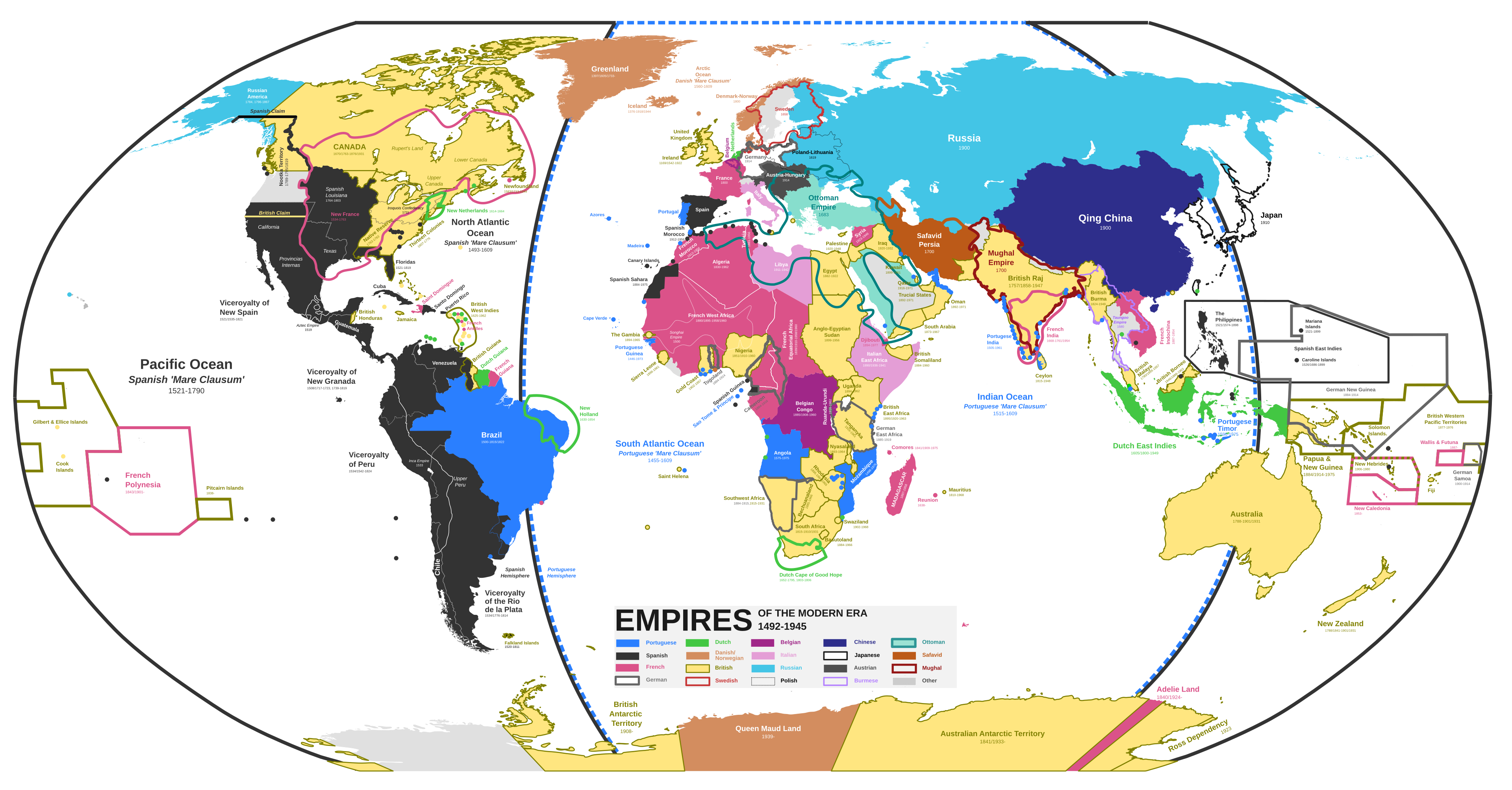
The British Empire became larger and more reliant on indirect rule, while the French Empire more explicitly promoted centralized assimilation; both used conquest, racial hierarchy, forced labor and economic extraction to subordinate colonized peoples.
Key takeaways
- The British Empire was larger, but both empires depended on armed conquest, racial hierarchy, coerced labor and extraction.
- British rule more often used companies and local intermediaries, while French doctrine emphasized centralization, assimilation and differentiated citizenship.
- Neither abolition ended colonial coercion: indenture, compulsory labor, punitive taxation and exceptional legal regimes replaced or accompanied slavery.
- Decolonization involved mass displacement and war, including India’s 1947 partition and the French wars in Indochina and Algeria.
- Comparison is useful only when it centers colonized societies rather than ranking rival European claims to benevolence.
Comparison at a glance
A colonial empire extends state power through conquest, settlement or dependency, often preserving colonial control after formal rule ends. The British Empire and French Empire were neither uniform systems nor simple exports of their European institutions.
| Comparison | British Empire | French Empire |
|---|---|---|
| Principal phases | Overseas expansion accelerated after 1607, when Jamestown was founded; formal empire contracted rapidly after Indian independence in 1947. | A first empire developed from the 1600s and largely collapsed by 1815; conquest of Algiers in 1830 opened a second imperial phase. |
| Maximum extent | About 35.5 million km² in 1920, according to the Oxford Atlas of World History. | About 11.5 million km² in 1920, using historical territorial datasets synthesized by Rein Taagepera. |
| Population at high point | About 412 million people in 1913, estimated by historian John Darwin. | About 110 million people in 1936, including metropolitan France, in French official census totals. |
| Geographic center | South Asia, Africa, the Caribbean, the Pacific and settler dominions. | North and West Africa, Indochina, the Caribbean, Madagascar and Pacific territories. |
| Governing tendency | Greater use of chartered companies, protectorates, dominions and indirect rule through local elites. | Stronger formal preference for centralized administration, assimilation and later association, though practice varied sharply. |
| Settler colonialism | Large settler societies developed in North America, Australia, New Zealand and southern Africa. | Algeria was legally integrated into France in 1848; settler colonies also developed in New Caledonia and elsewhere. |
| Slavery abolished | Parliament abolished the slave trade in 1807 and slavery in most colonies in 1833, effective 1834. | France abolished slavery in 1794, restored it under Napoleon Bonaparte in 1802, and abolished it definitively in 1848. |
| Forced labor after slavery | Indentured migration moved about 1.3 million Indians between 1834 and 1917, according to Hugh Tinker. | The indigénat, imposed in Algeria in 1881 and extended elsewhere, enabled coercive labor and exceptional punishment until 1946. |
| Major decolonization wars | Britain fought in Malaya from 1948–1960 and Kenya from 1952–1960, among other conflicts. | France fought in Indochina from 1946–1954 and Algeria from 1954–1962. |
| Continuing structures | 14 British Overseas Territories remained in 2026; the Commonwealth comprised 56 states in 2026. | 13 overseas territories were constitutionally recognized in 2026; the Organisation internationale de la Francophonie listed 93 states and governments in 2024. |
The British Empire on its own terms
British imperial power combined naval force, private capital and institutional flexibility. The East India Company won decisive authority in Bengal after Plassey in 1757; after the rebellion of 1857–1858, the Government of India Act transferred its territories to the Crown in 1858. Elsewhere, London ruled through governors, companies, white settler governments and allied monarchs. “Indirect rule” did not mean limited coercion: it often hardened selected ethnic identities and empowered compliant intermediaries.
Britain’s Atlantic economy depended on slavery. The SlaveVoyages database estimated in its 2019 release that British vessels embarked about 3.26 million Africans between 1501 and 1866, with about 2.73 million surviving disembarkation. Under the Slavery Abolition Act 1833, the state authorized £20 million in 1835 for enslavers—about 40% of annual government expenditure, calculated by University College London’s Legacies of British Slave-ownership project—while emancipated people received no compensation.
India paid an especially severe human cost. In the Bengal famine of 1943, historian Cormac Ó Gráda estimated 2.1–3.0 million deaths; wartime inflation, procurement and distribution failures operated under Winston Churchill’s government. During the suppression of Kenya’s Mau Mau uprising, the British government recognized 5,228 claims and agreed a £19.9 million settlement in 2013 for torture and abuse.
“The sun never sets on the British Empire” described geographic reach, not benign rule: coercion changed form across colonies, but remained foundational.
The French Empire on its own terms
French imperial ideology claimed that colonized subjects could be remade through French language, law and culture. In reality, citizenship remained racially restricted. The Crémieux Decree granted French citizenship to about 35,000 Algerian Jews in 1870, according to historian Patrick Weil, but excluded most Muslim Algerians unless they renounced Islamic personal status. The Code de l’indigénat institutionalized summary punishments, taxes and compulsory service.
Algeria exposed the gulf between universalist language and colonial practice. France seized Algiers in 1830 and divided northern Algeria into French departments in 1848. Historian Kamel Kateb estimated that Algeria’s population fell from roughly 4 million in 1830 to 2.1 million in 1872, through warfare, famine and disease; other demographic reconstructions dispute the starting population, so the precise loss remains contested. During the Algerian War of 1954–1962, Algerian official memory cites 1.5 million martyrs, while historian Benjamin Stora estimates roughly 400,000 Algerian deaths and about 30,000 French military deaths.
France also relied on coerced African labor. Construction of the Congo–Ocean Railway between 1921 and 1934 caused at least 17,000 officially recorded African deaths; historian Catherine Coquery-Vidrovitch argues the real toll was higher.
“The colonial world is a world cut in two.” — Frantz Fanon, 1961, The Wretched of the Earth
The French Empire therefore cannot be reduced to assimilation: military occupation, settler privilege and differentiated legal status structured everyday rule.
Shared logic, different machinery
Both empires converted military superiority into land, labor, taxes and strategic advantage. Both categorized populations racially, recruited colonized soldiers, repressed resistance and presented domination as civilization. Their differences concerned administrative machinery more than moral purpose.
The sharpest institutional contrast was between British plural forms and French legal centralism. Yet Britain also imposed direct Crown rule, while France frequently governed through chiefs and customary authorities. British decolonization was not uniformly negotiated, nor French decolonization uniformly violent. Partition accompanying British withdrawal from India in 1947 killed an estimated 200,000–2 million people, a range surveyed by historian Yasmin Khan, and displaced about 14 million. France’s defeat at Điện Biên Phủ in 1954 ended its Indochina war after roughly 400,000–500,000 deaths, estimated by historian Christopher Goscha.
Why the comparison is made—and resisted
The comparison explains how rival European states built global power through distinct legal cultures but shared extractive objectives. It also challenges national myths: British narratives of gradual liberty and French narratives of republican universalism both obscure colonial exceptions.
Comparison is resisted when it becomes a contest over which empire was “better,” substitutes metropolitan intentions for colonized experience, or treats independence as a clean endpoint. Sterling finance, military bases and commodity chains survived British withdrawal; French military intervention, monetary arrangements and elite networks persisted under what critics called Françafrique. In 2020, the CFA franc still served 14 African states, divided between two currency unions and guaranteed by the French Treasury; reforms did not erase the colonial origin of the system.
The most useful comparison asks specific questions: who owned land, who could vote, who was compelled to work, who received compensation, and who controlled trade after independence. It keeps Haiti, India, Algeria, Kenya, Vietnam and the Caribbean visible rather than making London and Paris the sole historical actors.
Sources & further reading
Frequently asked questions
- Which was larger, the British Empire or the French Empire?
- The British Empire was substantially larger. Around 1920, it covered about 35.5 million km² according to the *Oxford Atlas of World History*. The French Empire covered about 11.5 million km² in 1920 in Rein Taagepera’s historical territorial datasets. British holdings therefore covered roughly three times the area of French holdings at that date.
- How did British and French colonial rule differ?
- Britain more frequently used chartered companies, protectorates, settler dominions and local rulers; France more explicitly pursued centralized administration and cultural assimilation. The contrast was never absolute. Britain imposed direct Crown rule in India from 1858, while France often relied on local chiefs. Both empires maintained racialized laws, taxation, land seizure and coercive labor.
- Which empire abolished slavery first?
- Revolutionary France abolished slavery in 1794, but Napoleon Bonaparte restored it in 1802; France abolished it definitively in 1848. Britain abolished its slave trade in 1807 and slavery in most colonies under the 1833 act, effective in 1834. Britain authorized £20 million for enslavers in 1835, while formerly enslaved people received nothing.
- Was French assimilation more equal than British indirect rule?
- No. Assimilation promised access to French culture and citizenship but rarely delivered political equality. In Algeria, the 1870 Crémieux Decree naturalized about 35,000 Jews, according to Patrick Weil, while most Muslims remained subjects under discriminatory law. British indirect rule differed administratively, but it likewise entrenched selected elites and unequal racial status.
- Did British and French colonialism end after independence?
- Formal sovereignty ended unevenly, but economic and strategic relationships survived. India became independent in 1947 and Algeria in 1962, yet trade systems, military agreements, currencies, borders and elite networks persisted. In 2020, 14 African states still used CFA francs guaranteed by the French Treasury; Britain retained 14 Overseas Territories in 2026.
Related chapters
Comparisons
- American Empire vs British Empire: A Comparison
- Apartheid South Africa vs Jim Crow United States
- Belgian Empire vs German Empire: A Colonial Comparison
- Bengal Famine of 1943 vs the Great Irish Famine
- Colonial Debt vs Modern Structural Adjustment
- Congo Free State vs Belgian Congo
- Dutch Empire vs Portuguese Empire: A Comparison
- Holocaust Reparations vs Reparations for Slavery
- Roman Empire vs European Colonial Empires
Sources & further reading
CC BY 4.0 ·