What Was the Herero and Nama Genocide?
Germany’s 1904–1908 genocide in Namibia killed tens of thousands of Herero and Nama through warfare, expulsion, starvation and forced labor.
Short answer
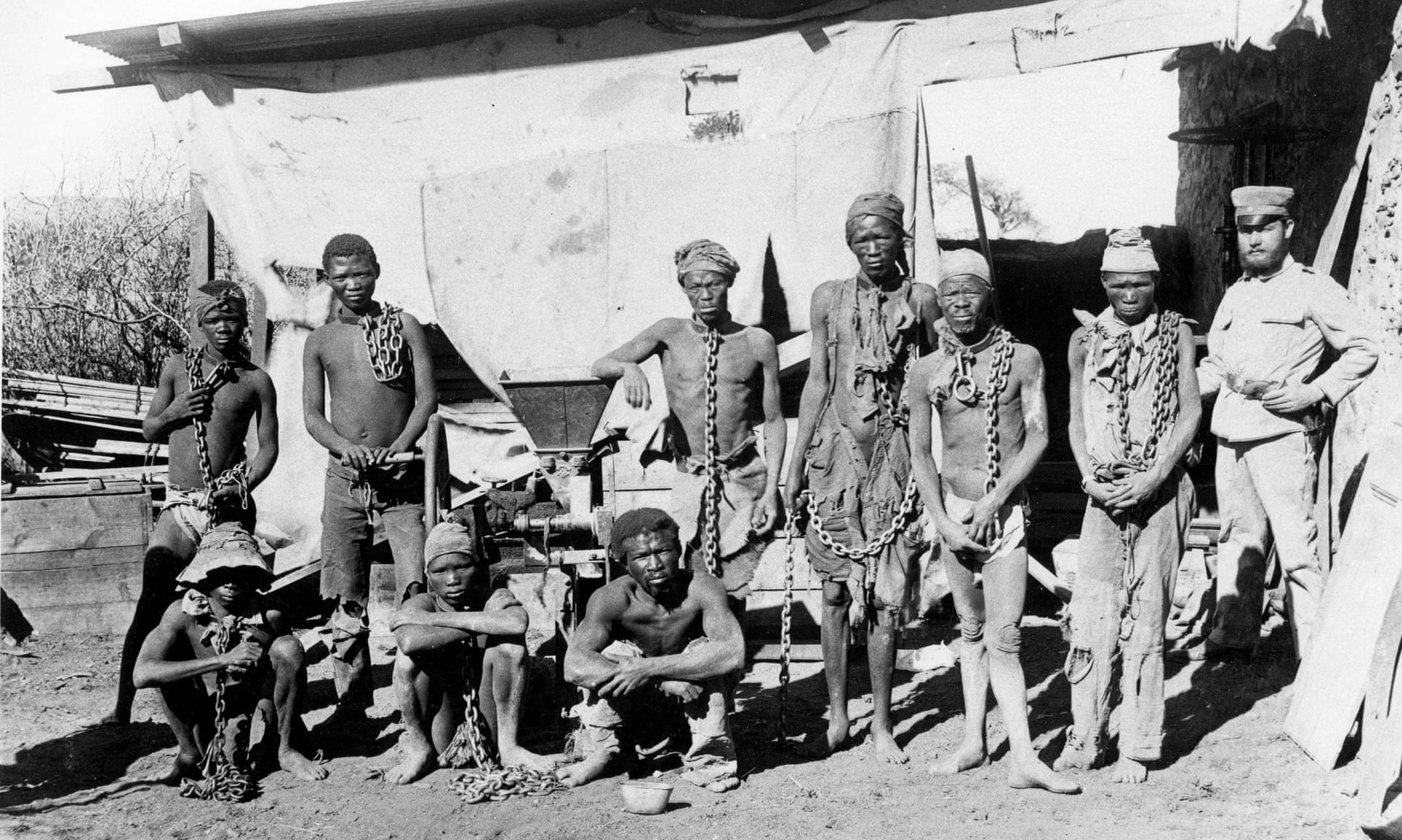
About 40,000–80,000 Herero and 10,000 Nama were killed by the German Empire in German South West Africa between 1904 and 1908. Known as the Herero and Nama genocide, it combined military killing, forced expulsion into the Omaheke desert, concentration camps, starvation, disease, forced labor and sexual violence. Germany formally recognized it as genocide in 2021.
Key takeaways
- German colonial forces killed approximately 40,000–80,000 Herero and about 10,000 Nama in German South West Africa between 1904 and 1908.
- Lothar von Trotha’s 2 October 1904 extermination order explicitly authorized shooting Herero and expelling survivors into the Omaheke desert.
- Concentration camps, forced labor, starvation, disease, executions and dispossession continued after Berlin rescinded the written extermination order in December 1904.
- Germany recognized the killings as genocide in 2021 and proposed €1.1 billion over 30 years, but descendant groups rejected the process.
- Historical recognition is broad, while arguments continue over exact population losses, descendant participation, land restitution and legally defined reparations.
The short answer: a colonial war became extermination
The genocide occurred in present-day Namibia under the German Empire, which ruled German South West Africa from 1884 to 1915. Colonial seizure of land and cattle, debt, racial law and violence drove Herero resistance beginning in January 1904. Lieutenant General Lothar von Trotha defeated Herero forces at the Battle of Waterberg on 11 August 1904, then drove civilians east toward the water-scarce Omaheke.
On 2 October 1904, von Trotha issued his Vernichtungsbefehl, or extermination order:
“Within the German borders every Herero, with or without a rifle, with or without cattle, will be shot.” — Lothar von Trotha, 1904, Proclamation to the Herero People
Berlin rescinded that written order in December 1904, but not the destructive policy. Survivors were incarcerated in camps, including Shark Island, Swakopmund and Windhoek, and subjected to forced labor, inadequate food, exposure and disease. Nama resistance under leaders including Hendrik Witbooi continued after October 1904; German forces answered with executions, deportation and confinement. Organized resistance was largely crushed by 1908.
Evidence of genocidal intent and colonial killing
The evidence is not limited to retrospective death counts. It includes von Trotha’s October 1904 order; military cordons that prevented Herero from returning from the Omaheke; contemporary reports of poisoned or guarded water sources; mass imprisonment; and mortality records from concentration camps. In an October 1904 letter, von Trotha described the conflict as a “racial struggle” and argued that the Herero nation had to be destroyed or expelled.
The colonial system continued after the extermination order was withdrawn. Germany’s 1907 regulations compelled surviving Africans to carry identification passes and restricted land ownership and movement. Prisoners were leased to military, railway and private employers. At Shark Island, established in 1905 near Lüderitz, Nama and Herero prisoners endured cold, hunger, disease and forced labor; German records cited by historians indicate mortality reaching roughly 45–74% among groups held there during 1905–1907, depending on the population and accounting period.
Bodies were also exploited. Skulls and other remains were sent to German institutions for racial research. Eugen Fischer studied mixed-descent families at Rehoboth in 1908 and published his racist findings in 1913. Germany returned 20 skulls to Namibia in 2011, followed by further remains in 2014 and 2018.
The Herero and Nama genocide was not an accidental consequence of drought or an ordinary battlefield defeat: documented orders and detention practices show state-directed group destruction.
Death tolls and the range of estimates
No complete census or death register exists. Colonial records were uneven, mobile populations were undercounted, and deaths in the desert or after displacement often went unrecorded. Consequently, historians distinguish between absolute estimates and percentages derived from disputed prewar population figures.
| Source or formulation | Herero deaths | Nama deaths | Period and basis |
|---|---|---|---|
| Common modern scholarly range | 40,000–80,000 | about 10,000 | Deaths during the 1904–1908 war, expulsion and camps |
| United Nations Whitaker Report | about 65,000 | about 10,000 | 1985 report; approximately 80% of Herero and 50% of Nama populations |
| Isabel V. Hull | roughly 60,000–80,000 | roughly 10,000 | 2005 synthesis of military destruction, desert expulsion and incarceration |
| German-Namibian Joint Declaration | approximately 65,000 | approximately 10,000 | 2021 political declaration using widely cited historical estimates |
The frequently repeated claim that 80% of Herero and 50% of Nama died comes from comparing estimated prewar populations with surviving populations. If the Herero population before 1904 was approximately 80,000, an estimate of 65,000 deaths implies about 81%. Larger prewar estimates produce the upper figure of 80,000 deaths. These are reconstructions, not precise counts.
Who disputes the classification, and why?
Mainstream genocide scholarship recognizes the events as genocide, but disputes concern legal liability, terminology and reparations. Some older German colonial histories described a “war” or “uprising,” foregrounding settler deaths and military operations while minimizing civilian expulsion and camp mortality. A minority of writers challenge the intent evidence or the reliability of population estimates. Neither uncertainty over exact totals nor the December 1904 cancellation of von Trotha’s order erases the documented attempt to destroy the Herero as a group or the subsequent destruction of Nama communities.
Legal arguments are narrower than historical findings. The 1948 Genocide Convention was adopted 40 years after 1908 and is generally not applied retroactively. In 2019, a United States federal court dismissed a lawsuit brought by Herero and Nama representatives against Germany on sovereign-immunity grounds; an appellate court affirmed dismissal in 2020. Those rulings did not decide that genocide had not occurred.
Germany first used the term genocide officially in 2015. In May 2021, Germany and Namibia announced a Joint Declaration under which Germany recognized genocide “from today’s perspective” and proposed €1.1 billion over 30 years for development programs. Herero and Nama traditional-authority and activist groups rejected the process because they were not direct negotiating parties and because Germany framed the funding as reconstruction and development, not legally owed reparations.
What followed: dispossession, memory and reparations claims
The genocide transformed Namibia’s ownership structure. Herero and Nama land and livestock were confiscated, while survivors entered a coercive labor regime serving settlers, mines, railways and farms. German rule ended when South African forces occupied the colony in 1915 during the First World War; South Africa then administered the territory under a League of Nations mandate from 1920. Namibia became independent on 21 March 1990.
The consequences remain material: inherited land inequality, family loss and the dispersal of communities cannot be separated from German colonial confiscation. Memorial campaigns have therefore demanded direct participation, restitution of human remains and cultural property, land-related redress, an apology accepted by descendants, and reparations rather than discretionary aid.
The 2021 declaration did not settle these demands. Namibia’s government sought revisions after domestic criticism, and descendant organizations continued to challenge bilateral negotiations that treated the Namibian state as their sole representative. Understanding this unresolved dispute requires keeping three questions distinct: whether genocide occurred, which historical estimate is strongest, and what legal or political remedy is owed. The first is settled in mainstream scholarship; the latter two remain contested. See the archive’s overviews of the Namibian genocide and the colonial system of the German Empire.
Sources & further reading
- United Nations, Whitaker Report on Genocide (1985)
- Encyclopaedia Britannica, “Herero and Nama genocide”
- United States Holocaust Memorial Museum, “German South West Africa”
- German Federal Foreign Office, Joint Declaration initialled in 2021
- Isabel V. Hull, Absolute Destruction: Military Culture and the Practices of War in Imperial Germany (2005)
- Jürgen Zimmerer and Joachim Zeller, eds., Genocide in German South-West Africa (2008)
Frequently asked questions
- How many Herero and Nama were killed?
- Scholars commonly estimate that 40,000–80,000 Herero and about 10,000 Nama died between 1904 and 1908. The United Nations’ 1985 Whitaker Report gave approximately 65,000 Herero and 10,000 Nama deaths, equivalent to about 80% and 50% of their estimated prewar populations respectively. Missing records make an exact count impossible.
- Who ordered the Herero genocide?
- Lieutenant General Lothar von Trotha, commander of German forces in German South West Africa, issued an extermination order on 2 October 1904. It declared that every Herero found inside the colony’s borders would be shot. Kaiser Wilhelm II’s government rescinded the written order in December 1904, but mass imprisonment, forced labor and lethal deprivation continued.
- Why is the Herero and Nama genocide considered a genocide?
- German forces deliberately targeted Herero and Nama communities between 1904 and 1908. Evidence includes Lothar von Trotha’s 1904 extermination order, military expulsion into the Omaheke desert, denial of return routes and water, and detention under lethal conditions. These acts demonstrate an intent to destroy protected ethnic groups, fitting the concept codified by the 1948 Genocide Convention.
- Did Germany apologize and pay reparations to Namibia?
- Germany formally recognized the events as genocide in May 2021 and proposed €1.1 billion over 30 years in reconstruction and development funding. Germany did not define that money as legally owed reparations. Herero and Nama representatives criticized the German-Namibian negotiations for excluding them as direct parties and argued that the proposed apology and funding did not adequately address land, restitution or descendant claims.
- Where did the Herero and Nama genocide happen?
- It occurred from 1904 to 1908 in German South West Africa, largely within present-day Namibia. Major sites included Waterberg, the Omaheke desert, Windhoek, Swakopmund and Shark Island near Lüderitz. Germany had declared the territory a colony in 1884; German rule ended after South African occupation in 1915, and Namibia achieved independence on 21 March 1990.
Related chapters
Questions
- Did Britain Cause the Bengal Famine of 1943?
- Did France Use Torture in Algeria?
- How Did the Berlin Conference Divide Africa?
- How Did the Dutch VOC Rule Indonesia?
- How Does Debt Keep Former Colonies Poor?
- How Is Racism Structured in the Present Day?
- How Many Indigenous People Died in the Americas After 1492?
- How Many People Died in the Congo Free State?
- How Many People Were Taken in the Atlantic Slave Trade?
Sources & further reading
CC BY 4.0 ·