Banda massacre and the Dutch nutmeg monopoly
How the Dutch East India Company destroyed Bandanese society in 1621, enslaved survivors and built a violent, immensely profitable nutmeg monopoly.
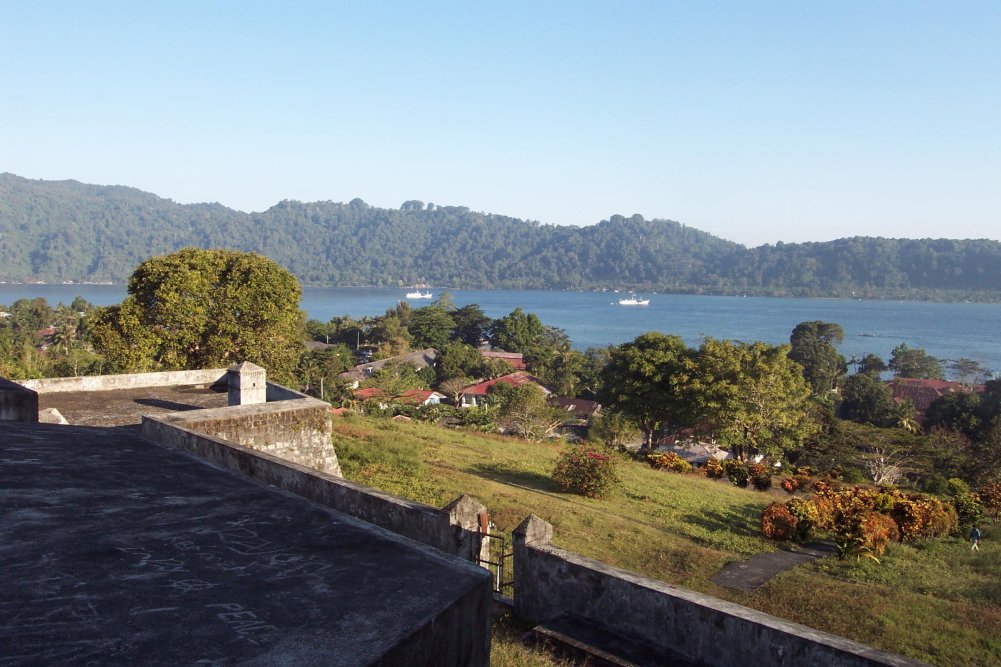
In 1621, the Dutch East India Company (VOC), commanded in the Banda Islands by Governor-General Jan Pieterszoon Coen, destroyed an independent trading society to secure exclusive control of nutmeg and mace. Dutch forces killed, deported or enslaved most of Banda’s roughly 15,000 inhabitants; historian Willard A. Hanna estimated that only about 1,000 remained afterward.
This was not an accidental wartime atrocity. It was the mechanism by which a chartered corporation converted the world’s only major nutmeg-producing territory into guarded plantations worked by enslaved people. The massacre belongs in the histories of colonial violence, mass atrocities and corporate extraction.
Key takeaways
- The VOC destroyed Bandanese society in 1621 to turn exclusive nutmeg purchasing into a territorial monopoly enforced by soldiers and forts.
- About 14,000 of Banda’s estimated 15,000 inhabitants were killed, displaced, deported or enslaved, according to Hanna’s 1978 reconstruction.
- No reliable source proves that all 14,000 missing Bandanese were killed; documented demographic destruction includes flight, famine and forced removal.
- VOC shareholders, European merchants and plantation leaseholders profited from spices cultivated after 1621 by a largely enslaved replacement workforce.
- Bandanese resistance defended political autonomy and open trade, while English intervention pursued a rival imperial monopoly rather than Bandanese freedom.
What happened in Banda
The Banda Islands, now in Indonesia’s Maluku province, were the world’s principal source of nutmeg and mace until seedlings were successfully transplanted elsewhere during the 18th and 19th centuries. Bandanese merchants sold spices through Asian commercial networks and resisted the VOC’s demand that they trade exclusively with the Dutch at imposed prices.
| Year | Event | Concrete detail |
|---|---|---|
| 1599 | First Dutch fleet reaches Banda | Wijbrand van Warwijck’s expedition entered an established regional market. |
| 1609 | Treaty imposed at Banda Neira | Dutch admiral Pieter Willemsz Verhoeff was killed during negotiations; the VOC built Fort Nassau. |
| 1616 | VOC occupies Pulau Ay | Survivors fled after Dutch conquest; English claims persisted on Run. |
| 1621 | Coen invades Great Banda | A VOC force of about 2,000, including roughly 1,600 Europeans and 300 Japanese mercenaries, attacked the islands. |
| 8 May 1621 | Orang kaya executed | VOC records identify 44 Bandanese leaders as condemned and beheaded. |
| 31 July 1667 | Treaty of Breda signed | England transferred Run to the Dutch while retaining New Netherland, including Manhattan. |
After accusing Bandanese leaders of violating coerced agreements, Coen ordered collective punishment. Villages were burned; people were killed, driven into the hills, transported to Batavia, or forced into slavery. Forty-four orang kaya—community leaders and merchant-notables—were executed on 8 May 1621 after torture and a VOC proceeding.
“Despairing of peace, we have put the matter in hand and, with God’s help, have brought the greater part of Banda under the Company.” — Jan Pieterszoon Coen, 1621, letter to the VOC directors, translated in surviving Company correspondence.
The phrase “with God’s help” framed organized dispossession as legitimate conquest. The material purpose was explicit: exclusive corporate command of production and sale.
The monopoly mechanism
The VOC held quasi-sovereign powers under its 1602 charter from the States General of the Dutch Republic: it could wage war, make treaties, build forts, govern territory and use armed force. In Banda, those powers produced a colonial plantation system called the perkeniersstelsel.
- The VOC expelled or enslaved the producers who rejected exclusive dealing.
- It divided nutmeg groves into about 68 plantation units, or perken, after 1621.
- European perkeniers received leases and had to sell the entire crop to the Company at fixed prices.
- Enslaved laborers—transported from elsewhere in the Indonesian archipelago, India and other VOC territories—cultivated and harvested the trees.
- Forts, patrol vessels and tree destruction outside controlled zones restricted supply, while the VOC resold spices in Europe at steep markups.
| Monopoly indicator | Date | Documented figure or range | Source basis |
|---|---|---|---|
| VOC starting capital | 1602 | 6.44 million guilders | VOC subscription accounts |
| Banda plantation units | after 1621 | about 68 perken | VOC land reorganization records; Hanna |
| Nutmeg purchase price in Banda | 17th century | about 0.5–0.6 guilders per pound | VOC price schedules summarized by historians |
| European resale markup | early 17th century | commonly reported at roughly 30–60 times Asian purchase cost | Jonathan Israel and spice-trade scholarship; varied by year and market |
| VOC dividend peak | 1606–1610 | 75% in 1606 and 50% in 1610, partly paid in spices | Company dividend records; not Banda-only revenue |
These figures should not be collapsed into a single “profit from the massacre.” VOC accounts combined regions, commodities and military costs. The defensible conclusion is structural: restricting nutmeg supply supported extraordinary margins, while plantation leaseholders and Company shareholders captured value produced by coerced labor.
How many people were killed, displaced or enslaved?
No complete 1621 census or death register survives. The most frequently cited reconstruction comes from Willard A. Hanna’s 1978 history: Banda’s pre-conquest population was about 15,000, and only about 1,000 people remained after killing, flight, deportation and enslavement. Some modern summaries describe roughly 2,500 people as killed directly and several thousand as dying from starvation, exposure or flight; documentation does not support a precise final death toll.
| Population measure | Year | Estimate | Attribution and limitation |
|---|---|---|---|
| Bandanese population before conquest | c. 1621 | about 15,000 | Willard A. Hanna, 1978 reconstruction |
| Remaining Bandanese population | after 1621 | about 1,000 | Hanna, 1978; excludes many deportees and refugees |
| Directly killed | 1621 | often cited as about 2,500 | Later historical summaries; incomplete VOC records |
| Total removed by death, flight, enslavement or deportation | 1621 | about 14,000 | Derived from Hanna’s 15,000 and 1,000 estimates; not a death toll |
| Executed orang kaya | 8 May 1621 | 44 | VOC accounts of the proceeding |
A range is more honest than a false total: the evidence establishes demographic destruction, but it cannot identify how every missing person died.
The archive therefore distinguishes direct execution and killing from the broader destruction of the population through famine, expulsion, flight, deportation and slavery. Comparable methodological cautions apply throughout the archive’s atrocity data.
Who profited, and who resisted?
The principal institutional beneficiary was the VOC, governed from Amsterdam by the Heeren XVII. Its shareholders received dividends generated across the Company’s Asian trade, while Dutch merchants, auctioneers, refiners and tax authorities benefited from European spice sales. In Banda, perkeniers obtained land and captive labor under VOC protection. Coen advanced a corporate-imperial project rather than acting as an isolated rogue commander.
Bandanese resistance preceded 1621 and continued through escape, armed defense and commercial evasion. Leaders refused to surrender the right to sell to Javanese, Malay, English and other buyers. Pulau Ay resisted major Dutch attacks before falling in 1616. People fled to the Kei Islands, Seram and other parts of eastern Indonesia, where Bandanese communities and trading connections survived.
English involvement was commercial and imperial, not humanitarian. English East India Company agents contested Dutch control of Ay and Run because they also wanted spice profits. Run’s formal transfer to the Dutch under the 1667 Treaty of Breda completed VOC territorial dominance in Banda; the treaty’s treatment of islands and colonies as exchangeable property exposed the imperial logic shared by both companies.
Denial, memory and present meaning
Dutch national memory long celebrated the VOC as evidence of maritime enterprise while marginalizing enslavement, massacre and coercion. Coen was commemorated with a statue erected in Hoorn in 1893. Its explanatory plaque was revised in 2012 after public dispute, but the statue remained, making it a continuing site of argument over whether contextualization without removal adequately addresses colonial honor.
Key facts
- The 1621 campaign was ordered by Governor-General Jan Pieterszoon Coen to enforce the VOC’s nutmeg monopoly.
- Hanna’s 1978 reconstruction places Banda’s population near 15,000 before conquest and roughly 1,000 afterward.
- The disappearance of about 14,000 people combines deaths, flight, deportation and enslavement, not 14,000 documented killings.
- Forty-four Bandanese orang kaya were executed on 8 May 1621 after a VOC proceeding.
- Enslaved laborers replaced much of the expelled population on approximately 68 post-1621 plantations.
Today, Banda shows how corporate law, military sovereignty and racialized forced labor could operate as one system. The VOC’s shareholders were separated from violence by ledgers, auctions and distance, but their returns depended on conquest. That structure remains relevant wherever corporations secure exclusive access to land, minerals or crops through state force, displacement and contracts imposed without meaningful consent.
The islands themselves are not a vacant monument to Dutch history. Banda’s population was 20,924 in Indonesia’s 2020 census and officially estimated at 21,902 in mid-2023 by Statistics Indonesia. Present-day Bandanese communities, including descendants of refugees and transported peoples, are central to the history and its interpretation—not supporting characters in a European commercial story.
Sources & further reading
- Encyclopaedia Britannica: Banda Islands
- Willard A. Hanna, Indonesian Banda — Internet Archive catalogue
- Cambridge University Press: The Dutch East India Company in Early Modern Japan
- Rijksmuseum: slavery and the Dutch colonial period
- Dutch National Archives: Dutch East India Company archives
- UNESCO Memory of the World: VOC archives
Frequently asked questions
- What was the Banda massacre?
- The Banda massacre was the VOC’s 1621 destruction of Bandanese society under Governor-General Jan Pieterszoon Coen. Dutch forces killed inhabitants, executed 44 leaders on 8 May, and deported, enslaved or expelled thousands. Historian Willard A. Hanna estimated in 1978 that only about 1,000 people remained from a pre-conquest population of roughly 15,000.
- Why did the Dutch massacre the Bandanese?
- The VOC attacked because Bandanese producers resisted contracts requiring them to sell nutmeg and mace exclusively to the Company at fixed prices. In 1621, Coen used military conquest to eliminate competing trade, seize the groves and reorganize production into about 68 plantations. The objective was an enforceable corporate monopoly, not simply political retaliation.
- How many people died in the Banda massacre?
- The exact death toll is unknown. Some modern accounts cite about 2,500 people killed directly in 1621, while many others died from hunger, exposure and violence during flight. Hanna’s 1978 estimate shows a broader demographic collapse from about 15,000 inhabitants to 1,000 remaining; the resulting 14,000 includes refugees, deportees and enslaved people, not deaths alone.
- Who owned and worked the nutmeg plantations after 1621?
- After the 1621 conquest, the VOC divided Banda’s groves into about 68 *perken*. European leaseholders called *perkeniers* managed them under Company rules and sold their entire crop to the VOC at fixed prices. Enslaved people transported from across the Indonesian archipelago, India and other VOC-controlled regions performed much of the cultivation and harvesting.
- What did the Treaty of Breda have to do with Banda?
- The Treaty of Breda, signed on 31 July 1667, ended the Second Anglo-Dutch War. England abandoned its claim to Run, a nutmeg-producing Banda island, while the Dutch accepted English control of New Netherland, including Manhattan. The exchange strengthened the VOC’s Banda monopoly, although the familiar claim that Manhattan was simply “swapped” for Run compresses a much broader settlement.
Related chapters
Topics
- Aimé Césaire and Discourse on Colonialism
- Algerian War of Independence and French Torture
- South African Apartheid: The Legal Architecture of Racism
- Atlantic Slave Trade: Scale, Profits and Resistance
- Belgian Congo: From Leopold’s Atrocities to Colonial Rule
- The 1943 Bengal Famine and British Policy
- Benin Bronzes: Looting, Trade and Restitution
- Berlin Conference and the Partition of Africa
- The Black War and the Genocide of Tasmanian Aboriginals
Sources & further reading
CC BY 4.0 ·