The 1943 Bengal Famine and British Policy
How British wartime policy, inflation, market failure and relief delays turned Bengal’s 1943 food crisis into a famine that killed up to 3 million.
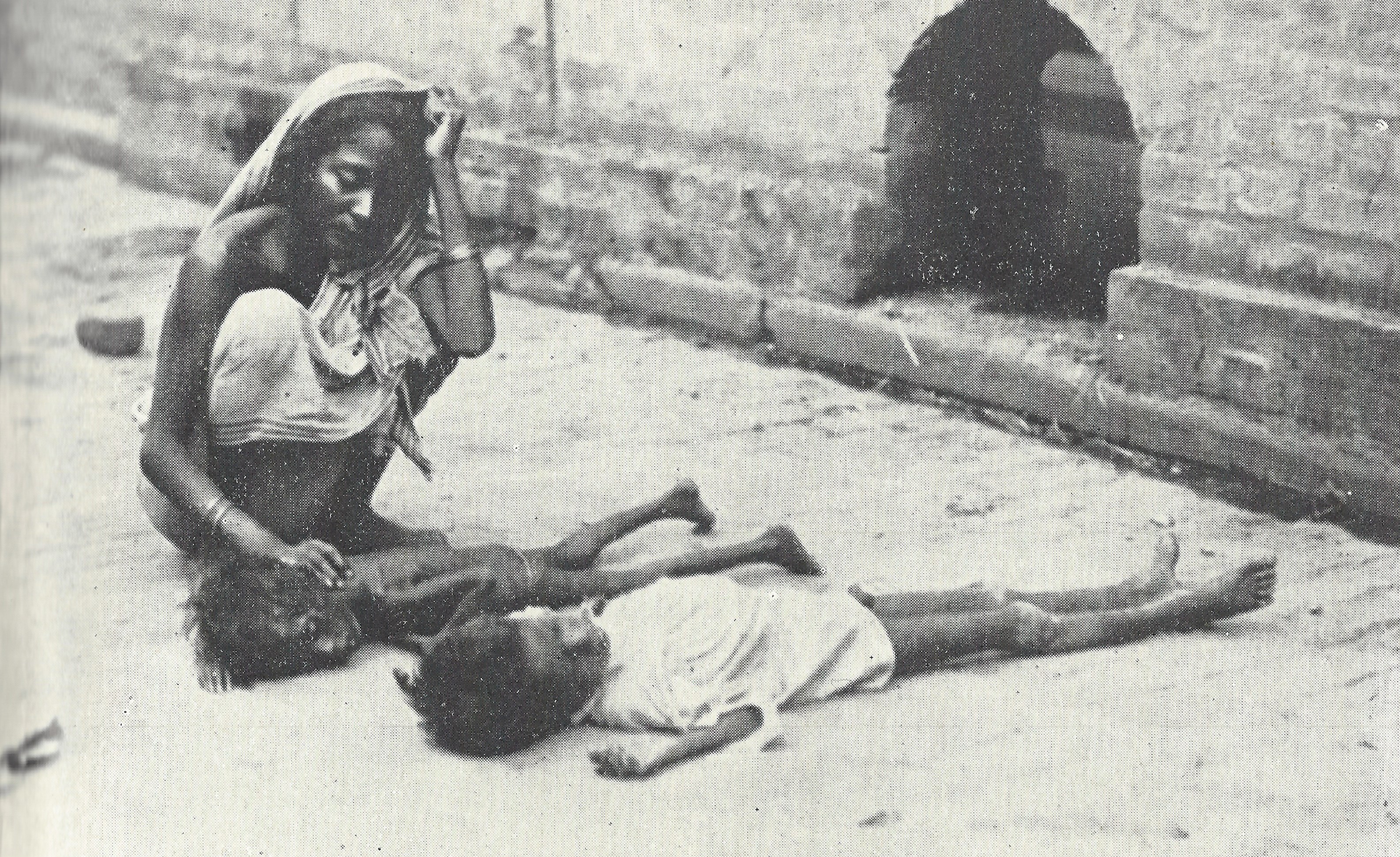
The Bengal famine of 1943 was not simply caused by insufficient rice. Under British rule, wartime inflation, military procurement, market speculation, loss of Burmese imports, transport disruption and coercive “denial” policies destroyed access to food. London and New Delhi delayed decisive relief while starvation and disease spread through Bengal.
Most modern accounts place excess deaths at about 2.1–3 million during 1943–44; the official 1945 Famine Inquiry Commission estimated about 1.5 million famine deaths in 1943 and a further 0.5–0.8 million deaths in 1944. The catastrophe belongs in the archive of British colonial history, mass civilian atrocities and contested mortality data.
Key takeaways
- British wartime procurement, inflation, denial policies and delayed relief converted Bengal’s 1942 food shock into mass starvation and disease during 1943–44.
- The 1945 Famine Inquiry Commission estimated 2.0–2.3 million deaths in 1943–44; later scholarship commonly places excess mortality near 3 million.
- About 46,000 boats were removed under Britain’s 1942 denial policy, damaging fishing, commerce and food transport in vulnerable coastal districts.
- Calcutta’s common-rice price rose from about Rs 6 per maund in January 1942 to roughly Rs 40 by September 1943.
- Imperial authorities protected military supply and selected urban consumers while rural laborers, fishers, artisans and small cultivators lost access to food.
What happened and how policy made famine
Bengal entered 1943 under wartime pressure. Japan’s 1942 conquest of Burma removed a rice supplier; Bengal had imported about 15% of its rice from Burma in ordinary prewar years, according to the 1945 Famine Inquiry Commission. A cyclone and tidal surge struck coastal Bengal on 16 October 1942, killing about 14,500 people and damaging crops, stores and livestock. Rice disease also reduced the winter aman harvest, although historians dispute the scale of the aggregate shortfall.
The decisive mechanism was loss of entitlement: prices rose beyond what laborers, fishers, artisans and small cultivators could pay. Economist Amartya Sen calculated in 1981 that Bengal’s 1943 food availability was not uniquely low compared with some non-famine years; Madhusree Mukerjee and other historians have emphasized wartime scarcity, imperial shipping priorities and government obstruction alongside market failure.
British authorities intensified disruption. Under the 1942 “rice denial” policy, officials removed surplus rice from coastal districts vulnerable to Japanese invasion. Under “boat denial,” they confiscated or destroyed roughly 46,000 boats capable of carrying at least 10 people, according to the 1945 commission. This impaired fishing, trade and evacuation.
- Burma fell to Japan in March 1942, cutting imports and provoking panic.
- Denial policies began in 1942, stripping coastal communities of grain and transport.
- Procurement, military demand, inflation and speculation drove rice prices upward during 1942–43.
- Bengal’s ministry and the Government of India delayed universal rationing and adequate rural relief.
- Starvation weakened immune systems; malaria, dysentery and other diseases caused most recorded deaths during 1943–44.
The numbers: deaths, prices and grain
No complete death registration existed, and displaced people often died outside their home districts. Estimates therefore depend on census deficits, excess-mortality models and retrospective surveys.
| Measure | Year or period | Figure | Source or qualification |
|---|---|---|---|
| Official famine deaths | 1943 | about 1.5 million | Famine Inquiry Commission, 1945 |
| Additional deaths | 1944 | 0.5–0.8 million | Famine Inquiry Commission, 1945 |
| Excess deaths | 1943–44 | about 3 million | Amartya Sen, 1981 |
| Modern scholarly range | 1943–44 | about 2.1–3 million | Syntheses by Cormac Ó Gráda and later historians |
| Broad published range | 1943–44 | 0.8–3.8 million | Reflects incompatible demographic methods |
The official Calcutta retail price of common rice rose from about Rs 6 per maund in January 1942 to roughly Rs 40 per maund by September 1943, according to commission series; one maund was approximately 37.3 kilograms. District prices and black-market quotations could be higher.
| Material indicator | Date | Concrete figure | Significance |
|---|---|---|---|
| Boats removed under denial | 1942 | about 46,000 | Restricted transport and livelihoods |
| Cyclone deaths | 16 October 1942 | about 14,500 | Official estimate cited by the 1945 commission |
| Rice price, Calcutta | January 1942 | about Rs 6 per maund | Before the steepest inflation |
| Rice price, Calcutta | September 1943 | about Rs 40 per maund | More than six times the January 1942 level |
| Australian wheat sent to India | September–November 1943 | about 100,000 tons | Late emergency shipment discussed in wartime records |
Who was protected and who profited
The colonial state protected Calcutta’s war industries, armed forces and politically important urban workers through procurement and rationing while rural Bengal remained exposed. Calcutta introduced formal rationing in January 1944—after peak mortality in late 1943. The priority was wartime production and urban order, not equal access to grain.
Large landholders, wholesale grain merchants, mill owners and speculators could benefit from rising prices, hoarding and state contracts. There is no defensible single total for private famine profits: accounts were fragmentary, black-market transactions were concealed and the 1945 inquiry did not calculate an aggregate. The documented fact is redistribution. People with grain, cash, storage and government access gained bargaining power; wage laborers and small producers sold land, tools, jewelry and livestock to survive.
British India also continued supporting an imperial war economy. London rejected or deferred multiple shipping requests from India during 1943, while vessels and grain were allocated across military theaters and stockpiles. Prime Minister Winston Churchill’s War Cabinet controlled scarce shipping, but responsibility was distributed through the Secretary of State for India, the Government of India and Bengal’s provincial administration.
“The starvation of anyhow under-fed Bengalis is less serious than that of sturdy Greeks.” — Winston Churchill, 1943, War Cabinet minute recorded in The Transfer of Power 1942–7.
The sentence exposes the racial hierarchy informing allocation; it does not by itself establish every operational cause. The case rests on policy records, requisitions, price evidence, delayed rationing and mortality.
Relief, resistance and public exposure
Resistance included food demonstrations, grain seizures, mutual aid, press reporting and demands for controlled prices. Communist Party of India organizers, women’s groups and relief committees opened kitchens and mobilized supplies. The Bengal Women’s Self-Defence League organized women around food and relief; its politics overlapped with the Communist-led anti-fascist movement after 1941.
Journalists and artists broke official distance. Ian Stephens, editor of The Statesman, published graphic photographs on 22 August 1943 and again in September 1943, forcing Calcutta and overseas readers to confront bodies in the streets. Chittaprosad Bhattacharya’s 1943 pamphlet Hungry Bengal documented Midnapore; British authorities seized and destroyed most copies. Bijon Bhattacharya’s 1944 play Nabanna turned famine displacement into political theater.
“The all-India shortage was brought about by the loss of imports from Burma, and was aggravated by the failure to arrange imports from abroad.” — Famine Inquiry Commission, 1945, Report on Bengal.
Military intervention under Field Marshal Archibald Wavell, who became Viceroy in October 1943, improved transport and relief. Better distribution, imports, the December 1943 aman harvest and Calcutta rationing in January 1944 reduced open starvation, but epidemic disease continued killing people throughout 1944.
Denial, responsibility and memory
Postwar official memory narrowed responsibility. The 1945 Famine Inquiry Commission criticized the Bengal government, the Government of India, traders and public behavior, yet framed failure as dispersed administrative error. This obscured the constitutional reality: Bengal had an elected provincial ministry under the Government of India Act 1935, but British governors retained reserve powers, imperial authorities controlled shipping and the Raj set wartime priorities.
Key facts
- The famine peaked in 1943, but elevated disease mortality continued through 1944.
- The 1945 official inquiry estimated 2.0–2.3 million deaths across 1943–44.
- British “boat denial” removed about 46,000 vessels in 1942.
- Calcutta rice prices increased from about Rs 6 to Rs 40 per maund between January 1942 and September 1943.
- Rural people lacked purchasing power while military and priority urban consumers received stronger protection.
- Churchill’s cabinet did not create the cyclone or rice disease, but imperial decisions worsened exposure and delayed relief.
Calling the famine wholly “natural” is contradicted by contemporary administrative evidence. Calling it a deliberately planned extermination goes beyond what surviving orders demonstrate. The strongest evidence supports culpable colonial policy: foreseeable mass death followed decisions that privileged war, empire and selected consumers over Bengal’s rural poor.
What the Bengal famine means now
The famine remains central to debates about colonial reparations, food security and state accountability. Its lesson is not merely that food must exist nationally. People must possess enforceable access to it through wages, public distribution, transport, health care and political voice. Aggregate supply statistics can conceal lethal exclusion.
India’s later food-policy institutions—including nationwide rationing, procurement and the public distribution system—developed partly from wartime failure. The Bengal case also warns against using emergency secrecy, racialized triage or market prices as substitutes for human need. Digitized shipping files, district reports, price series and census models should be read together, with uncertainty stated rather than used to erase responsibility. See the archive’s wider historical record, catalog of mass atrocities and methods for interpreting colonial data.
Sources & further reading
- Famine Inquiry Commission, Report on Bengal (1945), Internet Archive
- Amartya Sen, Poverty and Famines (Oxford University Press, 1981)
- Cormac Ó Gráda, Eating People Is Wrong, and Other Essays on Famine (Princeton University Press, 2015)
- Madhusree Mukerjee, Churchill’s Secret War (Basic Books, 2010)
- Janam Mukherjee, Hungry Bengal (Oxford University Press, 2015)
- Tirthankar Roy, “The Bengal Famine of 1943,” Economic History Review
Frequently asked questions
- How many people died in the 1943 Bengal famine?
- The British-appointed Famine Inquiry Commission estimated in 1945 that about 1.5 million people died from famine causes in 1943, with another 0.5–0.8 million deaths in 1944. Amartya Sen estimated about 3 million excess deaths across 1943–44 in his 1981 study. Modern scholarship commonly uses approximately 2.1–3 million, while broader published estimates range from 0.8 million to 3.8 million.
- Was Winston Churchill responsible for the Bengal famine?
- Winston Churchill was not solely responsible, but his 1943 War Cabinet controlled imperial shipping and repeatedly resisted or delayed Indian requests while prioritizing military theaters and other stockpiles. Responsibility also lay with the Government of India, Bengal’s provincial ministry, British governors and market actors. Crop damage and Burma’s loss were triggers; policy determined distribution, transport, prices and the timing of relief.
- Did Britain export food from India during the Bengal famine?
- British India remained part of an imperial wartime supply system in 1943, but claims about exports require distinguishing rice, wheat, military provisions, destinations and dates. The central documented failure was not simply one export figure: India’s government sought large imports, while London constrained shipping and allocations. About 100,000 tons of Australian wheat reached India between September and November 1943, after severe deprivation was already visible.
- What were the rice denial and boat denial policies?
- After Japan’s 1942 advance, British authorities sought to deny an invading army supplies in coastal Bengal. Officials removed “surplus” rice and confiscated or destroyed about 46,000 boats capable of carrying at least 10 people, according to the 1945 Famine Inquiry Commission. Boat denial damaged fishing, trade, evacuation and local grain movement, worsening civilian vulnerability before the famine peaked in 1943.
- Was the Bengal famine caused by a food shortage or market failure?
- Both physical disruption and access failure mattered. Burma’s fall in March 1942 ended rice imports; the 16 October 1942 cyclone killed about 14,500 people and damaged crops. Yet Amartya Sen argued in 1981 that collapsing purchasing power and soaring prices were decisive. Wartime procurement, speculation, inflation, transport restrictions and unequal rationing prevented rural people from obtaining available food.
Related chapters
Topics
- Aimé Césaire and Discourse on Colonialism
- Algerian War of Independence and French Torture
- South African Apartheid: The Legal Architecture of Racism
- Atlantic Slave Trade: Scale, Profits and Resistance
- Banda massacre and the Dutch nutmeg monopoly
- Belgian Congo: From Leopold’s Atrocities to Colonial Rule
- Benin Bronzes: Looting, Trade and Restitution
- Berlin Conference and the Partition of Africa
- The Black War and the Genocide of Tasmanian Aboriginals
Sources & further reading
CC BY 4.0 ·