Berlin Conference and the Partition of Africa
How the 1884–1885 Berlin Conference enabled Africa’s partition: rules, empires, profits, resistance, death tolls and colonial legacies.
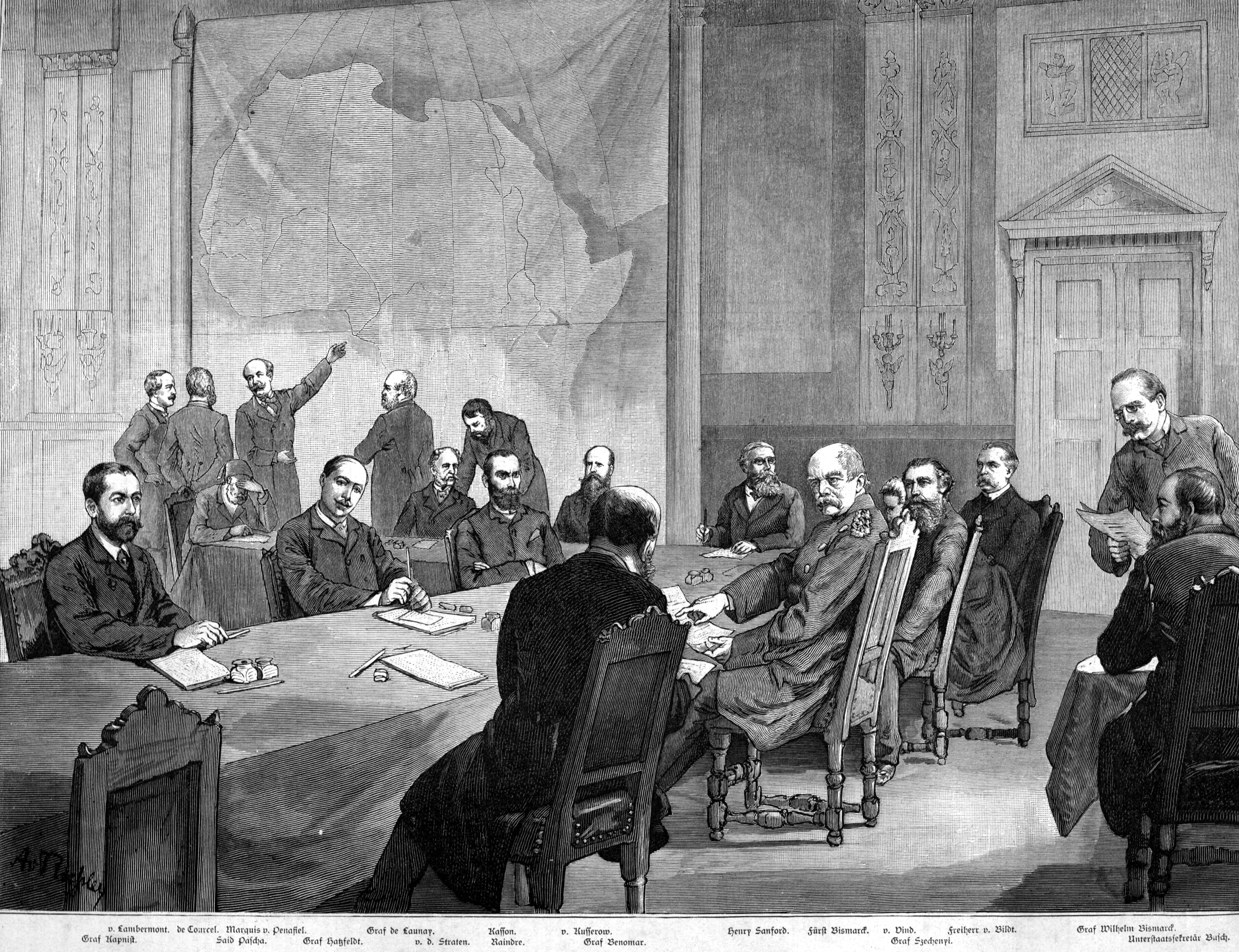
The Berlin Conference of 1884–1885 did not draw every African border, but it established rules that accelerated Europe’s armed partition of Africa. Fourteen states met in Berlin; no African polity was represented. The resulting General Act protected commerce and navigation, endorsed claims built through occupation, and converted imperial violence into mutually recognised European title.
Within roughly three decades, conquest placed almost all Africa under European rule. The conference must therefore be understood not as a single cartographic event but as a mechanism linking diplomacy, chartered companies, forced labour, taxation and military occupation. This hub connects the conference to the wider archive of colonial history, documented atrocities and comparative data.
Key takeaways
- The Berlin Conference created rules for European claims between 1884 and 1885 while excluding every African polity from representation.
- Effective occupation rewarded powers that converted paper claims into military posts, taxation, coerced treaties and enforceable colonial administration.
- By 1914, European empires controlled about 90% of Africa, compared with a commonly estimated 10% in 1870.
- Colonial partition transferred land, labour, rubber, ivory, minerals and tax revenues to European states, monarchs, companies and shareholders.
- African resistance was widespread, from Ethiopia’s 1896 victory at Adwa to anti-colonial wars met with famine, camps and mass killing.
What happened in Berlin
German chancellor Otto von Bismarck convened representatives at his official residence on Wilhelmstrasse on 15 November 1884. The meeting followed lobbying by Belgium’s King Leopold II, whose International Association of the Congo sought recognition for a vast personal domain. Delegates signed the General Act on 26 February 1885.
| Date | Event | Concrete result |
|---|---|---|
| 1876 | Leopold II founded the International African Association | A supposedly humanitarian organization became cover for territorial acquisition |
| 1882 | Britain occupied Egypt | British forces secured the Suez route while Egypt remained nominally Ottoman |
| 15 November 1884 | Berlin Conference opened | 14 participating states met; 0 African representatives attended |
| 26 February 1885 | General Act signed | 38 articles regulated trade, navigation, claims and stated anti-slavery obligations |
| 1885 | Congo Free State recognized | Leopold II became sovereign of about 2.3 million km² |
| 1898 | Fashoda confrontation | Britain and France nearly fought over rival territorial corridors in Sudan |
| 1914 | Partition largely complete | European states controlled about 90% of Africa, a standard historical estimate |
The participants were Austria-Hungary, Belgium, Britain, Denmark, France, Germany, Italy, the Netherlands, the Ottoman Empire, Portugal, Russia, Spain, Sweden–Norway and the United States. The United States signed the General Act but did not ratify it.
“All the Powers exercising sovereign rights or influence in the aforesaid territories bind themselves to watch over the preservation of the native tribes.” — General Act of the Berlin Conference, Article VI, 1885
The promise concealed the governing contradiction: European states declared duties toward Africans while excluding Africans from decisions about sovereignty, land and law.
The mechanism of partition
The conference’s key innovation was not a complete border map. Articles XXXIV and XXXV required a power taking new territory on an African coast to notify the other signatories and establish authority sufficient to protect claimed rights and trade. This principle of “effective occupation” encouraged officials and companies to race inland, sign coercive or misunderstood treaties, build posts, defeat armies and obtain European recognition.
The mechanism operated in a recurring sequence:
- Explorers, missionaries, merchants or company agents gathered intelligence and obtained purported treaties.
- A European government proclaimed a protectorate, colony or company concession.
- Soldiers established posts and used rifles, artillery and punitive expeditions to impose authority.
- Administrations demanded taxes payable in colonial currency, forcing people into wage labour or commodity production.
- European diplomacy converted occupation into recognized borders, usually without local consent.
The Act proclaimed free trade in the conventional Congo basin and free navigation on the Congo and Niger rivers. These provisions opened enormous inland markets to European capital while armed administrations controlled African labour and land. Britain ruled extensively through chartered enterprises such as the British South Africa Company; Germany used companies before direct rule; France deployed concessionary firms in Equatorial Africa; Leopold governed the Congo as personal property.
The numbers: territory, extraction and death
Africa’s land area is about 30.37 million km². Historians commonly describe European control as rising from roughly 10% in 1870 to about 90% by 1914; precise percentages vary because sovereignty and frontier control were often contested. Ethiopia preserved independence after defeating Italy at Adwa in 1896, while Liberia remained formally independent under strong United States influence.
These approximate benchmark shares synthesize figures widely used by historians of the Scramble for Africa; disputed frontiers make false precision inappropriate. Colonial conquest and extraction produced mass death, although incomplete censuses prevent a single continental total.
| Place and period | Measured extraction or mortality | Source and limits |
|---|---|---|
| Congo Free State, 1885–1908 | Population loss often estimated at 5–10 million | Adam Hochschild’s 1998 synthesis popularized the 10 million figure; Jan Vansina’s demographic reconstruction, published in 2010, supports roughly 50% decline in sampled areas but not a precise colony-wide toll |
| German South West Africa, 1904–1908 | About 65,000–80,000 Ovaherero and 10,000 Nama deaths | Common scholarly ranges summarized by Jürgen Zimmerer and Joachim Zeller in 2003; deaths followed warfare, expulsion, desert confinement and camps |
| Congo rubber exports, 1895–1901 | Rose from about 580 to 6,000 metric tons annually | E. D. Morel’s contemporary trade analysis and later Congo histories; series vary by customs category |
| French Equatorial Africa concessions, 1899 | About 40 companies received roughly 700,000 km² | Catherine Coquery-Vidrovitch’s research on concessionary rule; boundaries and company holdings changed |
The Congo estimate represents excess population loss through killing, starvation, disease, flight and reduced births—not a verified count of executions. Method and uncertainty belong beside every toll.
Who profited
European governments gained strategic territory, taxes and control of transport routes. Leopold II extracted ivory and wild rubber through the Force Publique and concession companies including Anglo-Belgian India Rubber Company, known as ABIR. Shareholders profited while hostage-taking, village destruction, flogging and mutilation enforced quotas. After international exposure, Belgium annexed Leopold’s Congo Free State in 1908.
Britain secured Egypt and the Suez Canal route, southern African minerals and extensive eastern territories. France assembled a west-to-east empire and granted immense Central African concessions. Germany acquired Togoland, Kamerun, German East Africa and German South West Africa. Portugal consolidated Angola and Mozambique; Italy and Spain obtained smaller possessions.
Key facts
- Fourteen states attended between 1884 and 1885, but no African ruler, community or political institution received representation.
- Leopold II personally controlled the Congo Free State from 1885 until Belgian annexation in 1908.
- Colonial profits depended on African land, labour and commodities, backed by taxes, prisons, armed companies and state militaries.
- Borders served imperial bargaining and administration rather than the consent or political geography of African societies.
Historian Thomas Pakenham described the partition as a “Scramble for Africa” driven by national rivalry, commerce and strategic calculation in his 1991 history The Scramble for Africa.
African resistance and colonial war
Partition was never uncontested. African states negotiated, evaded, rebelled and fought prolonged wars against conquest. Samori Touré resisted French expansion in West Africa from 1882 until his capture in 1898. The Asante fought Britain in multiple wars, including the War of the Golden Stool in 1900. Menelik II’s Ethiopian army defeated Italy at Adwa on 1 March 1896; Italian losses were about 6,000 killed, with estimates commonly ranging from 5,000 to 7,000.
In German East Africa, the Maji Maji uprising of 1905–1907 united communities against forced cotton cultivation and colonial rule. German scorched-earth warfare caused famine; historian John Iliffe estimated in 1979 that about 75,000 people died, while later accounts often give ranges from 75,000 to 300,000 because colonial records were fragmentary. In Libya, Omar al-Mukhtar led resistance against Italian occupation from 1923 until his capture and execution in 1931.
Resistance shaped colonial policy even when defeated. It forced empires to spend heavily on troops, exposed the fiction of consensual treaties, preserved political traditions and supplied later anti-colonial movements with leaders and memories.
Denial, memory and what it means now
European memory long presented Berlin as orderly diplomacy and empire as modernization. That framing detaches railways and ports from their purposes: moving troops, minerals and export crops; collecting tax; and disciplining labour. It also treats atrocities as aberrations despite their recurring role in establishing and maintaining colonial authority.
Germany formally recognized the colonial killings of Ovaherero and Nama as genocide in 2021 and announced €1.1 billion over 30 years for development projects, not legally defined reparations. Ovaherero and Nama representatives criticized their exclusion from negotiations and rejected the settlement’s adequacy. Belgium’s King Philippe expressed “deepest regrets” in 2020 for violence in Congo but did not issue a formal state apology.
Berlin’s consequences persist without implying that every present conflict was mechanically caused there. Colonial boundaries grouped and divided societies, privileged export corridors, concentrated land ownership and left states dependent on externally priced commodities. Debt, multinational concessions, illicit financial flows and unequal trade can reproduce extraction after formal independence, but contemporary African governments and firms also exercise agency and bear responsibility.
The conference remains a decisive case study in how international law can recognize possession while excluding the possessed. Recovering the record means linking maps to coercion, profits to labour and diplomatic clauses to measurable deaths—not treating partition as a neutral episode of state formation.
Sources & further reading
- General Act of the Berlin Conference, 1885 — Avalon Project, Yale Law School
- Encyclopaedia Britannica: Berlin West Africa Conference
- Richard Reid, A History of Modern Africa: 1800 to the Present — Wiley
- John Iliffe, Africans: The History of a Continent — Cambridge University Press
- United States Office of the Historian: Berlin Conference and the Colonization of Africa
- United Nations: The Question of Namibia
Frequently asked questions
- What was the Berlin Conference?
- The Berlin Conference was a meeting of 14 states convened by German chancellor Otto von Bismarck from 15 November 1884 to 26 February 1885. Its General Act regulated trade and navigation in parts of Africa and set diplomatic conditions for recognizing new coastal claims. No African representative attended, although African sovereignty, land and commerce were directly affected.
- Did the Berlin Conference divide Africa into countries?
- Not in a single map-making session. The 1884–1885 conference established rules—especially notification and “effective occupation”—that accelerated partition. Specific borders were then produced through bilateral European treaties, colonial decrees and military conquest. By 1914, European powers controlled about 90% of Africa; Ethiopia and Liberia remained formally independent, though Liberia faced strong United States influence.
- Which countries attended the Berlin Conference?
- Fourteen states participated in 1884–1885: Austria-Hungary, Belgium, Britain, Denmark, France, Germany, Italy, the Netherlands, the Ottoman Empire, Portugal, Russia, Spain, Sweden–Norway and the United States. Germany’s Otto von Bismarck chaired the meeting. The United States signed but did not ratify the General Act, and no African state or ruler had a seat.
- How was King Leopold II connected to the Berlin Conference?
- Belgium’s Leopold II lobbied for the meeting and used humanitarian and free-trade claims to secure international recognition for the Congo Free State in 1885. He personally ruled about 2.3 million km² until 1908. Forced rubber and ivory extraction caused killing, famine, disease and demographic collapse; estimates of Congo population loss commonly range from 5 million to 10 million.
- What are the Berlin Conference’s lasting effects?
- The conference accelerated conquest and helped establish borders serving European bargaining rather than African consent. Colonial governments oriented railways, ports, taxes and labour toward exports. After independence, many states inherited those borders, centralized coercive institutions and commodity dependence. These legacies influence present politics and extraction, but they do not alone explain every conflict or remove responsibility from postcolonial actors.
Related chapters
Topics
- Aimé Césaire and Discourse on Colonialism
- Algerian War of Independence and French Torture
- South African Apartheid: The Legal Architecture of Racism
- Atlantic Slave Trade: Scale, Profits and Resistance
- Banda massacre and the Dutch nutmeg monopoly
- Belgian Congo: From Leopold’s Atrocities to Colonial Rule
- The 1943 Bengal Famine and British Policy
- Benin Bronzes: Looting, Trade and Restitution
- The Black War and the Genocide of Tasmanian Aboriginals
Sources & further reading
CC BY 4.0 ·