The Black War and the Genocide of Tasmanian Aboriginals
How British invasion, frontier killing, martial law and forced exile nearly destroyed Tasmania’s Aboriginal nations between 1803 and 1876.
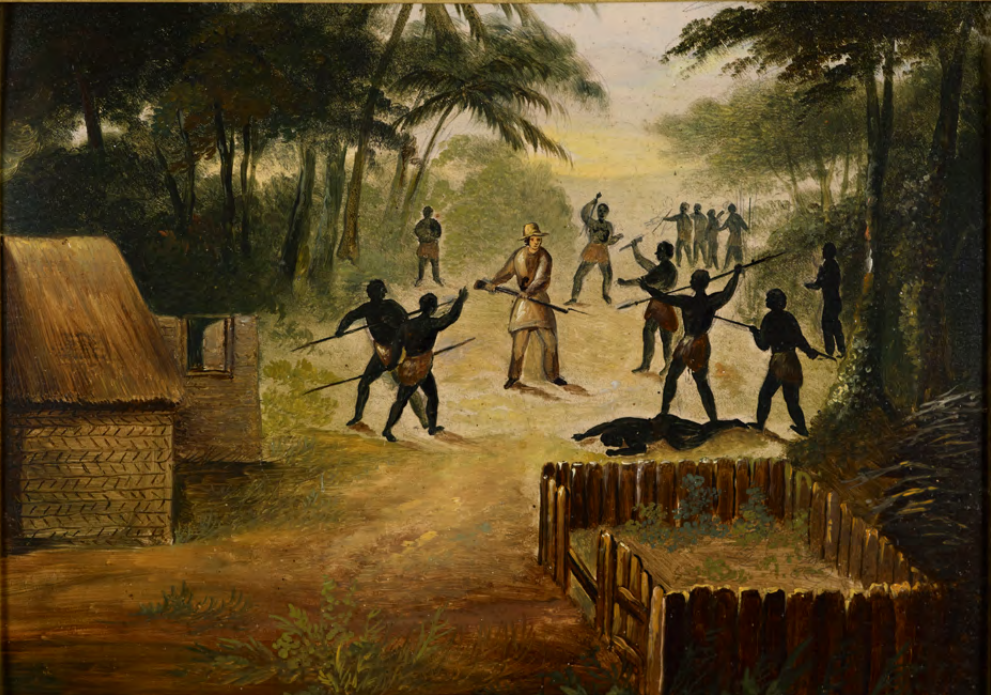
The Black War was the most intense phase of Britain’s invasion of lutruwita/Tasmania. From the mid-1820s to 1832, colonists, soldiers and police killed and dispossessed Aboriginal people, while Aboriginal fighters resisted occupation through mobile attacks. Lyndall Ryan’s 2012 reconstruction counted at least 878 Aboriginal people and 187 colonists killed in conflict from 1824 to 1831; exact totals remain contested because many frontier killings went unrecorded.
Violence was followed by coerced removal under George Augustus Robinson. Survivors were transported to Wybalenna on Flinders Island, where disease, malnutrition and despair caused further deaths. Historians including Henry Reynolds, Lyndall Ryan and Tom Lawson describe the combined process—killing, expulsion, confinement and attempted destruction of Aboriginal societies—as genocide. Tasmanian Aboriginal people survived, contrary to the colonial myth that they became “extinct.”
Key takeaways
- The Black War was a British colonial campaign of dispossession and violent suppression in lutruwita/Tasmania, peaking between 1824 and 1831.
- Lyndall Ryan reconstructed at least 878 Aboriginal and 187 colonial deaths during 1824–1831 in her 2012 history.
- Martial law, armed pursuit, bounties, the Black Line and forced exile worked together to destroy Aboriginal resistance and society.
- Pastoral settlers, merchants and the colonial government benefited as sheep numbers reached roughly 1 million by 1835.
- Tasmanian Aboriginal people survived killing, confinement and the false colonial claim that Truganini’s 1876 death marked their extinction.
What happened: invasion, war and forced removal
British occupation began at Risdon Cove in 1803 and Hobart in 1804. Settlers took hunting grounds and water sources, introduced sheep, abducted women and children, and attacked Aboriginal camps. At Risdon Cove on 3 May 1804, soldiers and settlers fired on a large Aboriginal gathering; estimates range from 3 deaths in Lieutenant William Moore’s contemporary account to about 30–60 in later traditions discussed by Reynolds.
By 1824, conflict had escalated across the settled districts. Lieutenant-Governor George Arthur proclaimed martial law against Aboriginal people on 1 November 1828. Parties of soldiers, police and armed settlers pursued them; Aboriginal bands burned huts, speared livestock and attacked settlers occupying their country.
| Date | State or colonial action | Consequence |
|---|---|---|
| 1803–1804 | British settlements founded at Risdon Cove and Hobart | Permanent invasion and land seizure began |
| 1 Nov 1828 | Arthur declared martial law | Military force gained broad authority against Aboriginal people |
| Oct–Nov 1830 | About 2,200–2,800 colonists joined the Black Line, according to contemporary returns assessed by Reynolds | The operation captured only 2 Aboriginal people directly |
| 1830–1835 | Robinson’s “Friendly Mission” negotiated or coerced surrender | Most surviving people were exiled to offshore islands |
| 1847 | Wybalenna closed | 47 survivors were transferred to Oyster Cove |
“The Black Natives of this Island are hereby declared to be open enemies to the King.” — Lieutenant-Governor George Arthur, 1828, martial-law proclamation.
The numbers: deaths, survival and uncertainty
No complete roll of the dead exists. Colonial officials often ignored killings by settlers, and oral evidence was discounted. Ryan’s 2012 study reconstructed at least 878 Aboriginal and 187 colonial deaths during 1824–1831. Earlier summaries commonly gave about 600–900 Aboriginal deaths and more than 200 colonists across the broader war. Nicholas Clements’s 2014 analysis estimated roughly 1,000 Aboriginal people and 201 colonists killed from 1824 to 1831.
| Measure | Date or period | Estimate and source |
|---|---|---|
| Aboriginal population before sustained invasion | c. 1803 | Common scholarly range: 3,000–7,000; Reynolds has used about 4,000–5,000 |
| Aboriginal conflict deaths | 1824–1831 | At least 878, Lyndall Ryan, 2012 |
| Colonial conflict deaths | 1824–1831 | 187, Ryan, 2012; 201, Nicholas Clements, 2014 |
| Aboriginal conflict deaths | 1824–1831 | About 1,000, Clements, 2014 |
| People transferred from Wybalenna | 1847 | 47 survivors, colonial records |
| Death of Truganini | 1876 | Falsely promoted as the death of the “last Tasmanian” |
These are minimum reconstructions, not a final ledger. See the archive’s historical data methods and wider catalogue of colonial atrocities.
Who profited: land, wool and colonial power
The principal beneficiaries were settlers who received or occupied Aboriginal land, merchants financing pastoral expansion, and the British colonial state. Wool linked Tasmanian dispossession to British textile markets. Van Diemen’s Land’s sheep population rose from about 54,600 in 1820 to roughly 1 million in 1835, according to colonial statistical returns reproduced by economic historians. Exports of wool increased from about 71,000 lb in 1820 to more than 3.5 million lb in 1835—a roughly 49-fold rise in 15 years.
George Arthur’s government granted large estates, supplied military protection and used convict labor to build roads, farms and police infrastructure. The Van Diemen’s Land Company, chartered in London in 1825, received a grant of 250,000 acres in 1825–1826 in the northwest, placing corporate pastoralism directly on Aboriginal country.
Key facts
- Britain occupied lutruwita without a treaty, purchase or Aboriginal consent from 1803.
- Pastoral expansion converted hunting grounds into privately claimed sheep runs.
- The Van Diemen’s Land Company obtained 250,000 acres in 1825–1826.
- Martial law in 1828 protected invasion rather than Aboriginal sovereignty.
- Wool exports exceeded 3.5 million lb by 1835 in colonial returns.
This extraction belongs within the longer history of colonialism, not an isolated frontier tragedy.
Resistance and the machinery of defeat
Aboriginal resistance was organized, strategic and adapted to local terrain. Leaders including Tongerlongeter, Montpelliatta, Eumarrah, Walyer and Mannalargenna coordinated movements, attacked stock and isolated homesteads, and evaded better-armed forces. Their objective was not random violence but defence of country, kin and food systems.
The colonial counteroffensive combined several mechanisms:
- Criminalization: Arthur’s 1828 martial-law proclamation treated Aboriginal resistance as warfare outside ordinary legal protection.
- Armed pursuit: soldiers, constables, roving parties and settlers tracked and shot people across the settled districts.
- Rewards: from 1830, the government offered £5 for each captured adult and £2 for each child, according to Arthur’s notices.
- Mass mobilization: the 1830 Black Line deployed approximately 2,200–2,800 participants across southeastern Tasmania.
- Removal: Robinson’s missions moved survivors first toward temporary stations and then to Flinders Island.
Resistance continued because invasion continued: attacks were concentrated where farms, stock and roads displaced Aboriginal access to country.
The Black Line’s immediate capture count—2 people in 1830—made it a tactical failure. Strategically, however, military pressure, demographic collapse and Robinson’s assurances helped force survivors into custody.
Exile, denial and memory
From 1832, many survivors were confined at Wybalenna on Flinders Island. Officials promised protection and civilization but imposed surveillance, Christian instruction, unsuitable diets and disruption of family life. Of roughly 200 people taken to the Bass Strait establishments between 1830 and 1835, fewer than 50 remained when Wybalenna closed in 1847; differing counts reflect transfers, escapes and incomplete registers.
The colonial “extinction” story later focused on Truganini, who died in Hobart in 1876. It erased Aboriginal families—especially descendants of Aboriginal women and Bass Strait Islander communities—and converted genocide into an apparently natural disappearance. Scientific racism prolonged the abuse: the Royal Society of Tasmania exhumed Truganini’s remains in 1878, two years after her death, and retained her skeleton until cremation and return to her community in 1976.
Public memory has shifted through Aboriginal activism, scholarship and massacre mapping. Yet disputes over terminology continue. A narrow account treats disease as the principal cause and the Black War as reciprocal conflict. Genocide scholarship instead examines intent through actions: land seizure, tolerated killing, removal of children, mass deportation and confinement under lethal conditions. The archive’s atrocity documentation records these mechanisms without reducing Aboriginal people to victims alone.
What it means now
The Black War established enduring structures: settler title resting on unceded land, economic wealth generated through dispossession, and institutions that denied Aboriginal authority while collecting Aboriginal remains and culture. Tasmania had no treaty as of 2026. The Tasmanian government opened a Pathway to Truth-Telling and Treaty process in 2021, but legislation establishing a formal treaty framework had not been completed by 2026.
Recognition requires more than renaming violence. It includes returning remains and cultural objects, protecting massacre sites, teaching named events and perpetrators, supporting palawa-led research, and confronting how present landholding emerged. “Extinction” must not be repeated as fact: palawa communities maintain identity, kinship, culture and political claims.
The Black War matters globally because it shows how genocide can proceed through overlapping public and private acts rather than one written command. War, bounty, pastoral profit, forced migration and institutional neglect formed a connected system. The result was near-destruction, not disappearance—and survival does not disprove genocidal intent.
Sources & further reading
- Lyndall Ryan, Tasmanian Aborigines: A History Since 1803
- Nicholas Clements, The Black War
- Henry Reynolds, An Indelible Stain? The Question of Genocide in Australia’s History
- University of Newcastle, Colonial Frontier Massacres Map
- National Museum of Australia: Black Line
- Australian Dictionary of Biography: George Augustus Robinson
Frequently asked questions
- Was the Black War a genocide?
- Many leading historians, including Henry Reynolds, Lyndall Ryan and Tom Lawson, classify the destruction of Tasmanian Aboriginal societies as genocide. Between 1824 and 1831, Ryan reconstructed at least 878 Aboriginal conflict deaths. Killing was compounded by land seizure, bounties, the 1828 martial-law regime, forced removal from 1830 and lethal confinement at Wybalenna.
- How many people died in the Black War?
- No definitive count exists because frontier killings were poorly recorded. Lyndall Ryan’s 2012 reconstruction counted at least 878 Aboriginal people and 187 colonists killed from 1824 to 1831. Nicholas Clements estimated in 2014 that about 1,000 Aboriginal people and 201 colonists died over the same period. Broader summaries often use 600–900 Aboriginal deaths and more than 200 colonial deaths.
- What was the Black Line in Tasmania?
- The Black Line was Lieutenant-Governor George Arthur’s mass military operation in October–November 1830. Approximately 2,200–2,800 soldiers, settlers, convicts and police formed a moving cordon intended to drive Aboriginal people into the Tasman Peninsula. It directly captured only 2 people, but intensified pressure that contributed to later removals by George Augustus Robinson.
- Who were the Aboriginal resistance leaders in the Black War?
- Named resistance figures included Tongerlongeter, Montpelliatta, Eumarrah, Walyer and Mannalargenna. During the 1820s and early 1830s, Aboriginal groups used mobility, detailed knowledge of country, stock attacks, hut burnings and coordinated strikes against settlers. They resisted invasion and defended hunting grounds, families and political autonomy against colonists, soldiers and roving parties.
- Did Tasmanian Aboriginal people become extinct after Truganini died?
- No. Truganini died in 1876, but the claim that she was the “last Tasmanian Aboriginal” erased surviving palawa families, particularly Bass Strait Islander communities descended from Aboriginal women. Her body was exhumed by the Royal Society of Tasmania in 1878 and remained in institutional custody until 1976. Tasmanian Aboriginal communities remain culturally and politically active.
Related chapters
Topics
- Aimé Césaire and Discourse on Colonialism
- Algerian War of Independence and French Torture
- South African Apartheid: The Legal Architecture of Racism
- Atlantic Slave Trade: Scale, Profits and Resistance
- Banda massacre and the Dutch nutmeg monopoly
- Belgian Congo: From Leopold’s Atrocities to Colonial Rule
- The 1943 Bengal Famine and British Policy
- Benin Bronzes: Looting, Trade and Restitution
- Berlin Conference and the Partition of Africa
Sources & further reading
CC BY 4.0 ·