Cape Coast Castle and the Atlantic Slave Trade
How Cape Coast Castle confined and exported enslaved Africans, who profited, how captives resisted, and how Ghana preserves this history today.
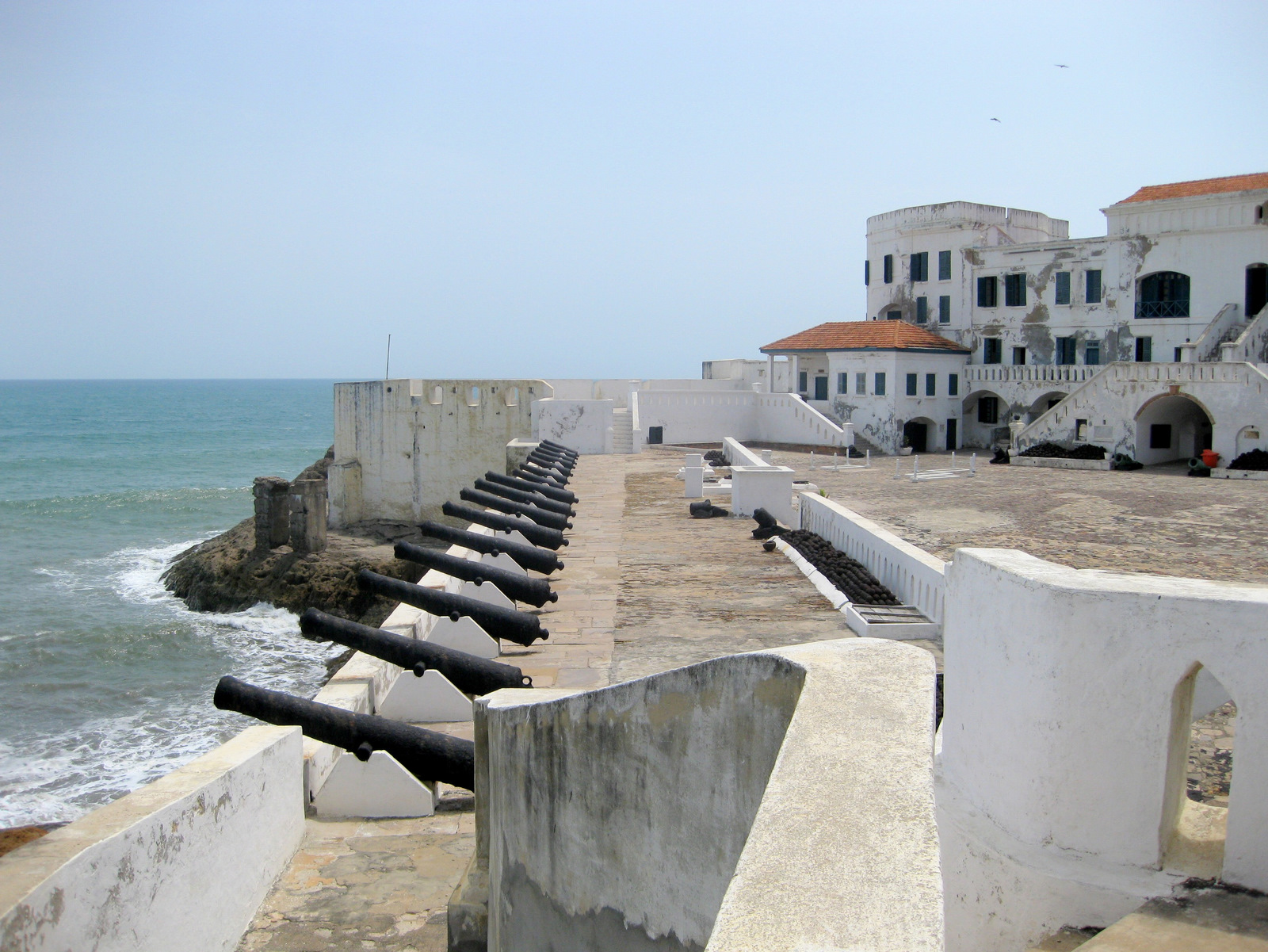
Cape Coast Castle in present-day Ghana was a fortified commercial depot in the Atlantic slave-trading system. European merchants bought captive Africans, confined them in crowded dungeons and transferred them through the “Door of No Return” to ships bound chiefly for the Americas. Britain controlled the castle from 1664 and made it the headquarters of its Gold Coast possessions in 1665.
The castle was one node in a larger coercive infrastructure: roughly 60 fortified European posts operated on the Gold Coast over several centuries, although commonly cited heritage accounts count about 40 surviving or major “slave castles” and forts. Coastal brokers, African states, European chartered companies, soldiers, shipowners, insurers and plantation interests all participated, but European empires created the transatlantic market, financed its expansion and converted captives into legally tradable property. See the archive’s wider /history, /atrocities and /data collections.
Key takeaways
- Cape Coast Castle was a fortified prison, market and embarkation point connecting Gold Coast captivity to Atlantic plantation slavery.
- Britain seized the castle in 1664, while the Royal African Company controlled it within a crown-backed monopoly after 1672.
- SlaveVoyages estimates 12.52 million African embarkations during 1501–1866, but no reliable figure isolates Cape Coast Castle’s traffic.
- About 1.82 million captives died during the Atlantic crossing, excluding deaths during capture, inland transport and fort confinement.
- Ghana preserves the castle as a memorial, museum and UNESCO-listed site requiring evidence-based interpretation rather than imperial nostalgia.
What happened at Cape Coast Castle
Portuguese traders established Cabo Corso—“Short Cape”—as a trading station in 1555. Swedish merchants built a permanent fort there in 1653, named Carolusborg after King Charles X Gustav. Control passed through Danish, Dutch and local hands before an English fleet seized it in 1664. The Royal African Company administered it from 1672; the African Company of Merchants assumed responsibility in 1750. Britain abolished its slave trade in 1807, but retained Cape Coast Castle as a colonial administrative center until 1877.
| Year | Event | Institution or power |
|---|---|---|
| 1555 | Portuguese trading post established at Cabo Corso | Portugal |
| 1653 | Permanent Carolusborg fort constructed | Swedish Africa Company |
| 1664 | English forces capture the fort | English Crown interests |
| 1672 | Chartered monopoly begins operating | Royal African Company |
| 1750 | Castle passes to a successor company | African Company of Merchants |
| 1807 | British participation in the trade becomes illegal | Slave Trade Act 1807 |
| 1877 | Gold Coast capital moves from Cape Coast to Accra | British colonial government |
| 1957 | Ghana achieves independence | State of Ghana |
The mechanism: capture, confinement and shipment
Cape Coast Castle did not operate in isolation. Warfare, raiding, kidnapping, judicial enslavement and debt supplied captives from the coast and interior. African merchants and political authorities conveyed prisoners through inland markets to European forts. Europeans supplied trade goods and Atlantic shipping, imposed racial property law in their colonies and generated sustained plantation demand.
The castle’s architecture organized people as cargo. Men and women were separated in underground chambers, guarded and inspected; traders negotiated prices above them. Captives selected for export were branded in parts of the wider trade, moved through the seaward gate, loaded into boats and taken to offshore vessels. Water shortages, disease, violence and inadequate sanitation made confinement lethal, although no reliable castle-specific death register survives.
- Captives were seized or sold through inland and coastal networks.
- Brokers transported them to Gold Coast markets and forts.
- Company officers exchanged textiles, metals, firearms, alcohol and cowries for people.
- Guards confined captives until a ship and commercially acceptable group were available.
- Boats carried captives through the surf to slave ships.
- Survivors were sold in Atlantic plantation societies under hereditary racial slavery.
“The stench of the hold while we were on the coast was so intolerably loathsome, that it was dangerous to remain there for any time.” — Olaudah Equiano, 1789, The Interesting Narrative of the Life of Olaudah Equiano.
The numbers: what can and cannot be counted
No defensible total exists for people exported specifically through Cape Coast Castle. Claims that assign millions to this single building generally lack surviving voyage-level evidence and risk confusing the castle with the entire Gold Coast. The best quantitative framework is the SlaveVoyages database: its 2019 estimates indicate approximately 12.52 million Africans embarked across the Atlantic between 1501 and 1866, with about 10.70 million disembarking alive—a Middle Passage loss near 1.82 million, or 14.5%.
| Measure | Years | Estimate | Source or basis |
|---|---|---|---|
| Africans embarked in the transatlantic trade | 1501–1866 | about 12.52 million | SlaveVoyages estimates, 2019 release |
| Africans landed alive | 1501–1866 | about 10.70 million | SlaveVoyages estimates, 2019 release |
| Deaths during Atlantic crossing | 1501–1866 | about 1.82 million | Difference between SlaveVoyages estimates |
| Embarked from the Gold Coast region | 1501–1866 | roughly 1.2 million | SlaveVoyages regional estimates; boundaries and missing voyages create uncertainty |
| Recorded Royal African Company captives embarked | 1672–1713 | about 150,000 | Company records synthesized by historian K. G. Davies, 1957 |
Gold Coast totals cover multiple ports—not Cape Coast alone—and exclude people killed during capture, marches or confinement. Historians also disagree over the regional total because voyage records are incomplete and embarkation-zone boundaries vary; published database revisions should therefore be treated as ranges rather than exact censuses.
Key facts
- Cape Coast Castle became an English possession in 1664 and a British headquarters in 1665.
- Approximately 12.52 million captives embarked from Africa between 1501 and 1866, according to SlaveVoyages’ 2019 estimates.
- Approximately 10.70 million reached the Americas alive; about 1.82 million died during the crossing.
- The Gold Coast embarkation region accounts for roughly 1.2 million people, but no sound castle-only total exists.
- Britain prohibited its subjects’ slave trade in 1807, decades before abolishing colonial slavery in 1833–1838.
Who profited
Profit moved through a chain rather than remaining at the castle. African rulers and merchants received imported goods; European companies collected commissions and monopoly returns; shipowners, captains, provisioners and insurers earned fees; plantation owners extracted unpaid labor; metropolitan merchants financed crops and re-exported sugar, tobacco, cotton, coffee and rum.
The Royal African Company was founded in 1672 under Charles II, with his brother James, Duke of York, as governor. Its monopoly joined royal power to private capital. Gold Coast purchases commonly involved textiles, iron and brass goods, firearms, gunpowder, alcohol and currencies such as cowries. Exact Cape Coast revenues are fragmentary and cannot responsibly be converted into a single profit figure.
| Commercial measure | Years | Figure | Qualification |
|---|---|---|---|
| Royal African Company captives transported | 1672–1689 | about 90,000–100,000 | Range reported from company-era records by modern historians |
| Royal African Company captives transported | 1672–1713 | about 150,000 | K. G. Davies, 1957; empire-wide, not Cape Coast-only |
| Estimated Atlantic embarkations | 1501–1866 | 12.52 million people | SlaveVoyages, 2019; people were treated as commercial units |
| Estimated Atlantic arrivals | 1501–1866 | 10.70 million people | SlaveVoyages, 2019 |
Cape Coast’s accounts cannot be read as neutral business records: every “piece,” price and loss represented a person subjected to sale, confinement and forced removal.
Resistance, refusal and abolition
Resistance occurred throughout the system: people fled captors, attacked escorts, refused food, damaged ships, preserved languages and spiritual practices, and rebelled at sea and in the Americas. Because company records prioritized inventory and discipline, many acts survive only as punishments, “losses” or complaints.
Gold Coast politics also constrained European power. Forts depended on African food supplies, brokers, military alliances and permission from local authorities; Europeans did not simply control the interior. That dependence does not erase collaboration or responsibility. It identifies the actual mechanism: unequal but negotiated coastal commerce feeding a European-built oceanic market and American plantation regimes.
Abolition resulted from sustained Black resistance and organized campaigning, not imperial benevolence. Ottobah Cugoano, born in the Gold Coast region and enslaved as a child, demanded abolition in his 1787 Thoughts and Sentiments on the Evil of Slavery. Britain’s Slave Trade Act received royal assent on March 25, 1807; the Slavery Abolition Act received assent on August 28, 1833, with emancipation beginning on August 1, 1834 and apprenticeship largely ending in 1838. British taxpayers compensated slave owners with £20 million in 1835—about 40% of government expenditure that year—while formerly enslaved people received nothing.
Denial, memory and what the castle means now
Cape Coast Castle became a Ghanaian national monument after independence in 1957 and forms part of UNESCO’s Forts and Castles, Volta, Greater Accra, Central and Western Regions, inscribed in 1979. It is now a museum, memorial and pilgrimage site, especially for African-descended visitors.
Public memory requires precision. Calling the building merely a “trading post” obscures that humans were traded there. Presenting European and African participation as equivalent obscures control over Atlantic shipping, colonial slave law, plantation demand and accumulated imperial capital. Conversely, attributing every Gold Coast embarkation to Cape Coast Castle inflates what the evidence can prove.
The castle matters now because wealth and inequality outlived legal abolition. Profits, commodities, ports, financial institutions and family fortunes linked Britain and other Atlantic powers to slavery, while colonized societies inherited violent borders and extractive economies. Responsible commemoration pairs the physical dungeons with voyage data, company records, African political history and descendant testimony. The relevant task is neither patriotic absolution nor spectacle, but documented accountability.
Sources & further reading
- SlaveVoyages: Trans-Atlantic Slave Trade Database
- UNESCO: Forts and Castles, Volta, Greater Accra, Central and Western Regions
- Encyclopaedia Britannica: Cape Coast Castle
- University College London: Legacies of British Slavery
- British Library: The transatlantic slave trade
- Smithsonian National Museum of African American History and Culture: The Door of No Return
Frequently asked questions
- How many enslaved Africans passed through Cape Coast Castle?
- No reliable surviving register provides a castle-only total. SlaveVoyages estimates that roughly 1.2 million captives embarked from the wider Gold Coast region between 1501 and 1866, but that region contained several ports and forts. Any claim that millions passed specifically through Cape Coast Castle should be treated cautiously unless supported by voyage-level records.
- Who built Cape Coast Castle?
- Portuguese traders established a post at Cabo Corso in 1555. The Swedish Africa Company built a permanent fort, Carolusborg, in 1653. After several changes of control, England captured it in 1664. The Royal African Company, chartered by Charles II in 1672, expanded and operated it within England’s slave-trading infrastructure.
- What happened inside Cape Coast Castle’s dungeons?
- Captive men and women were separated, guarded and held in poorly ventilated underground chambers while merchants arranged purchases and shipping. Prisoners faced crowding, insufficient water, disease and violence. Those selected for export were taken through the seaward gate to boats and then slave ships. No complete mortality register survives for the castle.
- When did Cape Coast Castle stop participating in the slave trade?
- Britain’s Slave Trade Act received royal assent on March 25, 1807, making British participation in the trade illegal from 1807. Smuggling continued elsewhere, and slavery itself remained legal across much of the British Empire until the Slavery Abolition Act of 1833 initiated emancipation on August 1, 1834, followed by apprenticeship through 1838.
- Why is Cape Coast Castle important today?
- Cape Coast Castle preserves physical evidence of the commercial machinery behind Atlantic slavery. Ghana gained independence in 1957, and UNESCO listed the associated Ghanaian forts and castles in 1979. Today the site serves as a museum, memorial and diaspora pilgrimage destination, linking documented histories of capture and shipment to continuing debates about colonial wealth, racism, restitution and reparations.
Related chapters
Topics
- Aimé Césaire and Discourse on Colonialism
- Algerian War of Independence and French Torture
- South African Apartheid: The Legal Architecture of Racism
- Atlantic Slave Trade: Scale, Profits and Resistance
- Banda massacre and the Dutch nutmeg monopoly
- Belgian Congo: From Leopold’s Atrocities to Colonial Rule
- The 1943 Bengal Famine and British Policy
- Benin Bronzes: Looting, Trade and Restitution
- Berlin Conference and the Partition of Africa
Sources & further reading
CC BY 4.0 ·