Force Publique and Rubber Terror in the Congo
How Leopold II's Force Publique enforced Congo rubber quotas through hostage-taking, killing and mutilation—and how Belgium profited and denied it.
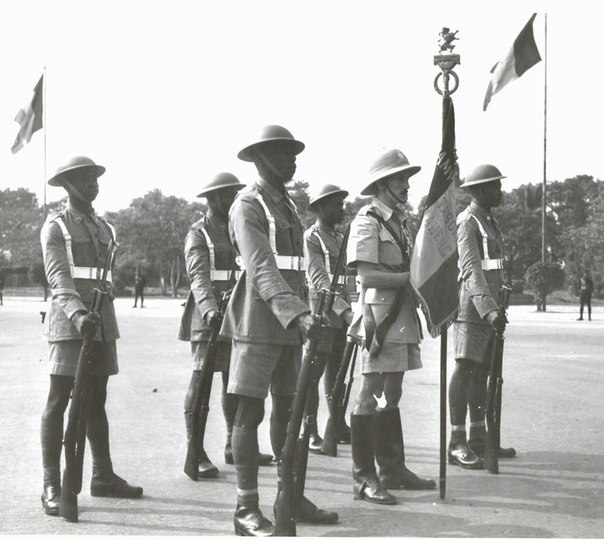
The Force Publique was the colonial army that imposed King Leopold II's rule in the Congo Free State from 1885 to 1908 and Belgian rule thereafter until 1960. During the rubber boom, its European officers and African soldiers enforced quotas through armed raids, hostage-taking, flogging, village destruction, killing and mutilation. The system converted Congolese lives and labor into private revenue.
No census recorded the full human cost. Historian Adam Hochschild popularized an estimate of roughly 10 million excess deaths between 1880 and 1920; demographers and historians propose wide ranges because the evidence cannot support a precise total. The absence of an exact count does not make the organized coercion uncertain: state records, missionary testimony, photographs and Congolese accounts establish its machinery in detail.
Key takeaways
- The Force Publique enforced Leopold II's rubber system through quotas, hostages, flogging, village destruction, shootings and documented mutilation from 1885 to 1908.
- Congo Free State rubber exports rose from about 100 tonnes in 1887 to approximately 6,000 tonnes in 1901.
- Population loss between about 1880 and 1920 was likely several million, with commonly cited estimates ranging from 5 million to 10 million.
- Leopold II received at least 50 million Belgian francs from Congo revenues, according to Jules Marchal's archival accounting.
- Belgian annexation in 1908 ended Leopold's personal state but retained colonial rule and the Force Publique until independence in 1960.
What happened: an army built for extraction
Leopold II created the Congo Free State in 1885 after the Berlin Conference of 1884–1885 recognized his claims. It was not initially a Belgian colony but the king's personal state. The Force Publique, founded in 1885, combined white Belgian and other European officers with African rank-and-file soldiers recruited or coerced inside and outside the Congo.
After the state asserted control over supposedly “vacant” land in 1891–1892, it compelled communities to gather wild rubber rather than paying free-market wages. Soldiers and company sentries seized women and children as hostages, burned settlements and punished communities that missed quotas. The chicotte, a whip made from hippopotamus hide, inflicted wounds that could disable or kill.
“The rubber collected costs hundreds of lives, and the scenes I have witnessed… have been of such a character that I cannot forget them.” — George Washington Williams, 1890, An Open Letter to His Serene Majesty Leopold II
| Date | Institution or event | Concrete significance |
|---|---|---|
| 1885 | Congo Free State and Force Publique established | Leopold II acquired control over about 2.3 million km² and created its colonial army |
| 1891–1892 | Domain decrees consolidated | The state claimed uncultivated land and subordinated rubber gathering to concessionary extraction |
| 1892–1894 | Congo–Arab War | Force Publique expansion helped the state seize eastern trade routes and territory |
| 1904 | Congo Reform Association founded | E. D. Morel and Roger Casement organized an international campaign against the regime |
| 1908 | Belgian annexation | Belgium took over the Congo after exposure of Free State atrocities |
| July 1960 | Force Publique renamed | Following independence on 30 June 1960, it became the Armée Nationale Congolaise |
The mechanism of rubber terror
The violence was administrative, not incidental. State agents assigned rubber quotas; concession companies delegated collection to armed posts; sentries raided communities; hostages compelled men to enter forests; and Force Publique patrols punished refusal or shortfalls.
- Officials designated land as state or concession territory.
- Agents imposed rubber or food quotas without freely negotiated contracts.
- Soldiers seized hostages, commonly women and children, until quotas arrived.
- Patrols flogged, shot or mutilated people and burned resisting villages.
- Soldiers had to account for ammunition, often by presenting a severed right hand for each cartridge fired.
The hand system was intended to prove that bullets had killed people rather than been used for hunting or withheld. It instead incentivized mutilation: hands could be cut from corpses or living victims to satisfy ammunition accounts or conceal misuse. Not every amputation followed this procedure, but evidence from the Casement investigation of 1903–1904, missionaries and photographs confirms that the practice occurred.
See the archive's broader guides to colonial history and documented atrocities.
The numbers: profits are clearer than deaths
Congo Free State rubber exports rose from roughly 100 metric tonnes in 1887 to about 6,000 tonnes in 1901, according to trade series reproduced by economic historians; series vary with whether they count Antwerp imports, Free State exports or calendar years. Prices and receipts surged because pneumatic tires and electrical insulation drove global demand.
| Measure | Year or period | Figure and source |
|---|---|---|
| Population loss | c. 1880–1920 | About 10 million in Hochschild's 1998 synthesis; commonly cited scholarly range roughly 5–10 million, but no census permits precision |
| Rubber exports | 1887 | About 100 metric tonnes in Congo Free State trade series |
| Rubber exports | 1901 | About 6,000 metric tonnes in Congo Free State trade series |
| Leopold's documented personal receipts | 1885–1908 | At least 50 million Belgian francs, calculated by Jules Marchal from state and royal records |
| Belgian parliamentary buyout | 1908 | 50 million Belgian francs granted to Leopold II, alongside assumption of Free State debts |
| Commission of Inquiry | 1904–1905 | 3 commissioners appointed in 1904; findings published in 1905 confirmed systemic coercion |
The population collapse combined killings, starvation, disease, falling fertility, forced migration and social disruption. Jean Stengers cautioned that 10 million cannot be treated as a body count; Jan Vansina nevertheless concluded from regional reconstruction that the demographic disaster was enormous. Responsible use of the figure preserves both facts: millions were lost, and exact attribution remains impossible. Consult the archive's data and estimates methodology.
Who profited
Leopold II was the central beneficiary and decision-maker. Historian Jules Marchal traced at least 50 million Belgian francs transferred to the king from Congo revenues between 1885 and 1908; converting that sum into modern currency is method-dependent and should not be presented as a single definitive equivalent. Leopold also directed Congo-derived money into Belgian monuments, estates and urban projects.
Private concession companies received vast territories and relied on state-backed coercion. The Anglo-Belgian India Rubber Company, known as ABIR, operated in the Maringa–Lopori basin; the Société Anversoise du Commerce au Congo operated in the north. Their shareholders and managers profited when rubber receipts exceeded the low costs of armed compulsion.
Belgium formally annexed the territory on 15 November 1908. Annexation ended Leopold's personal state and some notorious practices, but preserved colonial sovereignty, racial hierarchy and compulsory labor in altered forms. The Force Publique remained Belgium's army in the colony for another 52 years, until July 1960.
Congolese resistance and international exposure
Congolese people resisted by fleeing concession zones, hiding rubber, attacking posts, refusing quotas and organizing armed rebellions. Resistance was local and persistent, although fragmented communities faced rifles, hostage-taking and retaliatory destruction. The Batetela rebellions involved Force Publique soldiers and allies between 1895 and 1908; they cannot be reduced to rubber resistance, but exposed the instability of coerced colonial recruitment.
Missionaries including William Henry Sheppard documented destroyed settlements and severed hands. Alice Seeley Harris's photographs from 1904 gave international audiences visual evidence, including the image of Nsala contemplating the severed hand and foot of his daughter. Roger Casement's British government report, published in 1904 after his 1903 investigation, recorded hostage-taking, killings and mutilation.
Casement's 1904 report did not discover the terror; Congolese survivors had already described, resisted and endured it. International campaigning became effective when their testimony entered diplomatic and mass-media networks.
E. D. Morel used shipping records to show the underlying imbalance: the Congo exported valuable rubber and ivory while receiving weapons, ammunition and little ordinary trade. The Congo Reform Association, founded in 1904, helped turn evidence into sustained political pressure.
Denial, memory and what it means now
Leopold's administration denied systemic abuse, attacked witnesses and presented coercion as anti-slavery, civilization and development. In 1904, international pressure forced the king to appoint a three-member Commission of Inquiry. Its 1905 report confirmed hostage-taking, forced labor and violent abuses, while using the restrained language of an institution created by the accused regime.
The Force Publique's later military record—including campaigns in East Africa during World War I from 1914 to 1918 and against Italy in East Africa during World War II from 1940 to 1941—does not erase its role in colonial domination. At independence in 1960, its officer corps remained entirely white: not one Congolese commissioned officer served in a force of roughly 25,000 men, a frequently cited 1960 figure in histories of the Congo Crisis. The mutiny beginning on 5 July 1960 exposed that engineered exclusion.
Today, the rubber regime matters because it demonstrates how corporate concessions, state violence, racial ideology and distant consumer demand can operate as one extraction system. Debate over statues, museum collections, archives and reparative justice concerns documented transfers of wealth and power, not only historical symbolism. Belgium's King Philippe expressed his “deepest regrets” in 2020 and again acknowledged colonial abuses during his 2022 Congo visit, but issued no formal state apology or comprehensive reparations settlement by 2026.
Sources & further reading
- Roger Casement, Correspondence and Report from His Majesty's Consul at Boma respecting the Administration of the Independent State of the Congo (1904), Internet Archive
- Adam Hochschild, King Leopold's Ghost, publisher page
- Encyclopaedia Britannica, “Congo Free State”
- Royal Museum for Central Africa, colonial history resources
- United Nations Educational, Scientific and Cultural Organization, General History of Africa
- BBC News, Belgium's King Philippe expresses regret for colonial abuses, 2020
Frequently asked questions
- What was the Force Publique in the Congo?
- The Force Publique was the colonial armed force established by Leopold II in 1885 for the Congo Free State. European officers commanded African soldiers recruited or coerced across Central Africa. It conquered territory, enforced labor and rubber quotas, guarded concessions and suppressed resistance. Belgium retained it after annexing the Congo in 1908; it became the Armée Nationale Congolaise in July 1960.
- Why did Force Publique soldiers cut off hands?
- During the rubber regime, soldiers were often required to account for issued cartridges by producing the right hand of a person supposedly killed. The rule was intended to prevent ammunition theft but encouraged mutilation of corpses and living people. Roger Casement's 1904 report and missionary evidence documented the practice. Hands were also used to terrorize communities and falsify ammunition accounts.
- How many people died under Leopold II in the Congo?
- No reliable census existed for 1885–1908, so no exact death toll can be proved. Adam Hochschild's 1998 synthesis popularized an estimated population loss of about 10 million across roughly 1880–1920; historians commonly discuss a broad range of around 5–10 million. This includes deaths and population loss caused by killing, famine, disease, displacement and reduced births.
- How much rubber did the Congo Free State export?
- Trade series used by economic historians indicate that Congo Free State rubber exports grew from roughly 100 metric tonnes in 1887 to about 6,000 tonnes in 1901. Exact annual totals vary by series and accounting basis. The increase followed global demand for bicycle and automobile tires and was achieved through concessionary rule, compulsory gathering and Force Publique violence.
- Did Belgian rule end the Congo's forced labor system in 1908?
- Belgium annexed Leopold II's Congo Free State on 15 November 1908 and curtailed several internationally notorious abuses. It did not end coercive colonial extraction. Compulsory cultivation, labor recruitment, racial segregation and political exclusion continued in new legal and administrative forms. The Force Publique remained the colonial army for 52 more years, until Congo's independence in 1960.
Related chapters
Topics
- Aimé Césaire and Discourse on Colonialism
- Algerian War of Independence and French Torture
- South African Apartheid: The Legal Architecture of Racism
- Atlantic Slave Trade: Scale, Profits and Resistance
- Banda massacre and the Dutch nutmeg monopoly
- Belgian Congo: From Leopold’s Atrocities to Colonial Rule
- The 1943 Bengal Famine and British Policy
- Benin Bronzes: Looting, Trade and Restitution
- Berlin Conference and the Partition of Africa
Sources & further reading
CC BY 4.0 ·