The Haitian Revolution and the Price of Freedom
How enslaved people destroyed French rule in Haiti, abolished slavery, defeated Napoleon and were forced to pay France for independence.
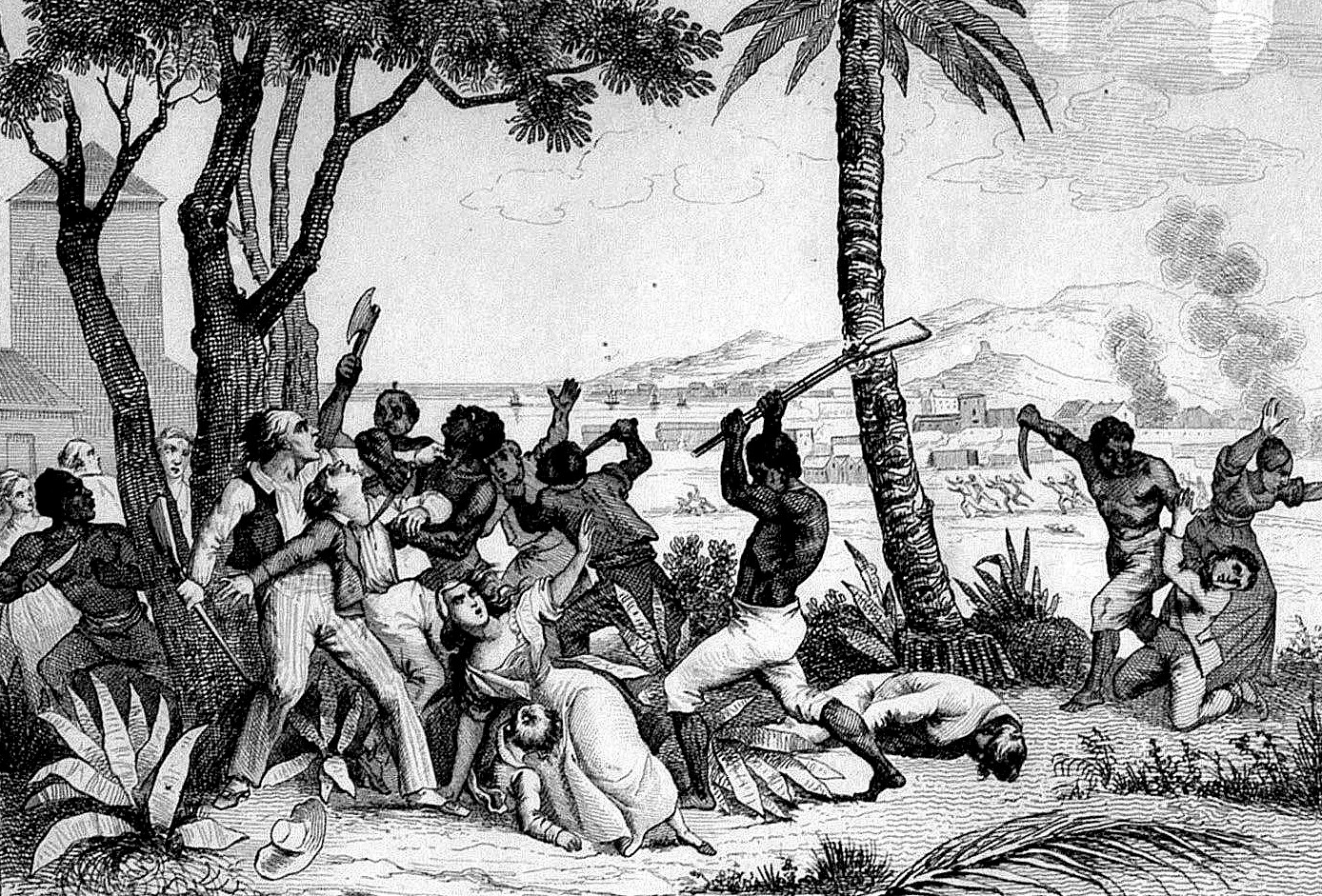
The Haitian Revolution (1791–1804) destroyed slavery and French colonial rule in Saint-Domingue, created Haiti and permanently altered the Atlantic world. Enslaved Africans and their descendants defeated local planters, invading British and Spanish forces, and Napoleon Bonaparte’s expedition—the army of Europe’s most powerful state.
Victory did not end imperial punishment. In 1825, French warships forced Haiti to accept a 150 million-franc indemnity compensating former enslavers for lost land and people. Reduced to 90 million francs in 1838, the principal and associated loans burdened Haiti until 1888; Haiti’s government made its final related French bank payment in 1947. This hub connects the revolution to the archive’s wider history, documented atrocities and comparative data.
Key takeaways
- The 1791–1804 Haitian Revolution was the only mass slave uprising to abolish slavery and establish a durable independent state.
- Napoleon’s 1802 expedition failed after Haitian resistance and disease killed an estimated 40,000–50,000 French expeditionary personnel.
- France used 528 cannon in 1825 to enforce a 150 million-franc indemnity benefiting former colonists and their heirs.
- The 1838 settlement lowered the stipulated indemnity total to 90 million francs but preserved Haiti’s dependence on French creditors.
- Haiti’s revolutionary victory transformed Atlantic politics, while diplomatic isolation, coerced debt and foreign intervention constrained the new state.
What happened: from plantation colony to independent Haiti
France’s Saint-Domingue was an exceptionally profitable plantation colony built on coerced African labor. In 1789, it held roughly 500,000 enslaved people, about 30,000 whites and approximately 25,000–30,000 free people of color; contemporary counts vary because registration was incomplete. The colony produced about 40% of the sugar and 60% of the coffee entering European markets, according to Laurent Dubois’s synthesis of late-1780s trade data.
A mass uprising began in the northern plain in August 1791. France’s civil commissioners Léger-Félicité Sonthonax and Étienne Polverel proclaimed emancipation in 1793; the National Convention abolished slavery throughout the French colonies on 4 February 1794. Toussaint Louverture then consolidated power, defeated rival forces and issued the authoritarian Constitution of 1801. Napoleon sent a force under Charles Leclerc in 1802 to restore metropolitan control. French troops deported Louverture, who died at Fort de Joux on 7 April 1803.
Jean-Jacques Dessalines led renewed resistance after France restored slavery in Guadeloupe in 1802 and its intentions became unmistakable. Haitian forces defeated Rochambeau at Vertières on 18 November 1803. Dessalines declared independence on 1 January 1804.
| Date | Event | Consequence |
|---|---|---|
| 14 August 1791 | Bois Caïman gathering, traditionally associated with Dutty Boukman and Cécile Fatiman | Organizing preceded the northern uprising |
| 22–23 August 1791 | Plantation revolt spreads across the north | Hundreds of estates attacked; colonial rule destabilized |
| 4 February 1794 | French National Convention abolishes colonial slavery | Emancipation receives metropolitan law |
| 20 May 1802 | Napoleon’s law maintains slavery where it still operated | Confirms the regime’s retreat from universal emancipation |
| 18 November 1803 | Battle of Vertières | French expedition decisively defeated |
| 1 January 1804 | Haitian independence declared | First sovereign state created by a victorious slave revolution |
The mechanism: slavery, war and coerced debt
Saint-Domingue’s wealth rested on forced labor, racial law, violence and continuous importation. High mortality made enslaved workers replaceable inputs in plantation accounting: the transatlantic slave-trade database records about 773,000 captives disembarked in Saint-Domingue from 1660 to 1791, with approximately 685,000 arriving from 1767 through 1791.
The post-independence mechanism changed from direct enslavement to financial coercion:
- In April 1825, King Charles X dispatched a squadron carrying 528 cannon and demanded an indemnity of 150 million gold francs.
- President Jean-Pierre Boyer accepted the ordinance on 3 July 1825 under threat of force; France recognized Haiti while compensating former colonists for property, including people they had claimed as property.
- Haiti borrowed 30 million francs from French banks in 1825 to make the first installment, but fees left only 24 million available.
- A treaty signed on 12 February 1838 reduced the unpaid principal to 60 million francs, making total stipulated indemnity payments 90 million francs.
- Debt service redirected customs revenue to French creditors; later refinancing extended related payments into the 20th century.
“The indemnity that we demand will be only a feeble compensation for the losses which the colonists have suffered.” — Baron de Mackau, instructions presented with Charles X’s ordinance, 1825.
The numbers: people, production and loss
Revolutionary mortality cannot be reduced to one secure total. Laurent Dubois reports that warfare from 1791 to 1804 killed roughly 100,000–200,000 Black people and about 24,000–25,000 whites. French military losses in the 1802–1803 expedition are commonly estimated at 40,000–50,000, overwhelmingly from yellow fever and other disease as well as combat. Philippe Girard estimates approximately 5,000 whites were killed in Dessalines’s 1804 massacres; other modern accounts give about 3,000–5,000.
| Measure | Year or period | Figure and source |
|---|---|---|
| Enslaved population | 1789 | About 500,000; Dubois and Geggus syntheses |
| Sugar exported | 1789 | About 77,000 metric tonnes; compiled French colonial trade returns |
| Coffee exported | 1789 | About 34,000 metric tonnes; compiled French colonial trade returns |
| Black deaths in revolutionary warfare | 1791–1804 | Roughly 100,000–200,000; Laurent Dubois |
| White deaths in revolutionary warfare | 1791–1804 | About 24,000–25,000; Laurent Dubois |
| French expeditionary deaths | 1802–1803 | About 40,000–50,000; range used by Dubois and Philippe Girard |
| Victims of Dessalines’s massacres | 1804 | About 3,000–5,000; modern scholarly range, with Girard near 5,000 |
These categories overlap: French expeditionary deaths form part of broader white wartime mortality, so they must not be added mechanically. See the archive’s data methodology for handling uncertain and overlapping estimates.
Who profited, and who paid
French merchants, shipowners, insurers, refiners and plantation proprietors accumulated returns from Saint-Domingue’s sugar, coffee, indigo and slave trade before 1791. Bordeaux, Nantes, Le Havre and Marseille were major beneficiaries. After 1825, former colonists and their heirs submitted claims to France’s indemnity commission; 12,000-plus approved claimant files distributed payments among property owners rather than survivors of slavery.
French banks also profited through commissions, interest and refinancing. The New York Times calculated in 2022 that Haiti paid about 112 million francs in indemnity and loan charges to France between 1825 and 1888, equivalent to roughly US$560 million in 2022 values; using foregone-growth scenarios, its journalists estimated losses to Haiti of US$21–115 billion by 2022. Those are modeled opportunity costs, not a settled reparations valuation.
Haiti’s payment was “a ransom” imposed upon a country whose independence had already been won. — Thomas Madiou, Histoire d’Haïti, volumes published 1847–1848.
Key facts
- Haiti abolished slavery through revolution, not through a gift from France.
- France demanded 150 million francs in 1825 and reduced the stipulated total to 90 million francs in 1838.
- The indemnity rewarded former enslavers while Haiti’s citizens received no compensation for generations of captivity.
- Customs receipts and export earnings serviced foreign creditors instead of infrastructure, education and public health.
- The payment system reinforced Haiti’s diplomatic isolation and dependence on overseas lenders.
Resistance, repression and revolutionary limits
Resistance ranged from marronage and poisoning to organized plantation revolt, military campaigning and constitutional state-building. Named leaders included Boukman, Fatiman, Louverture, Dessalines, Henri Christophe, Alexandre Pétion and Sanité Bélair. Enslaved field workers—not only generals and free elites—made emancipation irreversible by leaving plantations, taking weapons and refusing re-enslavement.
The revolution also contained civil war, coercive labor regimes and atrocities. Louverture and Dessalines sought export production through compulsory plantation labor. The 1799–1800 War of Knives pitted Louverture’s northern forces against André Rigaud’s southern government. In 1802–1803, French troops used executions, drownings, attack dogs and mass detention. In early 1804, Dessalines ordered the killing of most remaining French whites, with estimated deaths of 3,000–5,000. Naming these crimes does not erase the initiating system: France had enslaved hundreds of thousands and launched a 1802 war to recover colonial domination.
Denial, memory and what it means now
European and US elites treated independent Haiti as a threat because it proved enslaved people could overthrow racial slavery. France withheld recognition until 1825; the United States recognized Haiti only on 5 June 1862, during the Civil War, 58 years after independence. Plantation societies circulated racist portrayals of Haitian violence while minimizing slavery’s routine killing and Napoleon’s restoration project.
Haiti formally demanded restitution in 2003, when President Jean-Bertrand Aristide sought US$21,685,135,571.48, a government calculation for the indemnity plus interest as of 2003. France rejected the demand. In 2015, President François Hollande acknowledged a “moral debt” but explicitly denied a financial obligation. Debate now concerns restitution, archival transparency and the measurable effects of extracted capital—not whether slavery-generated claims were just.
The revolution’s meaning is direct: universal liberty became real because Black insurgents forced states that proclaimed rights to confront their exclusions. Haiti’s later poverty was not evidence of Black incapacity. It developed under diplomatic quarantine, coerced indemnity, foreign debt, occupations—including the US occupation from 1915 to 1934—and repeated external interference documented across the archive’s history of colonial power and atrocity records.
Sources & further reading
- Laurent Dubois, Avengers of the New World (Harvard University Press)
- David Geggus, Haitian Revolutionary Studies (Indiana University Press)
- SlaveVoyages: Trans-Atlantic Slave Trade Database
- The New York Times, “The Ransom” investigation (2022)
- French National Archives: indemnity records for former Saint-Domingue colonists
- Library of Congress, Haiti country study and historical collections
Frequently asked questions
- What caused the Haitian Revolution?
- The revolution grew from Saint-Domingue’s violent plantation order, where about 500,000 enslaved people labored in 1789, alongside conflict among white colonists, free people of color and imperial officials. France’s 1789 Revolution destabilized authority, but enslaved people made emancipation through the northern uprising of August 1791 and sustained warfare against French, British, Spanish and planter forces.
- Who led the Haitian Revolution?
- No single leader controlled the entire revolution from 1791 to 1804. Dutty Boukman and Cécile Fatiman are associated with its opening mobilization; Toussaint Louverture became its dominant general and governor; Jean-Jacques Dessalines led the final war against Napoleon’s forces. Henri Christophe, Alexandre Pétion, André Rigaud, Sanité Bélair and thousands of unnamed combatants also shaped the outcome.
- How many people died in the Haitian Revolution?
- Exact totals are unavailable and categories overlap. Historian Laurent Dubois gives roughly 100,000–200,000 Black deaths and about 24,000–25,000 white deaths during 1791–1804. The 1802–1803 French expedition lost an estimated 40,000–50,000 personnel, largely to yellow fever. Dessalines’s 1804 massacres killed approximately 3,000–5,000 whites, according to the modern scholarly range.
- Why did Haiti pay France for independence?
- France threatened renewed war. In April 1825, Charles X sent warships carrying 528 cannon and demanded 150 million gold francs in return for recognition. President Jean-Pierre Boyer accepted on 3 July 1825. The 1838 treaty lowered the stipulated total to 90 million francs, but loans, fees and interest transferred Haitian customs revenue to former colonists and French financiers.
- When did Haiti finish paying the French independence debt?
- The original indemnity and connected French loans should be distinguished. The New York Times reconstruction found approximately 112 million francs paid to France from 1825 through 1888. Later refinancing shifted obligations among creditors, and Haiti made its final related payment to France’s National City Bank-linked debt structure in 1947—122 years after Charles X imposed the indemnity.
Related chapters
Topics
- Aimé Césaire and Discourse on Colonialism
- Algerian War of Independence and French Torture
- South African Apartheid: The Legal Architecture of Racism
- Atlantic Slave Trade: Scale, Profits and Resistance
- Banda massacre and the Dutch nutmeg monopoly
- Belgian Congo: From Leopold’s Atrocities to Colonial Rule
- The 1943 Bengal Famine and British Policy
- Benin Bronzes: Looting, Trade and Restitution
- Berlin Conference and the Partition of Africa
Sources & further reading
CC BY 4.0 ·