Herero and Nama Genocide in German South-West Africa
Evidence-led guide to Germany’s 1904–08 genocide of the Herero and Nama: extermination orders, death tolls, forced labor, profit and memory.
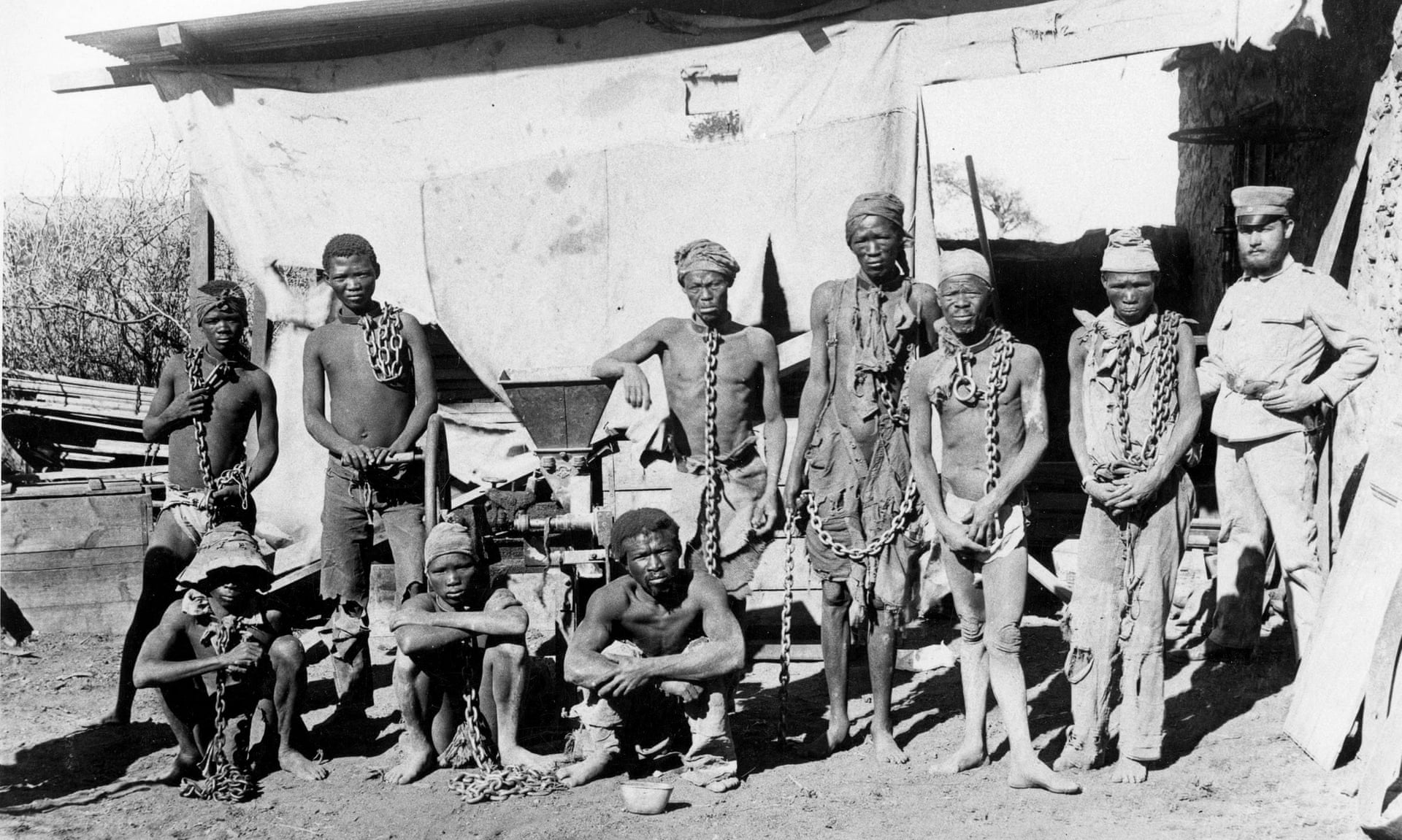
The Herero and Nama genocide was the German Empire’s destruction of Indigenous societies in German South-West Africa, present-day Namibia, from 1904 to 1908. Colonial troops expelled Herero people into the Omaheke, poisoned or guarded water sources, issued an extermination order, and later confined surviving Herero and Nama in lethal concentration camps and forced-labor compounds.
Germany formally recognized the events as genocide in 2021. The violence killed approximately 65,000 Herero and 10,000 Nama according to Germany and Namibia’s 2021 Joint Declaration; a wider, frequently cited range is 40,000–80,000 Herero and about 10,000 Nama. This hub connects the case to the archive’s wider records of colonial history, mass atrocities, and contested demographic data.
Key takeaways
- German forces used battlefield defeat, desert expulsion, extermination orders, concentration camps and forced labor to destroy Herero and Nama societies between 1904 and 1908.
- The 2021 Joint Declaration estimated 65,000 Herero and 10,000 Nama deaths, while published Herero estimates range from 40,000 to 80,000.
- Settlers, colonial employers and railway and mining interests benefited from confiscated land, cattle, pass laws and coerced prisoner labor.
- Herero and Nama forces resisted under Samuel Maharero, Hendrik Witbooi, Jakob Marengo and other leaders despite overwhelming German military power.
- Germany recognized the genocide in 2021, but affected communities dispute a €1.1 billion development package negotiated without their direct authority.
What happened: conquest, expulsion and confinement
Germany proclaimed the colony in 1884, appropriating land through coercive treaties, debt and settler expansion. In January 1904, Herero forces rose against colonial rule. Lieutenant General Lothar von Trotha replaced Governor Theodor Leutwein as military commander and defeated Herero fighters at the Battle of Waterberg on 11 August 1904. German cordons drove families east toward the water-scarce Omaheke.
“Within the German boundaries every Herero, whether found armed or unarmed, with or without cattle, will be shot.” — Lothar von Trotha, Extermination Order, 2 October 1904.
Berlin rescinded that order in December 1904, but not the destructive system. Survivors were imprisoned at places including Shark Island, Swakopmund and Windhoek. Following Nama resistance under leaders such as Hendrik Witbooi and Jakob Marengo, Nama prisoners entered the same regime. In camps operating principally from 1904 to 1908, hunger, exposure, disease, beatings, executions and forced labor killed prisoners.
- Dispossession: colonial law and settlers took land, cattle and political autonomy.
- Military encirclement: troops defeated Herero forces at Waterberg in August 1904.
- Desert expulsion: patrols blocked return routes and access to water in late 1904.
- Concentration camps: surrendered and captured people were registered, confined and hired out from 1904 to 1908.
- Forced labor: prisoners built railways, worked docks and served settler, military and company interests.
The numbers: populations and deaths
No complete colonial register exists, and wartime displacement makes exact counting impossible. The often-repeated baseline comes from the German colonial census tradition: approximately 80,000 Herero before the war and 15,130 counted in 1911; approximately 20,000 Nama before the war and 9,781 counted in 1911. These comparisons imply catastrophic loss but combine deaths, refugees and census uncertainty.
| Population | Prewar estimate | Count or estimate after war | Death estimate | Source and year of estimate |
|---|---|---|---|---|
| Herero | 80,000 in 1904 | 15,130 in 1911 | 65,000 | Germany–Namibia Joint Declaration, 2021 |
| Herero | 80,000 in 1904 | — | 40,000–80,000 | Scholarly range summarized by Encyclopaedia Britannica, 2024 |
| Nama | 20,000 in 1904 | 9,781 in 1911 | 10,000 | Germany–Namibia Joint Declaration, 2021 |
| Shark Island prisoners | — | — | 1,032–3,000 during 1905–07 | Casper Erichsen, 2005; range reflects incomplete records |
Key facts
- The genocide occurred between 1904 and 1908 under German imperial rule.
- The 2021 German–Namibian declaration cited 65,000 Herero deaths and 10,000 Nama deaths.
- The broader published Herero estimate ranges from 40,000 to 80,000 deaths.
- Shark Island’s documented toll is incomplete; historians estimate 1,032–3,000 deaths during 1905–07.
Who profited from dispossession and forced labor
German settlers, the colonial state, shipping interests, railway contractors and mining companies benefited from seized land and coerced workers. By 1907, colonial ordinances required Africans to carry identification passes and restricted landholding, movement and cattle ownership. Confiscated Herero and Nama territory was redistributed to white settlers and concessionary companies.
| Beneficiary or system | Concrete measure | Date | Material consequence |
|---|---|---|---|
| German settlers | Indigenous land and cattle confiscated | 1904–07 | Expansion of settler farms after surviving communities lost independent economic bases |
| Otavi Mining and Railway Company | Otavi–Swakopmund railway | 1903–06 | Approximately 567 km completed by 1906, serving copper exports |
| Colonial employers | Pass and labor controls | 1907 | Africans compelled into a regulated wage-labor market |
| German colonial administration | Prisoner hiring | 1905–08 | Camp inmates supplied to railways, docks, farms and military projects |
Prisoners were issued numbered neck tags and hired to employers. Women and children also performed labor while receiving inadequate food and shelter. Bodies became colonial assets after death: doctors and collectors sent human remains to German institutions for racial research. Eugen Fischer studied prisoners at Shark Island in 1908; his racial theories later influenced German eugenics.
The camps converted military captives into a controlled labor force while settler society absorbed the land and cattle from which those captives had been expelled.
Resistance and colonial repression
Herero resistance began under Paramount Chief Samuel Maharero in January 1904 after years of land loss, debt manipulation and violence. Initial orders sought to spare women, children, missionaries and non-German Europeans, contradicting colonial portrayals of indiscriminate African savagery. After Waterberg, organized Herero resistance fragmented, but survivors crossed deserts and borders to evade German forces.
Nama leaders launched or renewed guerrilla war in October 1904. Hendrik Witbooi, already a veteran opponent of German expansion, was killed in combat on 29 October 1905. Jakob Marengo led a mobile campaign across southern Namibia and the Cape border until colonial forces killed him on 20 September 1907. Cornelius Fredericks surrendered in March 1906 and died at Shark Island on 16 February 1907.
German repression relied on approximately 14,000 troops at the campaign’s peak in 1905, according to military histories synthesized by Isabel V. Hull in 2005. The colony’s war cost the German state roughly 585 million marks by 1909, Hull reports, showing that exterminatory warfare was pursued despite immense public expense.
Denial, recognition and contested repair
German colonial accounts framed mass death as punishment for rebellion or as desert misfortune. For decades, official commemoration centered German soldiers while Herero and Nama testimony, graves and claims remained marginalized. Namibia became independent from South Africa on 21 March 1990; descendants then intensified demands for recognition, return of remains, land reform and reparations.
In 2004, German development minister Heidemarie Wieczorek-Zeul apologized at Waterberg and acknowledged that the atrocities would now be called genocide. Germany returned human remains in ceremonies in 2011, 2014 and 2018, although institutions still hold remains and provenance work remains incomplete.
Germany and Namibia announced a Joint Declaration in May 2021. Germany recognized genocide and proposed €1.1 billion over 30 years for reconstruction and development programs, not legally defined reparations. Major Herero and Nama representative bodies rejected negotiations that excluded them from direct decision-making and challenged both the amount and the state-to-state framework.
| Recognition milestone | Date | Specific action |
|---|---|---|
| Wieczorek-Zeul speech | 14 August 2004 | German minister apologized and invoked present-day genocide law |
| First major remains handover | 30 September 2011 | Charité transferred 20 skulls to Namibia |
| Joint Declaration announced | 28 May 2021 | Germany recognized genocide and offered €1.1 billion over 30 years |
| Namibian parliamentary debate | 21 September 2021 | Opposition and affected communities challenged the agreement |
What the genocide means now
The genocide links colonial land seizure, racial science, concentration camps and extractive infrastructure. It should not be reduced to a rehearsal for the Holocaust: each crime has its own actors, targets and context. Yet institutional continuities matter, including military doctrines, racial anthropology and personnel moving through imperial networks.
In Namibia, the material legacy is visible in unequal landholding and wealth. The 2018 Namibia Land Statistics report recorded approximately 27.9 million hectares of freehold agricultural land; previously advantaged Namibians owned about 70% of that land in 2018, while previously disadvantaged Namibians owned about 16%. These categories are postcolonial administrative classifications, not direct measures of genocide-era theft, but they expose the durability of settler land structures.
Recognition without affected-community authority leaves the central question unresolved: who decides what repair means? Credible redress requires direct Herero and Nama participation, transparent land and financial data, return of human remains and cultural property, and mechanisms capable of addressing inherited dispossession rather than relabeling ordinary development aid.
Sources & further reading
- Germany–Namibia Joint Declaration, 2021
- United States Holocaust Memorial Museum: Herero and Nama Genocide
- Encyclopaedia Britannica: Herero and Nama genocide
- Isabel V. Hull, Absolute Destruction
- Jürgen Zimmerer and Joachim Zeller, Genocide in German South-West Africa
- Namibia Statistics Agency: Namibia Land Statistics 2018
Frequently asked questions
- What was the Herero and Nama genocide?
- The Herero and Nama genocide was the German Empire’s destruction of Indigenous communities in German South-West Africa from 1904 to 1908. General Lothar von Trotha issued an extermination order on 2 October 1904; troops expelled Herero people into the Omaheke and later confined Herero and Nama survivors in concentration camps, where forced labor, hunger, disease and abuse caused mass death.
- How many Herero and Nama people were killed?
- Germany and Namibia’s 2021 Joint Declaration estimated that 65,000 Herero and 10,000 Nama died between 1904 and 1908. Published Herero estimates range from 40,000 to 80,000, reflecting uncertain prewar populations, displacement and incomplete colonial records. Approximately 1,032–3,000 prisoners died at Shark Island during 1905–07, according to estimates discussed by historian Casper Erichsen.
- Who ordered the extermination of the Herero?
- Lieutenant General Lothar von Trotha issued the written extermination order on 2 October 1904 after the Battle of Waterberg on 11 August 1904. It declared that every Herero found within the colony would be shot. Berlin withdrew the order in December 1904, but imprisonment, forced labor, dispossession and lethal camp conditions continued until 1908 under German imperial authority.
- Did Germany pay reparations for the Herero and Nama genocide?
- Germany’s May 2021 Joint Declaration recognized genocide and proposed €1.1 billion over 30 years for development and reconstruction in Namibia. Germany explicitly treated the sum as development funding rather than legally owed reparations. Major Herero and Nama organizations rejected the arrangement because they lacked direct negotiating power and because the package did not adequately address land, compensation or binding legal responsibility.
- How is the Herero and Nama genocide connected to colonialism today?
- The genocide entrenched land seizure, racialized labor control and settler wealth after 1904. Namibia’s 2018 Land Statistics report found that previously advantaged Namibians owned about 70% of approximately 27.9 million hectares of freehold agricultural land, while previously disadvantaged Namibians owned about 16%. Present disputes concern land reform, restitution, human remains, historical accountability and Herero and Nama authority over reparative policy.
Related chapters
Topics
- Aimé Césaire and Discourse on Colonialism
- Algerian War of Independence and French Torture
- South African Apartheid: The Legal Architecture of Racism
- Atlantic Slave Trade: Scale, Profits and Resistance
- Banda massacre and the Dutch nutmeg monopoly
- Belgian Congo: From Leopold’s Atrocities to Colonial Rule
- The 1943 Bengal Famine and British Policy
- Benin Bronzes: Looting, Trade and Restitution
- Berlin Conference and the Partition of Africa
Sources & further reading
CC BY 4.0 ·