Indian Rebellion of 1857 and Its Aftermath
How the 1857–59 Indian rebellion challenged East India Company rule, how Britain retaliated, transferred power and reshaped colonial India.
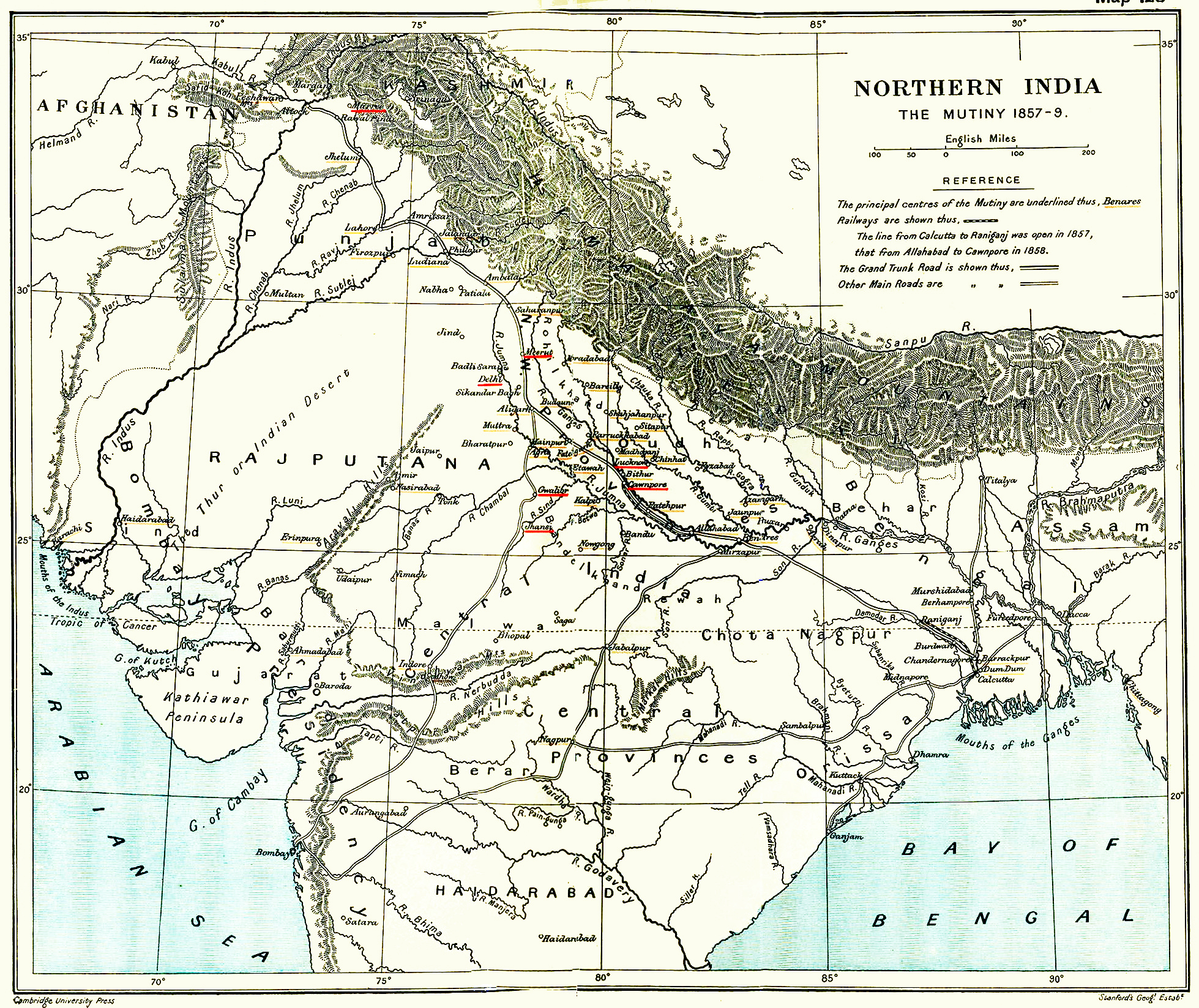
The Indian Rebellion of 1857 was a military mutiny that became a broad, uneven war against the British East India Company. Beginning at Meerut on 10 May 1857, it spread through Delhi, Awadh, Bundelkhand and parts of central and northern India. Rebels restored the Mughal emperor Bahadur Shah II as a symbolic sovereign, while local leaders pursued distinct political, agrarian and dynastic aims.
Britain reconquered the principal rebel centers through siege warfare, collective punishment, executions and village destruction. Gwalior fell on 20 June 1858; Queen Victoria’s proclamation transferred Company territories to the Crown on 1 November 1858; Britain declared peace on 8 July 1859. The conflict ended Company government, not colonial exploitation.
Key takeaways
- The Indian Rebellion began as a sepoy mutiny at Meerut in May 1857 and became a wider anti-Company war.
- British reconquest combined regular warfare with executions, collective punishment, confiscation, urban expulsion and the destruction of suspected rebel villages.
- About 6,000 Europeans died, according to Saul David’s 2002 estimate, while Indian deaths remain incomplete, disputed and systematically under-recorded.
- The 1858 transfer to Crown rule ended East India Company government but preserved colonial taxation, racial hierarchy and Britain-centered extraction.
- Memory remains contested between “mutiny” and “independence war,” labels that each obscure the uprising’s diverse participants, motives and geography.
What happened: revolt, war and reconquest
Company expansion had displaced rulers, landlords and soldiers. Governor-General Lord Dalhousie’s Doctrine of Lapse enabled annexations including Jhansi in 1854; Awadh was annexed separately on 7 February 1856. Revenue demands, disrupted patronage and missionary activity deepened suspicion. The immediate military crisis concerned Pattern 1853 Enfield rifle cartridges rumored to be greased with cow and pig fat, offending Hindu and Muslim troops who had to bite them open.
On 9 May 1857, 85 troopers at Meerut received prison terms for refusing cartridges. Their comrades rebelled on 10 May, killed British officers and civilians, and marched approximately 64 kilometers to Delhi. The uprising combined sepoy mutinies, peasant action, urban revolt and attempts to restore dispossessed authorities; Punjab, Bengal proper and much of southern India did not join it.
- Rebels seized Delhi on 11 May 1857 and proclaimed Bahadur Shah II emperor.
- British forces retook Delhi on 20 September 1857 after a siege lasting from 8 June.
- Lucknow’s British residency was relieved in November 1857; the city was reconquered in March 1858.
- Jhansi fell on 3 April 1858; Rani Lakshmibai died near Gwalior on 18 June.
- Gwalior was recaptured on 20 June 1858; formal peace followed on 8 July 1859.
The numbers: forces, deaths and destruction
No complete casualty register exists. Records privilege European losses, while Indian combatants and civilians were frequently uncounted. Historian Saul David estimated in his 2002 book The Indian Mutiny that about 6,000 Europeans were killed, including civilians. Historian William Dalrymple reported in 2006 that roughly 100,000 people were killed in Delhi during the uprising and British reconquest, an estimate encompassing violence, flight and associated devastation rather than a formal body count. Amaresh Misra’s much larger claim of 10 million Indian deaths over 1857–67, published in 2007, remains unsupported by mainstream demographic scholarship and should not be presented as consensus.
| Measure | Date or period | Figure | Source and qualification |
|---|---|---|---|
| Imprisoned Meerut troopers | 9 May 1857 | 85 | Court-martial record; immediate trigger |
| Bengal Army strength | 1857 | about 139,000 Indian troops and 26,000 Europeans | David Omissi, 1994; rounded establishment figures |
| Bengal Army units that mutinied or disbanded | 1857–58 | 54 of 74 regular infantry regiments | Thomas Metcalf, 1964 |
| Europeans killed | 1857–58 | about 6,000 | Saul David, 2002; soldiers and civilians |
| Delhi deaths | 1857 | about 100,000 | William Dalrymple, 2006; broad estimate, not a census |
| Claimed Indian deaths | 1857–67 | 10 million | Amaresh Misra, 2007; disputed and outside scholarly consensus |
Numerical uncertainty is not evidence of limited violence. It records a colonial system that counted European casualties more systematically than conquered Indians.
See the archive’s comparative atrocity documentation and data methodology for guidance on reading contested tolls.
Who profited and how power changed hands
The East India Company’s shareholders lost direct government, but Britain preserved the conquered territory, tax base and trade. Parliament’s Government of India Act, enacted on 2 August 1858, transferred Company territories and administrative machinery to the Crown. A secretary of state for India, advised by a 15-member council, replaced the Company’s Board of Control and Court of Directors.
| Extraction or transfer | Year | Concrete figure | Beneficiary or consequence |
|---|---|---|---|
| East India Company capital redemption | 1874 | £6 million | British state paid shareholders when the Company was dissolved |
| Indian public debt | 1857–58 to 1860–61 | roughly £59 million to £98 million | Revolt costs shifted heavily onto Indian finances; B. R. Tomlinson, 1993 |
| Secretary of State’s India Council | 1858 | 15 members | Centralized imperial control in London |
| European-to-Indian army ratio | post-1858 target | approximately 1:2 in Bengal; 1:3 in Madras and Bombay | Reduced risk of another sepoy majority revolt |
Reconstruction protected landlords considered loyal, especially in Awadh, and redirected military recruitment toward communities classified by British officials as “martial races,” notably Sikhs, Gurkhas and Punjabis. British manufacturers, shipping interests, investors and officials continued to benefit from Indian revenues and procurement. The public debt increase—approximately £39 million between 1857–58 and 1860–61 in Tomlinson’s series—meant colonized taxpayers financed much of their own reconquest.
Resistance and British retaliation
Resistance had no single command. Nana Sahib led at Kanpur; Begum Hazrat Mahal defended the claim of her son Birjis Qadr in Awadh; Rani Lakshmibai fought in Jhansi and Gwalior; Kunwar Singh mobilized in Bihar; Tantia Tope continued guerrilla operations until his capture and execution on 18 April 1859. Bahadur Shah II’s authority was largely symbolic, but Delhi gave the revolt an imperial center.
British troops, Company loyalists and allied Indian rulers conducted exemplary punishment: prisoners were shot, hanged or blown from cannon; suspected villages were burned; property was confiscated. After retaking Delhi in September 1857, troops expelled much of its population and looted the city. In Awadh, Governor-General Lord Canning’s proclamation of 3 March 1858 confiscated proprietary rights across most of the province, subject to later grants for loyalty.
“The Government of the British Raj has come to an end.” — Bahadur Shah II, proclamation attributed to the Delhi court, 25 August 1857.
Rebel forces also killed noncombatants, most notoriously at Kanpur’s Bibighar in July 1857, where approximately 200 British women and children were murdered according to contemporary British counts. Britain used those deaths to authorize and celebrate reprisals on a much greater territorial scale. Naming rebel atrocities does not equalize a local massacre with a state reconquest backed by imperial armies, collective punishment and confiscation.
Denial, memory and the rebellion’s meaning now
British imperial culture called the conflict the “Indian Mutiny,” narrowing a heterogeneous uprising to military indiscipline and centering British suffering. Indian nationalist memory later popularized “First War of Independence,” a phrase associated especially with V. D. Savarkar’s 1909 history. Neither label fully describes a conflict that was simultaneously mutiny, civil war, agrarian rebellion, dynastic restoration and anti-colonial struggle.
Key facts
- The uprising began at Meerut on 10 May 1857 and reached Delhi on 11 May 1857.
- Its strongest regions were the upper Gangetic plain, Awadh, Bundelkhand and central India, not the entire subcontinent.
- Britain retook Gwalior on 20 June 1858 but declared formal peace only on 8 July 1859.
- The Government of India Act of 2 August 1858 abolished Company government and established Crown rule.
- Post-1858 reforms reorganized, rather than dismantled, colonial extraction and racial military control.
Queen Victoria’s proclamation of 1 November 1858 promised religious noninterference, equal legal protection and respect for princely rights. Those promises helped stabilize rule while racial discrimination and coercive taxation continued. The rebellion matters now because it exposes how corporate conquest became formal empire, how debt converted military violence into long-term extraction, and how official archives manufacture selective memory. Place it within the archive’s wider history of colonial rule, not as an isolated military episode.
Sources & further reading
Frequently asked questions
- What caused the Indian Rebellion of 1857?
- The immediate trigger was the Pattern 1853 Enfield cartridge controversy, but the causes were broader: Company annexations, land-revenue pressure, military discrimination, disrupted aristocratic patronage and fears of forced Christianization. Awadh’s annexation on 7 February 1856 alienated soldiers, landlords and court dependents. After 85 troopers were imprisoned at Meerut on 9 May 1857, their comrades revolted on 10 May.
- How many people died in the Indian Rebellion of 1857?
- No reliable total exists. Saul David estimated in 2002 that about 6,000 Europeans, including civilians, were killed in 1857–58. William Dalrymple gave a broad 2006 estimate of roughly 100,000 deaths in Delhi amid revolt, siege, reconquest and displacement. Amaresh Misra’s 2007 claim of 10 million Indian deaths during 1857–67 is disputed and is not accepted as a scholarly consensus figure.
- Was 1857 a mutiny or India’s first war of independence?
- It was both a military mutiny and a wider political and social rebellion, but neither conventional label is sufficient. From 10 May 1857, Bengal Army mutinies merged with peasant resistance, urban revolt and campaigns by displaced rulers. “Indian Mutiny” minimizes civilian participation; “First War of Independence,” popularized by V. D. Savarkar in 1909, overstates unified national aims and all-India participation.
- Who were the principal leaders of the 1857 rebellion?
- Prominent leaders included Bahadur Shah II in Delhi, Nana Sahib at Kanpur, Begum Hazrat Mahal in Awadh, Rani Lakshmibai at Jhansi and Gwalior, Kunwar Singh in Bihar and Tantia Tope in central India. They did not form one centralized command. Lakshmibai died on 18 June 1858; Tantia Tope was captured and executed on 18 April 1859.
- What changed after the rebellion ended?
- The Government of India Act of 2 August 1858 transferred Company territories to the British Crown. Queen Victoria’s proclamation followed on 1 November 1858, and formal peace was declared on 8 July 1859. Britain reorganized the army, increased the European proportion, favored designated “martial races,” protected loyal princes and landlords, and loaded much of the reconquest’s cost onto Indian public finances.
Related chapters
Topics
- Aimé Césaire and Discourse on Colonialism
- Algerian War of Independence and French Torture
- South African Apartheid: The Legal Architecture of Racism
- Atlantic Slave Trade: Scale, Profits and Resistance
- Banda massacre and the Dutch nutmeg monopoly
- Belgian Congo: From Leopold’s Atrocities to Colonial Rule
- The 1943 Bengal Famine and British Policy
- Benin Bronzes: Looting, Trade and Restitution
- Berlin Conference and the Partition of Africa
Sources & further reading
CC BY 4.0 ·