Mau Mau uprising and British counter-insurgency in Kenya
How Britain fought Kenya’s Mau Mau uprising through detention, forced resettlement, torture and execution—and how survivors secured redress.
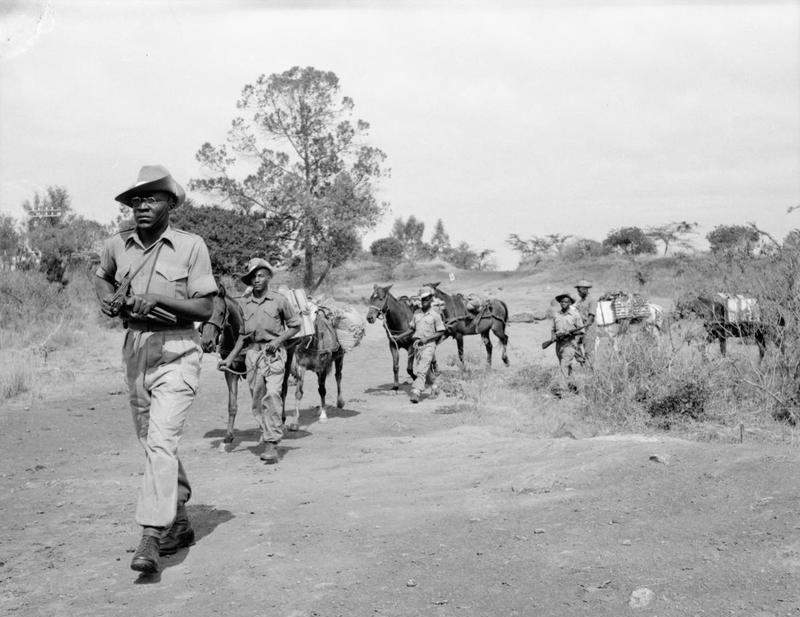
The Mau Mau uprising was an anti-colonial war fought mainly in central Kenya from 1952 to 1960. The Kenya Land and Freedom Army (KLFA), drawn chiefly from Kikuyu, Embu and Meru communities, attacked colonial forces, settlers and African loyalists. Britain answered with troops, executions, mass detention, forced labour and the enclosure of more than 1 million rural people in guarded villages.
The conflict grew from conquest and land alienation, not an inexplicable outbreak of violence. White settlement had concentrated fertile land and political power in European hands while African farmers faced dispossession, labour controls and racial rule. See the archive’s wider accounts of colonial history, mass atrocities and historical data.
Key takeaways
- The Mau Mau uprising arose from colonial land seizure, racial rule and labour exploitation, not from irrational or inherently ethnic violence.
- Britain defeated the forest armies by combining military operations with mass detention, forced resettlement, food controls, executions and torture.
- Official records counted 11,503 Mau Mau deaths through 1956, while disputed demographic estimates place wider excess mortality as high as 300,000.
- Approximately 1.05 million Kikuyu were confined in guarded villages during 1954–1956, according to Caroline Elkins’s 2005 estimate.
- In 2013, Britain paid £19.9 million to 5,228 Kenyan claimants after concealed colonial files strengthened evidence of systematic abuse.
What happened: revolt and emergency rule
Governor Evelyn Baring declared a State of Emergency on 20 October 1952 after escalating sabotage, oath-taking and political violence, including the assassination of loyalist chief Waruhiu wa Kungu on 7 October 1952. Jomo Kenyatta and other nationalist leaders were arrested during Operation Jock Scott, although prosecutors never proved that Kenyatta commanded Mau Mau.
KLFA guerrillas operated mainly from the Aberdare Range and Mount Kenya forests. Their weapons were scarce: homemade guns, stolen firearms and pangas. The colonial coalition combined British regiments, the Royal Air Force, the settler Kenya Regiment, the King’s African Rifles, police and tens of thousands of African Home Guard personnel.
| Date | Event | Concrete measure or outcome |
|---|---|---|
| 20 October 1952 | Emergency declared | Emergency rule remained formally in force until 12 January 1960 |
| 24 April 1954 | Operation Anvil began in Nairobi | About 24,000 Africans were screened and roughly 16,000 detained, according to historian David Anderson’s 2005 account |
| 18 January 1955 | General amnesty offer announced | Fighters were offered surrender terms; the offer expired on 10 July 1955 |
| 21 October 1956 | Dedan Kimathi captured | Executed at Kamiti Prison on 18 February 1957 |
| 12 January 1960 | Emergency ended | Kenya became independent on 12 December 1963 |
“We are determined to have independence in our lifetime.” — Dedan Kimathi, attributed statement during the Emergency, reproduced in Kenyan historical memory.
The counter-insurgency progressively separated fighters from food, intelligence and civilian protection. Forest warfare mattered, but coercive control of civilians broke the rebellion.
The mechanism: detention, villages and forced labour
Britain built a detention-and-‘rehabilitation’ system known as the Pipeline. Suspected adherents were screened, classified and moved through camps according to their supposed cooperation. Confession and repudiation of Mau Mau oaths became conditions for release. Beatings, sexual assault, starvation, stress positions and forced labour were documented across the system.
In the rural reserves, Operation Anvil was followed by villagisation. Caroline Elkins estimated in 2005 that about 1.05 million Kikuyu were confined in approximately 800 guarded villages during 1954–1956; official colonial figures also put the enclosed population above 1 million. Women and children formed much of this controlled population.
- Security forces removed urban suspects and screened them collectively.
- Officials classified detainees by presumed political commitment rather than ordinary criminal conviction.
- Camp staff used compulsory labour, punishment and coerced confession to force ‘rehabilitation’.
- Guarded villages imposed curfews, movement passes, trenches and collective discipline on rural civilians.
- Food controls and military sweeps isolated forest fighters from civilian support.
In a 1957 memorandum, Kenya’s attorney general Eric Griffith-Jones described detention abuses as “distressingly reminiscent of conditions in Nazi Germany or communist Russia,” while insisting that officials should protect themselves through legally defensible procedures.
Deaths, detention and punishment: the numbers
No single death total captures the conflict because colonial records distinguish combatants, civilians, loyalists and detainees—and because officials destroyed records during decolonisation. The official count is a floor, while later demographic estimates remain disputed.
| Measure | Figure and year | Source or qualification |
|---|---|---|
| Mau Mau killed | 11,503 by 1956 | British official Emergency tally cited by David Anderson in 2005 |
| Security-force deaths | 63 military and 33 police, 1952–1956 | British official tally cited by Anderson in 2005 |
| African loyalists/civilians killed by Mau Mau | 1,819, 1952–1956 | British official tally cited by Anderson in 2005 |
| European civilians killed | 32, 1952–1956 | British official tally cited by Anderson in 2005 |
| Judicial executions | 1,090, 1952–1956 | Anderson’s 2005 reconstruction; the largest British use of capital punishment in a twentieth-century colonial emergency |
| Detention | Official peak above 70,000 in 1954; scholarly estimates of people passing through camps range from roughly 80,000 to 160,000 for 1952–1960 | Colonial statistics; Anderson, 2005; Elkins, 2005 |
| Excess deaths | Up to 130,000–300,000, 1952–1960 | Caroline Elkins’s 2005 demographic extrapolation; contested and not an identified-body count |
Key facts
- Britain hanged 1,090 convicted people between 1952 and 1956, according to Anderson’s 2005 archival reconstruction.
- The official 11,503 Mau Mau death count through 1956 excludes unrecorded deaths and contested excess mortality.
- About 1.05 million Kikuyu were enclosed in guarded villages during 1954–1956, according to Elkins’s 2005 estimate.
- The Hola camp killing of 11 men on 3 March 1959 exposed the detention regime’s lethal violence.
Who profited from dispossession and coercion
The settler economy that preceded the war reserved political privilege, labour and high-potential land for Europeans. By the early 1950s, roughly 3,000 European farmers occupied about 7 million acres in the ‘White Highlands,’ figures reported in contemporary colonial statistics and later scholarship. Around 1.25 million Kikuyu were meanwhile compressed into reserves or working as tenants, labourers and squatters; exact population categories varied by the 1948 census and administrative counting.
| Economic structure | Figure and date | Beneficiaries and burden |
|---|---|---|
| European-held ‘White Highlands’ | About 7 million acres by 1952 | Approximately 3,000 European farmers held privileged access to fertile land |
| Swynnerton Plan finance | £5 million approved in 1954 | Credit and consolidation favoured commercially viable African titleholders while landless households lost customary access |
| Guarded villages | About 800 villages containing 1.05 million people by 1956 | The state obtained surveillance and labour control; Kikuyu households bore confinement, unpaid work and food insecurity |
| British emergency expenditure | Roughly £55 million during 1952–1960 | British and Kenyan taxpayers funded military rule protecting the colonial state and settler property |
The Swynnerton Plan of 1954 promoted individual title, cash crops and an African landholding elite. It expanded opportunities for some loyalists and prosperous farmers but entrenched class differentiation. Home Guard members and collaborating chiefs could gain wages, protection or access to confiscated property; detainees and villagers supplied coerced labour for roads, trenches and colonial agriculture. This was extraction enforced through racial law, explored comparatively in the archive’s atrocities collection.
Resistance, defeat and decolonisation
Mau Mau was not synonymous with all Kenyan nationalism. Its core lay among Kikuyu, Embu and Meru, with some Kamba and Maasai participation. Many Luo, Kalenjin and other Kenyans remained outside its principal networks; some served in the King’s African Rifles, police or Home Guard. Kikuyu society itself was divided by class, generation, Christian affiliation, local rivalry and coercion.
KLFA fighters demanded ithaka na wĩyathi—land and freedom. Resistance included forest warfare, intelligence networks, food supply, oath administration, strikes and clandestine organizing. Women such as Field Marshal Muthoni wa Kirima carried supplies, gathered intelligence and fought, while women outside the forests endured collective punishment and sustained underground networks.
The guerrillas were militarily contained by 1956, the year Kimathi was captured, but Britain did not restore the old political order. The Emergency exposed the cost of permanent settler supremacy. Constitutional negotiations at Lancaster House during 1960–1962 moved Kenya toward majority rule; independence followed on 12 December 1963 under Prime Minister Jomo Kenyatta. Military defeat and political consequence therefore diverged: Mau Mau did not single-handedly win independence, but it made continued colonial domination harder and more expensive.
Denial, archives, reparations and memory
Officials minimized torture during the Emergency and removed incriminating files before independence. The concealed ‘migrated archives’ comprised about 8,800 files from 37 former colonies when Britain acknowledged them in 2011 after litigation. Their discovery supported survivors’ claims and revealed systematic knowledge of abuse within the colonial administration.
In Mutua and Others v Foreign and Commonwealth Office, five elderly Kenyans—Wambugu Wa Nyingi, Paulo Muoka Nzili, Jane Muthoni Mara, Susan Ciong’ombe Ngondi and the estate of Nyingi Nthirangu—brought test claims alleging torture or sexual abuse. On 6 June 2013, Foreign Secretary William Hague expressed regret, acknowledged torture and ill-treatment, and announced £19.9 million for 5,228 claimants plus support for a Nairobi memorial. The settlement averaged about £3,800 per claimant before considering legal arrangements; Britain denied general legal liability.
The memorial to victims of torture and ill-treatment opened in Uhuru Park on 12 September 2015. Kenya had lifted its ban on Mau Mau in 2003, after approximately 53 years of illegality dating from 1950. Memory remains contested: nationalist celebration can obscure Mau Mau killings of African opponents, while colonial nostalgia suppresses the state’s much greater machinery of imprisonment, execution and forced resettlement.
The case matters now because it connects land inequality, archival concealment and state violence. It also shows why documented datasets must distinguish official counts, demographic estimates and named victims rather than merging unlike evidence.
Sources & further reading
- David Anderson, Histories of the Hanged (WorldCat)
- Caroline Elkins, Imperial Reckoning (Penguin Random House)
- Huw Bennett, Fighting the Mau Mau (Cambridge University Press)
- UK government statement on the Mau Mau claims, 6 June 2013
- The National Archives: migrated archives
- Harvard Gazette: Caroline Elkins and the Kenya Emergency
Frequently asked questions
- What caused the Mau Mau uprising in Kenya?
- The uprising grew from British conquest, African land dispossession, settler control of roughly 7 million acres by 1952, political exclusion and coercive labour relations. Kikuyu squatters and farmers faced especially intense pressure. After years of organizing and oath-taking, Governor Evelyn Baring declared an Emergency on 20 October 1952, turning a political and agrarian crisis into a full colonial counter-insurgency.
- How many people died during the Mau Mau uprising?
- British official figures counted 11,503 Mau Mau killed by 1956, alongside 1,819 African loyalists or civilians, 32 European civilians, 63 military personnel and 33 police killed. David Anderson published these figures in 2005 but treated the Mau Mau total as incomplete. Caroline Elkins’s 2005 excess-death estimate reached 130,000–300,000 for 1952–1960; that extrapolation remains contested.
- Did British forces use torture in Kenya?
- Yes. During the 1952–1960 Emergency, detainees suffered beatings, sexual violence, castration, starvation, stress positions and forced labour in the Pipeline camp system. Eleven men were beaten to death at Hola camp on 3 March 1959. In 2013, Foreign Secretary William Hague acknowledged that Kenyans had suffered torture and ill-treatment by the colonial administration and announced a £19.9 million settlement.
- Was Jomo Kenyatta the leader of Mau Mau?
- British authorities portrayed Jomo Kenyatta as Mau Mau’s organizer and arrested him on 20 October 1952. He was convicted in 1953 after a compromised trial, but reliable evidence never established that he commanded the Kenya Land and Freedom Army. Dedan Kimathi became its best-known forest leader. Kenyatta was released in 1961 and became Kenya’s prime minister at independence on 12 December 1963.
- Did the Mau Mau uprising win Kenyan independence?
- Not through a straightforward battlefield victory. British and colonial forces had largely contained KLFA guerrillas by Dedan Kimathi’s capture on 21 October 1956. Yet the Emergency raised the financial, political and reputational cost of settler rule. Alongside mass nationalism, labour activism and constitutional negotiation during 1960–1962, it helped make majority rule unavoidable. Kenya became independent on 12 December 1963.
Related chapters
Topics
- Aimé Césaire and Discourse on Colonialism
- Algerian War of Independence and French Torture
- South African Apartheid: The Legal Architecture of Racism
- Atlantic Slave Trade: Scale, Profits and Resistance
- Banda massacre and the Dutch nutmeg monopoly
- Belgian Congo: From Leopold’s Atrocities to Colonial Rule
- The 1943 Bengal Famine and British Policy
- Benin Bronzes: Looting, Trade and Restitution
- Berlin Conference and the Partition of Africa
Sources & further reading
CC BY 4.0 ·