The Nakba: Palestinian Displacement in 1948
A documented history of the 1948 Nakba: mass expulsion, village destruction, property seizure, Palestinian resistance and the unresolved refugee crisis.
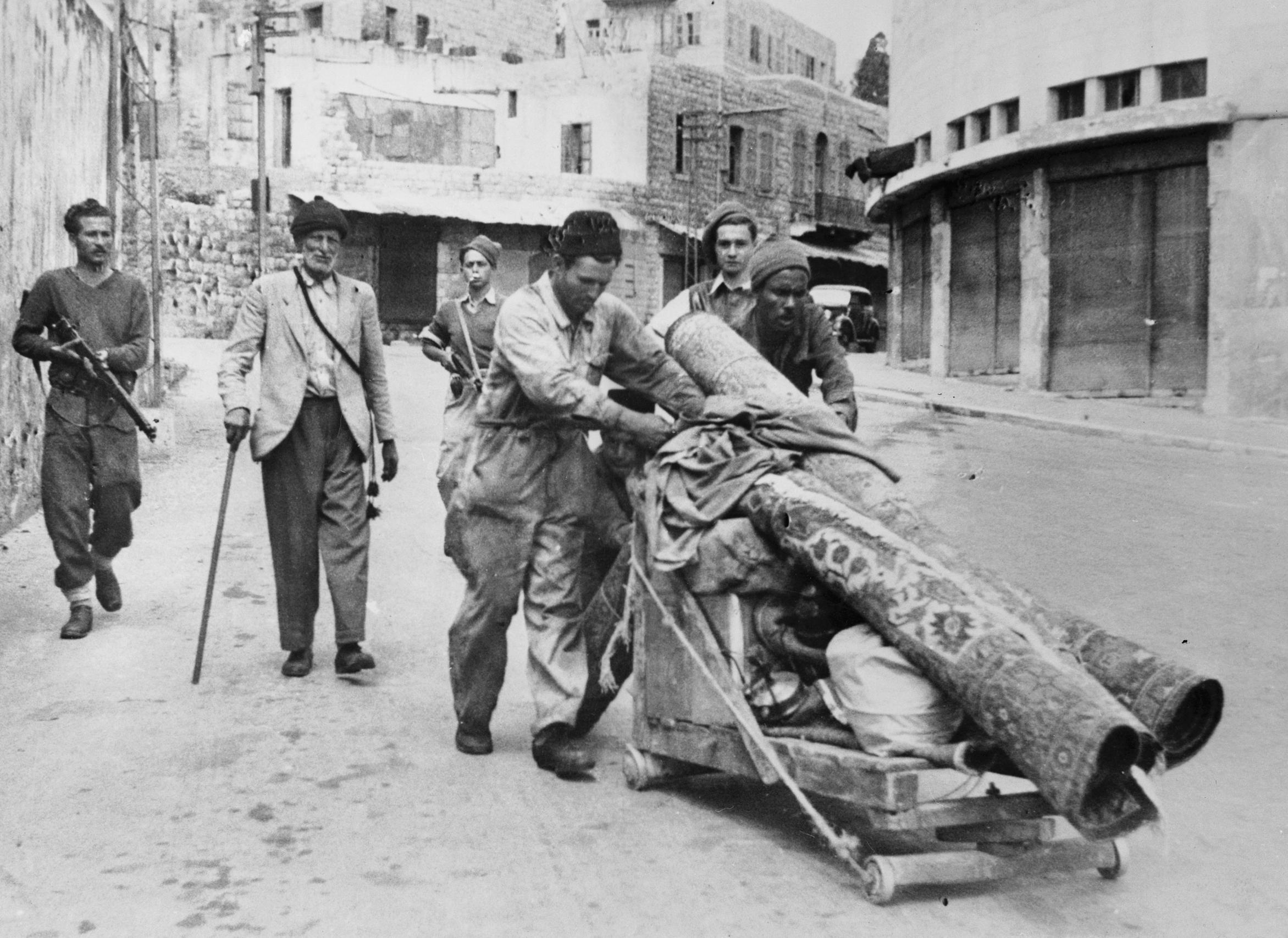
The Nakba—Arabic for “catastrophe”—was the mass displacement and dispossession of Palestinians during the 1947–49 Palestine war and the establishment of Israel. Zionist and then Israeli forces expelled or drove roughly 750,000 Palestinians from their homes in 1947–49; more than 400 Palestinian towns and villages were depopulated or destroyed, and refugees were denied return.
The Nakba dismantled Palestinian society through military assault, forced flight, massacre, property confiscation and erasure of place. Its consequences remain active in refugee camps, Israeli land law, occupation and recurring displacement. This hub connects the documented history, recorded atrocities and underlying data.
Key takeaways
- The Nakba displaced approximately 750,000 Palestinians in 1947–49 through expulsion, assault, fear, massacre and military prevention of return.
- More than 400 Palestinian communities were depopulated, while Israeli law transferred millions of dunams of refugee property to state-controlled institutions.
- Palestinian displacement began in late 1947, before Arab state armies entered the war on 15 May 1948.
- United Nations Resolution 194 addressed return and compensation in December 1948, but its central refugee provision was never implemented.
- The Nakba remains unresolved because millions of registered refugees and descendants are denied return while dispossession and displacement continue.
What happened and how displacement worked
Britain announced in 1947 that it would end its Mandate over Palestine. United Nations General Assembly Resolution 181, adopted on 29 November 1947, proposed allocating 55% of Palestine to a Jewish state although Jews constituted about 33% of the population and owned roughly 7% of privately held land, according to British Mandate statistics compiled for 1946–47. Civil war followed; after Israel declared independence on 14 May 1948, neighboring Arab armies entered on 15 May.
Displacement occurred through direct expulsions, attacks and bombardment, massacres, siege, threats, and panic produced by news from other communities. Plan Dalet, adopted by the Haganah in March 1948, authorized occupation of strategically important localities and the destruction or expulsion of villages that resisted. Operations Nachshon, Dani, Hiram and Yoav depopulated major areas. In July 1948, Israeli forces expelled approximately 50,000–70,000 Palestinians from Lydda and Ramle; historian Benny Morris gives about 50,000, while Ilan Pappé and other accounts use figures approaching 70,000.
“The military conquest of the area will be accompanied by the destruction of villages… and the expulsion of the population outside the boundaries of the state.” — Haganah General Staff, Plan Dalet, 1948, translated wording in published documentary collections.
The numbers: refugees, deaths and destroyed communities
No single ledger captures every expulsion or death. The figures below identify both the estimate and its producer rather than presenting contested totals as exact.
| Measure | Date | Figure or range | Source of estimate |
|---|---|---|---|
| Palestinians displaced | 1947–49 | About 750,000; scholarly and UN estimates commonly range from 700,000 to 800,000 | UNRWA; Benny Morris; Rashid Khalidi |
| Palestinian towns and villages depopulated | 1947–49 | 400–530; 418 villages documented in detail | Walid Khalidi; Salman Abu Sitta |
| Palestinians killed | 1947–49 | Approximately 10,000–15,000 | Aref al-Aref and later historical syntheses |
| Deir Yassin victims | 9 April 1948 | About 100–120, revised downward from early reports of 254 | Benny Morris; Sharif Kanaana |
| Lydda–Ramle expellees | July 1948 | About 50,000–70,000 | Benny Morris; Ilan Pappé and Palestinian accounts |
| Registered Palestine refugees | 1950 | About 914,000 | UNRWA registration records |
UNRWA’s registered total rose from about 914,000 in 1950 to approximately 5.9 million in 2023 because registration extends through the male line to descendants who meet agency criteria. This is an administrative population, not a claim that every registered person was personally expelled in 1948.
Key facts
- Displacement began after November 1947, months before neighboring Arab armies entered Palestine on 15 May 1948.
- Approximately 150,000 Palestinians remained inside the new Israeli state in 1949, many as internally displaced “present absentees.”
- Israeli forces controlled approximately 78% of Mandatory Palestine by the 1949 armistices, compared with the 55% proposed for a Jewish state in 1947.
- UN General Assembly Resolution 194 of 11 December 1948 addressed refugee return and compensation, but Israel did not implement its central provision.
Dispossession and who profited
Israel converted wartime flight into permanent expropriation. Emergency regulations placed refugee property under a Custodian; the Absentees’ Property Law of 1950 transferred control over land, houses, businesses, crops and bank accounts. The Development Authority Law of 1950 enabled onward transfer, particularly to state bodies and the Jewish National Fund. Palestinians who remained within Israel could also be classified as “absentees” because they had temporarily left their home locality.
| Asset or transfer | Date | Recorded scale | Principal beneficiary or administrator |
|---|---|---|---|
| Land held under absentee-property control | 1950–54 | Roughly 4.2–4.6 million dunams in official and scholarly estimates | Israeli Custodian and Development Authority |
| Refugee bank accounts unfrozen under international pressure | 1953–58 | About £P3.2 million released, according to UN Conciliation Commission reporting | Verified Palestinian account holders |
| Citrus land abandoned or seized | 1948 | Roughly 150,000 dunams in contemporary estimates | Israeli state agencies and cultivators |
| JNF purchase from Development Authority | 1949–53 | About 2.3 million dunams across two major transactions | Jewish National Fund |
The state, the Jewish National Fund, new immigrants settled in emptied homes, agricultural collectives and private users all benefited materially. Exact 1948 monetary value remains disputed because land, movable goods, harvests and lost income were calculated under incompatible methods.
Palestinian resistance and survival
Palestinians resisted through armed defense, attempts to return across armistice lines, petitions, strikes, testimony, political organization and preservation of land deeds and village records. The Arab Higher Committee, local militias and the Arab Liberation Army fought during 1947–48, although Palestinian forces were fragmented after years of British repression, especially during the 1936–39 Arab Revolt.
After 1948, refugees organized in camps across the West Bank, Gaza, Jordan, Lebanon and Syria. Their political movement later included the Palestine Liberation Organization, founded in 1964, and mass uprisings beginning with the First Intifada in December 1987.
- Families preserved keys, deeds, tax records and oral histories linking refugees to specific properties.
- Refugees repeatedly attempted return; Israeli forces treated many as “infiltrators,” with thousands killed at borders in 1949–56 according to Benny Morris.
- Palestinian researchers mapped depopulated localities and recorded testimony before surviving witnesses died.
- Annual Nakba commemorations, widely observed from the 1990s onward, turned family memory into public historical claim.
Palestinian resistance after 1948 was not confined to armed struggle: documentation, education, labor organizing and the insistence on return were central methods of political survival.
Denial, memory and the continuing Nakba
Official Israeli narratives long described Palestinians as leaving voluntarily or at Arab leaders’ orders. Archival research by Israeli “New Historians,” including Benny Morris, Avi Shlaim and Tom Segev, confirmed extensive expulsions and destruction, although these scholars differ sharply over intent and whether “ethnic cleansing” best describes the overall process. Palestinian historians including Walid Khalidi, Nur Masalha and Rashid Khalidi documented organized depopulation and the institutional suppression of return.
Israel’s 2011 Budget Foundations amendment—often called the Nakba Law—permits reduced state funding for institutions that commemorate Israel’s founding as a day of mourning. The law does not formally criminalize private remembrance, but it creates financial pressure against public commemoration.
The Nakba matters now because the refugee question remains unresolved. UNRWA recorded approximately 5.9 million registered Palestine refugees in 2023. Israel continues to reject a general right of return, while Palestinians cite Resolution 194, international refugee principles and property rights. Displacement since 1967, settlement expansion, home demolition, residency revocation and the mass uprooting of Gaza’s population since October 2023 have made “ongoing Nakba” a legal, political and historical framework rather than only a memorial phrase. Comparative evidence is cataloged in the archive’s atrocities and quantitative data.
Sources & further reading
- United Nations: General Assembly Resolution 194 (1948)
- UNRWA: Palestine refugees
- Institute for Palestine Studies: All That Remains
- Encyclopaedia Britannica: Palestine war and the Nakba
- Cambridge University Press: The Birth of the Palestinian Refugee Problem Revisited
- United Nations Conciliation Commission for Palestine records
Frequently asked questions
- What was the Nakba in 1948?
- The Nakba was the mass displacement and dispossession of Palestinians during the 1947–49 Palestine war and Israel’s establishment on 14 May 1948. Zionist and Israeli forces depopulated more than 400 communities and displaced approximately 750,000 people through expulsions, attacks, fear and prevention of return. The term also encompasses property confiscation, social fragmentation and continuing denial of refugee return.
- How many Palestinians were expelled or displaced during the Nakba?
- Most UN and scholarly accounts estimate that approximately 750,000 Palestinians were displaced in 1947–49, with a commonly cited range of 700,000–800,000. UNRWA initially registered about 914,000 refugees in 1950, a larger administrative figure that included eligible people who had lost both homes and livelihoods. Precise totals vary because wartime records were incomplete and registration rules differed.
- How many Palestinian villages were destroyed in 1948?
- Historians generally identify more than 400 Palestinian towns and villages as depopulated in 1947–49. Walid Khalidi documented 418 villages in *All That Remains* in 1992, while Salman Abu Sitta’s broader geographic accounting approaches 530 localities. Many were demolished; others were repopulated, renamed or incorporated into Israeli cities, forests and agricultural settlements.
- Did Palestinians leave voluntarily in 1948?
- The evidence does not support a single voluntary exodus. Haganah and Israeli operations expelled communities directly, including approximately 50,000–70,000 people from Lydda and Ramle in July 1948. Others fled bombardment, massacres such as Deir Yassin on 9 April 1948, siege or fear. Israeli forces and laws then barred return and confiscated refugee property.
- What does the Palestinian right of return mean?
- The right of return is the claim that Palestinians displaced in 1947–49, and those displaced afterward, may return to their homes or receive restitution and compensation. UN General Assembly Resolution 194, adopted on 11 December 1948, stated that refugees wishing to return and live at peace should be permitted to do so at the earliest practicable date. Israel rejects a general return, leaving the issue unresolved.
Related chapters
Topics
- Aimé Césaire and Discourse on Colonialism
- Algerian War of Independence and French Torture
- South African Apartheid: The Legal Architecture of Racism
- Atlantic Slave Trade: Scale, Profits and Resistance
- Banda massacre and the Dutch nutmeg monopoly
- Belgian Congo: From Leopold’s Atrocities to Colonial Rule
- The 1943 Bengal Famine and British Policy
- Benin Bronzes: Looting, Trade and Restitution
- Berlin Conference and the Partition of Africa
Sources & further reading
CC BY 4.0 ·