Sand Creek Massacre: Facts, Death Toll and Legacy
How John Chivington’s troops massacred Cheyenne and Arapaho people at Sand Creek in 1864, the disputed death toll, investigations and legacy.
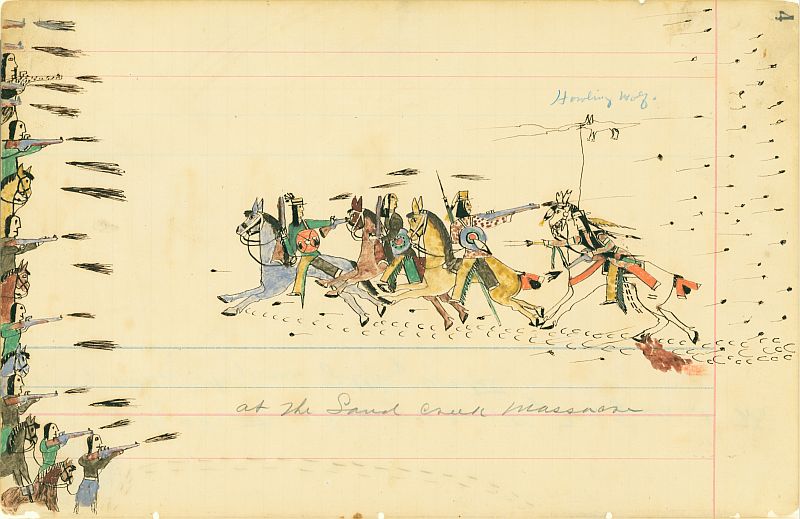
The Sand Creek massacre was the killing and mutilation of a predominantly Cheyenne and Arapaho village by United States troops in Colorado Territory on November 29, 1864. Colonel John M. Chivington led approximately 675 men, chiefly from the 3rd Colorado Cavalry, against people who had been told to camp near Fort Lyon as a sign of peace. Modern authorities generally place the dead at about 150–230; many were women, children and older people.
Sand Creek was not an accidental battle. It grew from settler expansion, official demands for Indigenous land, military dehumanisation and a territorial government that authorised violence against Native people. The atrocity intensified the Colorado Wars and became one of the best-documented crimes in the wider history of United States colonial violence.
Key takeaways
- United States troops under John Chivington attacked a peaceful Cheyenne and Arapaho village at Sand Creek on November 29, 1864.
- Modern estimates generally place the 1864 death toll between about 150 and 230, with women and children forming most victims.
- Chivington’s 1864 claim of 500–600 dead warriors was propaganda contradicted by eyewitnesses, demographic evidence and federal investigations.
- Settlers, miners and territorial institutions benefited as violence accelerated Cheyenne and Arapaho dispossession and consolidated United States control of Colorado.
- Congress condemned the massacre in 1865, but no commanding officer was criminally convicted and promised reparations remained substantially unfulfilled.
What happened at Sand Creek
Cheyenne peace chief Black Kettle and Arapaho leader Left Hand had pursued accommodation after meeting territorial and military officials at Camp Weld on September 28, 1864. Major Edward W. Wynkoop had encouraged their people to camp near Fort Lyon. Major Scott J. Anthony, who replaced Wynkoop, later told them to remain at Sand Creek, roughly 40 miles northeast of the fort.
Before dawn on November 29, 1864, Chivington’s column reached the village. Black Kettle raised a United States flag and reportedly a white flag above his lodge. Soldiers attacked anyway, using small arms and artillery as residents fled toward excavated pits along the creek. Captain Silas Soule and Lieutenant Joseph Cramer refused to order their companies into the killing.
“I tell you Ned it was hard to see little children on their knees have their brains beat out by men professing to be civilized.” — Captain Silas Soule, letter to Major Edward Wynkoop, December 14, 1864.
Troops scalped and mutilated corpses, taking body parts as trophies. Denver audiences later viewed trophies from the attack. The violence belongs in the archive of documented United States atrocities, not under the perpetrators’ original label of a military victory.
| Event | Date and documented figure |
|---|---|
| Camp Weld council | September 28, 1864; 7 named Cheyenne and Arapaho delegates attended |
| Attack began | November 29, 1864, at approximately dawn |
| Attacking force | Approximately 675 troops in 1864, according to National Park Service summaries |
| Congressional testimony | March 1865; Joint Committee hearings examined the attack |
| National historic site authorised | November 7, 2000, by Public Law 106-465 |
| National historic site dedicated | April 28, 2007 |
The numbers: victims, troops and disputed claims
No complete roll of the dead survives. Chivington claimed that 500–600 Native people, characterised as warriors, had been killed in 1864. That claim conflicts with eyewitness evidence, demographic reconstruction and later federal assessments. The National Park Service now gives an approximate death toll of 230 Cheyenne and Arapaho people in 1864, while older historical accounts commonly used about 150–200. Historian Gary L. Roberts concluded in 2006 that at least 163 named or otherwise identified people died and that the total may have approached 200.
| Source or claimant | Year published or stated | Estimated deaths | Characterisation |
|---|---|---|---|
| John M. Chivington | 1864 | 500–600 | Claimed mostly or entirely warriors; rejected by later investigations |
| Joint Committee on the Conduct of the War | 1865 | About 70–163 reported across testimony | Witnesses differed; committee found women and children slaughtered |
| Gary L. Roberts, historical study | 2006 | At least 163; possibly near 200 | Reconstruction from names, testimony and community evidence |
| National Park Service | Current official summary | Approximately 230 | Cheyenne and Arapaho victims, mostly women, children and older people |
The often-repeated estimate that roughly two-thirds of the victims were women and children reflects survivor testimony and later scholarship, although no exact 1864 census permits a final percentage. Claims as high as more than 600 survive in popular retellings, but they exceed the likely village population and derive substantially from Chivington-era boasting rather than reliable enumeration. See the archive’s approach to conflicting figures in historical data.
Land seizure, political gain and who profited
Sand Creek served a colonial project already formalised through coercive diplomacy. The 1851 Treaty of Fort Laramie recognised an extensive Cheyenne and Arapaho territory. After the 1858–1859 Pikes Peak gold rush brought tens of thousands of newcomers, federal negotiators imposed the 1861 Treaty of Fort Wise. Only a small minority of chiefs signed it; the agreement purported to reduce the nations’ Colorado land to a reservation of roughly 4 million acres, commonly estimated at less than one-thirteenth of the territory recognised in 1851.
The principal beneficiaries were not soldiers collecting ordinary pay but the settler polity: miners gained access to mineral districts; ranchers and farmers occupied land; merchants supplied migration and war; and territorial politicians strengthened demands for security, infrastructure and eventual statehood. Governor John Evans issued proclamations on June 27 and August 11, 1864, directing “friendly Indians” toward designated posts and authorising citizens to pursue “hostile Indians” and take captured property.
The United States compounded the crime through the 1865 Treaty of the Little Arkansas. Article VI promised reparations including land grants and payments to survivors and relatives, but many commitments were never delivered. This pattern—violence, dispossession, treaty revision and incomplete compensation—was a mechanism of colonial extraction.
Resistance, survival and official investigations
Cheyenne and Arapaho people resisted before, during and after the attack through diplomacy, flight, armed defence, testimony and preservation of family histories. Black Kettle survived Sand Creek but was killed with others when Lieutenant Colonel George A. Custer’s 7th Cavalry attacked his Washita village on November 27, 1868.
The immediate record survived partly because military dissenters spoke. Their actions can be traced in sequence:
- On November 29, 1864, Silas Soule and Joseph Cramer withheld their companies from the main assault.
- On December 14, 1864, Soule wrote Edward Wynkoop a detailed eyewitness account of killings and mutilations.
- In February–March 1865, Soule and other witnesses testified before military and congressional inquiries.
- On April 23, 1865, Soule was murdered in Denver; former soldier Charles Squier was implicated, but no court established that the killing was retaliation for Soule’s testimony.
- In 1865, the Joint Committee on the Conduct of the War condemned Sand Creek as a “foul and dastardly massacre.”
The Joint Committee reported that Chivington had “deliberately planned and executed a foul and dastardly massacre” — Report on the Conduct of the War, 1865.
Chivington had left the army before proceedings could impose a military sentence. No commanding officer was criminally convicted for the massacre. Tribal oral histories and survivor descendants preserved evidence that official accounts had minimised or distorted.
Denial, commemoration and present meaning
The massacre was first marketed as the Battle of Sand Creek. Chivington and allied newspapers inflated enemy numbers and represented murdered civilians as combatants. That denial was challenged almost immediately by soldiers, survivors, federal investigators and later Cheyenne and Arapaho historians.
Key facts
- The target on November 29, 1864, was a village containing many families, not a force of 500–600 warriors.
- Black Kettle displayed a United States flag in 1864, but it did not stop the attack.
- Federal inquiries in 1865 condemned the killings, yet no commanding officer received a criminal conviction.
- Congress authorised the Sand Creek Massacre National Historic Site in 2000, and it opened in 2007.
- The Northern Cheyenne, Northern Arapaho, and Cheyenne and Arapaho Tribes remain central authorities on the site and its history.
Memory changed materially when “massacre” displaced “battle” in public institutions. The National Park Service and tribal partners completed site research during the 1990s; Congress authorised the 12,583-acre national historic site in 2000, and the site was dedicated on April 28, 2007. The protected boundary does not reduce the event to one landscape: its consequences include forced migration, intergenerational loss and treaty claims.
Sand Creek now demonstrates why perpetrator reports cannot be treated as neutral data. It also exposes the limits of retrospective condemnation without prosecution, full reparations or restoration. Its history connects military violence to land markets, racial ideology and the expansion of state power—structures examined across the archive’s history collection.
Sources & further reading
- National Park Service: Sand Creek Massacre National Historic Site
- National Park Service: Foundation Document, Sand Creek Massacre National Historic Site
- Library of Congress: Report of the Joint Committee on the Conduct of the War, 1865
- Smithsonian Magazine: The Horrific Sand Creek Massacre Will Be Forgotten No More
- History Colorado: Sand Creek Massacre
- Gary L. Roberts, Sand Creek: Tragedy and Symbol, University of Oklahoma Press
Frequently asked questions
- How many people died in the Sand Creek massacre?
- Most modern estimates place the death toll at about 150–230 Cheyenne and Arapaho people killed on November 29, 1864. Historian Gary L. Roberts identified at least 163 victims in 2006 and suggested the total may have approached 200. The National Park Service uses approximately 230. Colonel John Chivington’s 1864 claim of 500–600 dead warriors is not considered credible.
- Why did the United States Army attack Sand Creek?
- The attack arose from settler demands for Cheyenne and Arapaho land, the 1858–1859 gold rush, escalating warfare and dehumanising territorial policy. Governor John Evans’s 1864 proclamations encouraged coercive concentration and attacks on people labelled hostile. Colonel John Chivington then led approximately 675 troops against Black Kettle’s village on November 29, despite its residents’ peace efforts and proximity to Fort Lyon.
- Were the Cheyenne and Arapaho at Sand Creek under military protection?
- They had strong reason to believe camping near Fort Lyon signalled peace. Major Edward Wynkoop had negotiated with Cheyenne and Arapaho representatives, and Major Scott Anthony subsequently directed them to remain at Sand Creek. Black Kettle raised a United States flag when approximately 675 troops approached on November 29, 1864. The precise legal status was contested afterward, but prior military assurances make the attack’s betrayal clear.
- Was anyone punished for the Sand Creek massacre?
- No commanding officer was criminally convicted. Congressional and military inquiries in 1865 denounced the killings, and the Joint Committee called them a “foul and dastardly massacre.” John Chivington had left military service before an army punishment could be imposed. Governor John Evans resigned under federal pressure in 1865. Captain Silas Soule, a key witness who refused to join the attack, was murdered on April 23, 1865.
- Where is the Sand Creek massacre site today?
- The site lies in Kiowa County in southeastern Colorado, near the town of Eads. Congress authorised Sand Creek Massacre National Historic Site through Public Law 106-465 on November 7, 2000. The National Park Service, working with Cheyenne and Arapaho tribal nations, dedicated the site on April 28, 2007. Its authorised area covers 12,583 acres and protects the massacre landscape and associated cultural resources.
Related chapters
Topics
- Aimé Césaire and Discourse on Colonialism
- Algerian War of Independence and French Torture
- South African Apartheid: The Legal Architecture of Racism
- Atlantic Slave Trade: Scale, Profits and Resistance
- Banda massacre and the Dutch nutmeg monopoly
- Belgian Congo: From Leopold’s Atrocities to Colonial Rule
- The 1943 Bengal Famine and British Policy
- Benin Bronzes: Looting, Trade and Restitution
- Berlin Conference and the Partition of Africa
Sources & further reading
CC BY 4.0 ·