Sharpeville massacre: apartheid police violence
How South African police killed 69 people at Sharpeville on 21 March 1960, the pass-law protest, official repression, resistance and memory.
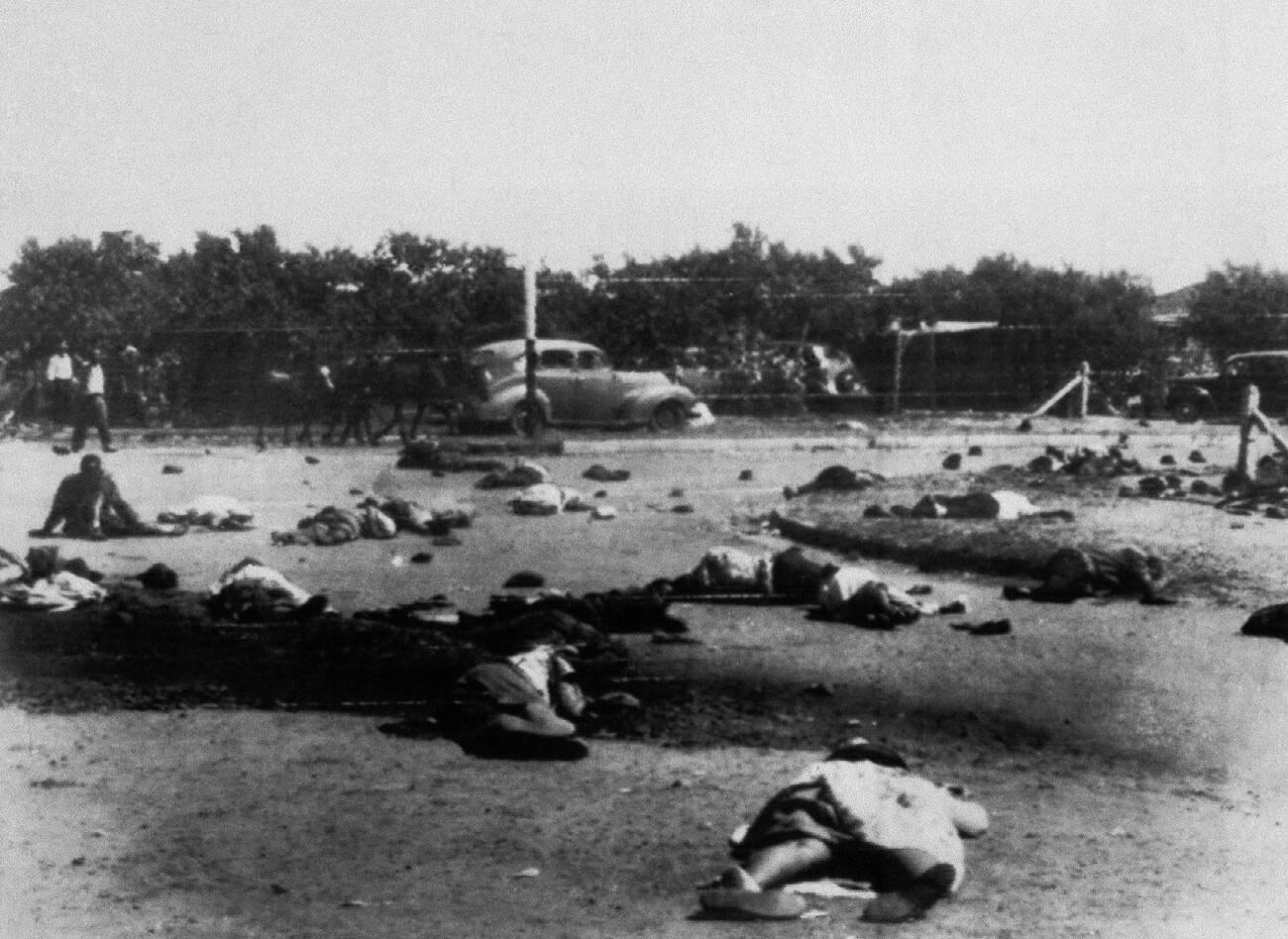
On 21 March 1960, South African Police officers fired on an anti-pass-law gathering outside Sharpeville police station, killing 69 people and wounding 180 according to the apartheid government’s official figures for 1960. Many victims were shot in the back as the crowd fled. No police officer was convicted for the killings.
Sharpeville exposed apartheid as a system maintained not only by discriminatory statutes but by lethal state force. The massacre, subsequent emergency rule and banning of liberation movements transformed South African resistance and international opposition to white-minority government.
Key takeaways
- South African Police killed 69 people and wounded 180 at an anti-pass-law gathering in Sharpeville on 21 March 1960.
- Evidence recorded in 1960 showed many victims were shot from behind as police discharged 705 rounds into the fleeing crowd.
- Pass laws criminalized Black mobility and helped mining, farming and other employers control labor, residence and workers’ bargaining power.
- The apartheid government answered the massacre with emergency detention and banned the PAC and ANC on 8 April 1960.
- No police officer was convicted for the killings, although the post-apartheid Truth and Reconciliation Commission found excessive force and gross violations.
What happened at Sharpeville
The Pan Africanist Congress (PAC), led by Robert Sobukwe, organized a national campaign against the pass laws for 21 March 1960. Protesters were instructed to leave their pass documents at home, present themselves for arrest and overwhelm the system through disciplined non-cooperation. In Sharpeville, a Black township near Vereeniging in the Transvaal, thousands gathered around the police station.
Accounts differ over the crowd’s maximum size: the official commission chaired by Judge P. J. Wessels described approximately 5,000 people immediately before the shooting in 1960, while later histories and commemorative accounts have commonly given a range of 5,000–7,000 for 1960. Police reinforcements arrived with armored vehicles; aircraft flew low overhead. The crowd had stones but no firearms were reported among those shot.
At about 1:15 p.m. on 21 March 1960, after a scuffle near the station entrance, police opened fire. The official record stated that 705 rounds were discharged in roughly 40 seconds. Officers continued firing as people ran. Evidence presented to the official inquiry established that many bullets entered victims from behind.
“The photographs taken of the dead bodies show that the bullets struck a very large number of persons in the back.” — P. J. Wessels, chair, Report of the Commission of Enquiry into the Events at Sharpeville and Langa, 1960.
The numbers and the machinery of repression
The official 1960 toll—69 killed and 180 wounded, or 249 casualties—remains the standard figure used by South African institutions and historians. Unlike many colonial atrocities, Sharpeville does not carry a credible competing death range: uncertainty concerns the crowd size, sequence and individual police responsibility rather than the accepted total killed.
| Measure | Figure and date | Source or qualification |
|---|---|---|
| People killed | 69 on 21 March 1960 | South African government’s 1960 official toll |
| People wounded | 180 on 21 March 1960 | South African government’s 1960 official toll |
| Total casualties | 249 on 21 March 1960 | Sum of the official 1960 killed and wounded figures |
| Women among the dead | 8 in 1960 | Officially recorded victim total |
| Children among the dead | 10 in 1960 | Officially recorded victim total |
| Police ammunition discharged | 705 rounds in 1960 | Evidence summarized by the Wessels Commission |
| Crowd before firing | About 5,000–7,000 in 1960 | Rough range across official and later historical accounts |
Pass control made Black presence in designated “white” areas conditional and punishable. The Natives (Abolition of Passes and Co-ordination of Documents) Act of 1952 standardized the reference book that recorded identity, employment and permission to remain. Arrest, prosecution, removal and labor coercion enforced this administrative order.
Key facts
- The massacre occurred outside Sharpeville police station on 21 March 1960.
- Police killed 69 people and wounded 180 according to official figures issued in 1960.
- Eight women and 10 children were among the 69 people officially recorded dead in 1960.
- Police fired 705 rounds in approximately 40 seconds, according to evidence recorded by the 1960 inquiry.
- The state banned the PAC and African National Congress (ANC) on 8 April 1960.
See the archive’s wider history of racial rule, catalog of state atrocities and comparative casualty data.
Who profited from pass-law rule
Sharpeville was not an isolated failure of crowd control. Pass laws served an economy built around controlled Black labor. Mining houses, white commercial agriculture, manufacturers and white households benefited from a workforce whose mobility, residence and bargaining power were restricted by statute and policing. The state and municipalities collected fines while employers received labor under conditions shaped by threatened arrest and removal.
| Economic indicator | Concrete figure | Significance |
|---|---|---|
| Pass-law arrests | More than 17 million between 1916 and 1984 | South African Institute of Race Relations historical compilation; repeated arrests are included |
| Gold production | About 21 million fine ounces in 1970 | South African production reached its historical peak a decade after Sharpeville |
| Share of non-communist world gold | About 70% in 1970 | Contemporary industry and historical mineral statistics |
| Gold price | US$35 per fine ounce in 1960 | Official United States parity under Bretton Woods in 1960 |
These figures do not assign the 21 March 1960 shooting to individual corporations. They identify the material system protected by apartheid policing. Major mining groups, including Anglo American Corporation and the mining houses organized through the Chamber of Mines, operated within a migrant-labor regime sustained by racial movement controls, compounds and unequal wages.
Resistance, emergency rule and armed struggle
The PAC’s campaign challenged the state by making Black people’s mass arrest unmanageable. After Sharpeville, protests spread, workers stayed home and pass books were publicly burned. On 30 March 1960, the government declared a state of emergency; official figures reported more than 18,000 detainees during the emergency of 1960. Parliament then enacted the Unlawful Organizations Act, and the government banned the PAC and ANC on 8 April 1960.
The sequence mattered:
- On 21 March 1960, the PAC’s anti-pass campaign brought protesters to police stations, including Sharpeville and Langa.
- On 30 March 1960, emergency regulations expanded detention powers and suppressed meetings and reporting.
- On 8 April 1960, the state outlawed the PAC and ANC, forcing organized opposition underground or into exile.
- In 1961, the PAC formed Poqo and the ANC helped establish Umkhonto we Sizwe, marking a shift toward armed resistance after peaceful organization was criminalized.
- On 7 November 1962, the United Nations General Assembly adopted Resolution 1761, calling for sanctions and creating the Special Committee against Apartheid.
Sharpeville did not make repression begin in South Africa; it demonstrated internationally that lawful, peaceful opposition could be answered with mass gunfire and organizational prohibition.
The massacre therefore sits at a hinge in liberation history: the state’s response narrowed nonviolent political space, while survivors and activists carried evidence of apartheid violence abroad.
Denial, accountability and public memory
Police initially claimed danger and panic justified the firing. The Wessels Commission criticized aspects of police conduct but produced no criminal accountability. The state prosecuted neither the commanders who controlled the scene nor the rank-and-file officers whose weapons killed and wounded people. Instead, it detained opponents and prohibited their organizations.
The Truth and Reconciliation Commission, established under South Africa’s 1995 law and reporting from 1998, concluded that the police had used excessive force at Sharpeville and that the shooting constituted a gross human-rights violation. Its process clarified institutional responsibility but did not deliver prosecutions for the 69 killings committed in 1960.
Memory changed after apartheid. President Nelson Mandela signed South Africa’s democratic Constitution at Sharpeville on 10 December 1996. Since 1995, South Africa has observed 21 March as Human Rights Day. The United Nations General Assembly designated 21 March as the International Day for the Elimination of Racial Discrimination through Resolution 2142 (XXI), adopted on 26 October 1966.
Commemoration can obscure as well as preserve. Calling Sharpeville merely a “tragedy” removes the actors: armed South African Police officers fired state ammunition into a fleeing Black crowd; apartheid institutions protected them afterward. Accurate memory retains the victims, the political demand and the chain of command.
What Sharpeville means now
Sharpeville remains a reference point for examining police fire against demonstrators, racialized movement controls and impunity. It shows how bureaucratic rules—documents, permits, zones and arrests—can organize exploitation before visible mass violence occurs. It also shows that inquiries without prosecution may establish facts while leaving perpetrators unpunished.
The massacre’s contemporary meaning is not that apartheid survives unchanged. South Africa became a constitutional democracy after its first universal-suffrage election on 27 April 1994. Rather, Sharpeville supplies tests for present institutions: Who authorizes force? Who is treated as inherently threatening? Which economic interests benefit from coercive policing? Who controls evidence and investigation afterward?
For comparative research, place Sharpeville within the archive’s chronology of colonialism and resistance, its documented record of mass violence, and its methods for interpreting official statistics and disputed tolls.
Sources & further reading
- South African History Online: Sharpeville Massacre, 21 March 1960
- Encyclopaedia Britannica: Sharpeville massacre
- United Nations: International Day for the Elimination of Racial Discrimination
- Truth and Reconciliation Commission of South Africa Report
- Tom Lodge, Sharpeville: An Apartheid Massacre and Its Consequences
Frequently asked questions
- What happened in the Sharpeville massacre?
- On 21 March 1960, South African Police opened fire on thousands protesting pass laws outside Sharpeville police station in the Transvaal. Police discharged 705 rounds in about 40 seconds. The apartheid government’s official 1960 figures recorded 69 people killed and 180 wounded; photographs and inquiry evidence showed that many victims were shot in the back while fleeing.
- Why were people protesting at Sharpeville?
- The Pan Africanist Congress, led by Robert Sobukwe, called a national anti-pass campaign for 21 March 1960. Black protesters were asked to leave their reference books at home and offer themselves for arrest. The 1952 pass-law system controlled where Black South Africans could live, travel and work, exposing them to arrest, removal and prosecution for document violations.
- How many people died in the Sharpeville massacre?
- The accepted official toll for 21 March 1960 is 69 people killed and 180 wounded, totaling 249 casualties. The dead included 8 women and 10 children in official records. Accounts place the crowd at roughly 5,000–7,000, but no major scholarly alternative challenges the official death toll. Many victims were struck from behind as they fled.
- Was anyone held accountable for the Sharpeville massacre?
- No police officer was convicted for killing the 69 victims on 21 March 1960. The apartheid-era Wessels Commission investigated but did not produce criminal accountability. South Africa’s Truth and Reconciliation Commission, reporting from 1998, later found that police used excessive force and committed gross human-rights violations. The state had instead detained opponents and banned the PAC and ANC in 1960.
- How did Sharpeville change South African history?
- Sharpeville accelerated international condemnation and transformed resistance. The government declared an emergency on 30 March 1960, detained more than 18,000 people according to official figures, and banned the PAC and ANC on 8 April 1960. After peaceful organization was crushed, both movements established armed structures in 1961. The United Nations adopted anti-apartheid Resolution 1761 on 7 November 1962.
Related chapters
Topics
- Aimé Césaire and Discourse on Colonialism
- Algerian War of Independence and French Torture
- South African Apartheid: The Legal Architecture of Racism
- Atlantic Slave Trade: Scale, Profits and Resistance
- Banda massacre and the Dutch nutmeg monopoly
- Belgian Congo: From Leopold’s Atrocities to Colonial Rule
- The 1943 Bengal Famine and British Policy
- Benin Bronzes: Looting, Trade and Restitution
- Berlin Conference and the Partition of Africa
Sources & further reading
CC BY 4.0 ·