Sykes–Picot and the Carving of the Middle East
How Britain and France secretly divided Ottoman Arab lands in 1916, imposed mandates, extracted resources and shaped modern Middle Eastern borders.
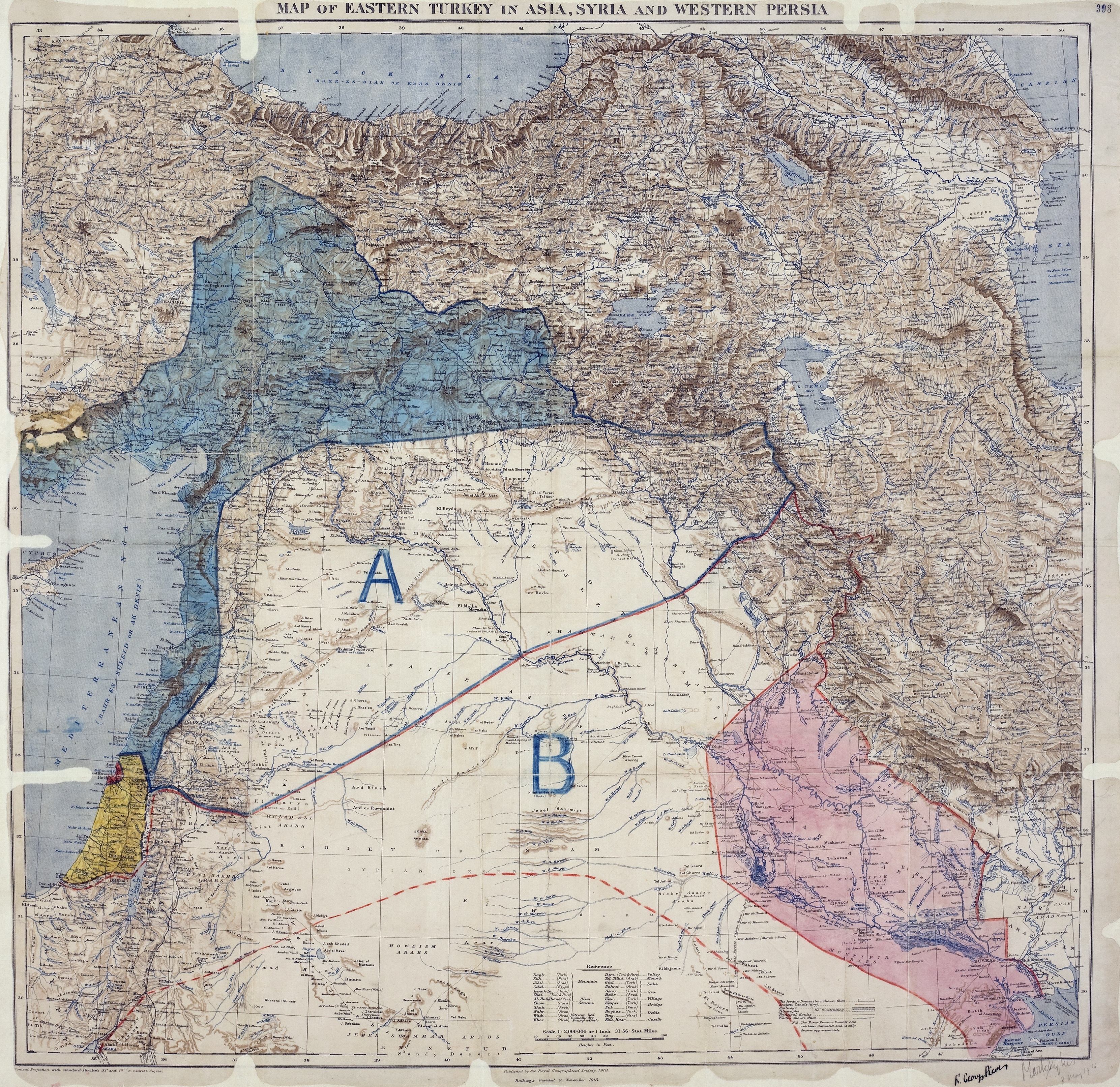
The Sykes–Picot Agreement was a secret British–French arrangement signed on 16 May 1916, with Russian assent, for dividing much of the Ottoman Middle East into zones of direct rule and influence after an anticipated Allied victory. Negotiated by Sir Mark Sykes and François Georges-Picot, it contradicted Arab expectations encouraged by British wartime correspondence and treated inhabited lands as imperial assets.
Sykes–Picot did not itself draw every modern border. Britain and France revised its scheme through military occupation, the 1920 San Remo settlement, League of Nations mandates and later treaties. Yet it remains shorthand for the wider colonial partition that produced Iraq, Transjordan, Palestine, Lebanon and French-ruled Syria while subordinating self-determination to strategy, oil and imperial communications.
Key takeaways
- Sykes–Picot was a secret 1916 imperial partition plan, not the sole legal instrument that created every modern Middle Eastern border.
- Britain and France implemented partition through wartime occupation, the 1920 San Remo settlement and League of Nations mandates approved in 1922.
- Colonial repression killed thousands, including an estimated 6,000–10,000 Iraqis in 1920 and 6,000–10,000 Syrians during the 1925–1927 revolt.
- British strategic routes and Iraqi oil, alongside French political and commercial influence, were central material interests behind the post-Ottoman settlement.
- The agreement remains significant because it symbolizes externally imposed sovereignty, although later treaties and local actors also shaped the region.
What happened: secret partition during war
Britain and France negotiated while fighting the Ottoman Empire in the First World War. The agreement placed coastal Syria and Lebanon under prospective French control; southern Mesopotamia around Basra and Baghdad under British control; inland Arab territories in French and British spheres; and Palestine under a proposed international administration. Russia assented after securing Allied promises concerning Constantinople and Ottoman Armenian provinces; Italy was informed and accommodated in 1917.
“I should like to draw a line from the ‘e’ in Acre to the last ‘k’ in Kirkuk.” — Sir Mark Sykes, account of an informal explanation to Prime Minister H. H. Asquith, 1915, recorded in The Caliphs’ Last Heritage
The Bolsheviks exposed the text after Russia’s November 1917 revolution; Izvestia and Pravda published it on 23 November 1917, and the Manchester Guardian followed on 26 November 1917. Disclosure revealed the gap between secret imperial planning and Britain’s 1915–1916 Hussein–McMahon correspondence with Sharif Hussein of Mecca.
| Date | Instrument or event | Concrete effect |
|---|---|---|
| 14 July 1915–10 March 1916 | Hussein–McMahon correspondence | 10 letters exchanged over an Arab revolt and prospective independence, with disputed territorial exclusions |
| 16 May 1916 | Sykes–Picot Agreement | Created 5 projected zones: 2 of direct control, 2 spheres of influence and 1 international zone |
| 2 November 1917 | Balfour Declaration | British government supported a Jewish “national home” in Palestine |
| 23–26 November 1917 | Agreement published | Soviet newspapers and then the Manchester Guardian exposed the secret partition |
| 19–26 April 1920 | San Remo Conference | Britain received mandates for Palestine and Mesopotamia; France received Syria and Lebanon |
| 24 July 1922 | League mandates approved | Internationalized British and French rule under the mandate system |
The mechanism: occupation, mandates and borders
Sykes–Picot was a blueprint, not a self-executing map. Allied armies supplied coercive power. General Edmund Allenby entered Jerusalem on 11 December 1917; British forces occupied Baghdad on 11 March 1917 and Damascus on 1 October 1918. France then removed the Arab government proclaimed under Faisal: General Henri Gouraud’s forces defeated Yusuf al-Azma’s army at Maysalun on 24 July 1920 and entered Damascus.
The League of Nations described mandates as a “sacred trust of civilisation,” but Britain and France controlled foreign affairs, armed forces, taxation and concessions. France separated Greater Lebanon from Syria on 1 September 1920. Britain constructed the Kingdom of Iraq in 1921 from the former Ottoman provinces of Basra, Baghdad and Mosul, and recognized the Emirate of Transjordan under Abdullah in 1921. The Palestine Mandate took effect on 29 September 1923.
The wider process belongs within the archive’s histories of colonial rule, documented mass violence and comparative historical data.
The numbers: territory, oil and human cost
No defensible death toll can be assigned to the 1916 agreement alone. Violence arose from conquest, mandate repression and struggles over the states imposed afterward. Estimates vary because colonial records often counted combatants selectively and minimized civilian deaths.
| Event | Year(s) | Deaths or casualties | Source or basis |
|---|---|---|---|
| Iraqi Revolt | 1920 | About 6,000–10,000 Iraqis killed; 426 British and Indian troops killed | Lower figure commonly cited from British-era accounting; upper estimate used by modern historians including Charles Tripp |
| Battle of Maysalun | 1920 | About 400 Syrian defenders killed; French accounts reported 42 killed | Contemporary military figures, repeated by Philip S. Khoury and later historians |
| Great Syrian Revolt | 1925–1927 | Roughly 6,000–10,000 Syrians killed | Range synthesized in modern scholarship, including Michael Provence and Philip S. Khoury |
| Damascus bombardment | 18–20 October 1925 | Approximately 500–1,500 residents killed | Contemporary diplomatic and press estimates; exact count remains disputed |
British authorities spent approximately £40 million suppressing Iraq’s 1920 revolt, according to contemporary parliamentary and colonial accounting summarized by historian Charles Tripp. That cost helped push London toward indirect monarchy and aerial policing rather than immediate withdrawal.
Key facts
- The agreement was concluded on 16 May 1916 and remained secret until Soviet publication in November 1917.
- It allocated zones without consulting the Arab, Kurdish, Armenian, Assyrian, Jewish and other populations living within them.
- Britain and France converted wartime occupation into 3 principal League mandates approved in 1922: Palestine, Mesopotamia and Syria-Lebanon.
- The resulting order produced no independent Kurdish state, despite conditional provisions discussed in the 1920 Treaty of Sèvres.
- Colonial repression caused deaths in the thousands, but no credible single casualty total covers the entire partition process.
Who profited: empires, companies and client rulers
Britain secured the route toward India, strategic depth around the Suez Canal and access to Iraqi oil. France gained political and commercial predominance in Syria and Lebanon. Local monarchies headed by Hashemite allies obtained thrones, but remained constrained by treaties, advisers and military dependence.
Oil sharpened the settlement. The Turkish Petroleum Company received an Ottoman concession in 1914, discovered oil at Baba Gurgur near Kirkuk on 14 October 1927 and became the Iraq Petroleum Company in 1929. Under the 31 July 1928 Red Line Agreement, ownership was divided among the Anglo-Persian Oil Company, Royal Dutch/Shell, Compagnie Française des Pétroles and the Near East Development Corporation, each with 23.75%; Calouste Gulbenkian held 5%.
| Beneficiary | Year | Quantified share or advantage |
|---|---|---|
| Britain | 1920 | 2 mandates assigned at San Remo: Mesopotamia and Palestine |
| France | 1920 | 1 mandate covering Syria and Lebanon |
| Four corporate groups | 1928 | 23.75% of Iraq Petroleum Company each |
| Calouste Gulbenkian | 1928 | 5% of Iraq Petroleum Company |
| Iraq Petroleum Company | 1934 | Kirkuk–Haifa and Kirkuk–Tripoli pipelines opened, about 942 km and 856 km respectively |
The beneficiaries were therefore not abstract “Western powers” alone. They included named governments, oil corporations, banks, concession-holders and monarchies built into an imperial security system.
Resistance, repression and constrained independence
Resistance began before the mandates were legally approved. Iraq’s 1920 revolt united, unevenly, Shi'a clerics, Sunni officers and tribal forces. France crushed the Great Syrian Revolt of 1925–1927 with artillery, armored vehicles and aerial bombing. Palestinians mounted strikes and armed resistance against British rule and mass Zionist immigration during the 1936–1939 Arab Revolt.
- In 1920, rebels disrupted British administration across the middle Euphrates before imperial reinforcements restored control.
- In 1925, Druze forces under Sultan al-Atrash ignited a revolt that spread to Damascus and other Syrian regions.
- In 1936, Palestinians began a general strike lasting 6 months, from April to October, followed by armed insurgency through 1939.
- By 1939, British repression had killed roughly 2,000–5,000 Palestinian Arabs, according to ranges used by historians including Matthew Hughes; thousands more were imprisoned, wounded or exiled.
The mandate system replaced openly annexationist language with international supervision, but coercive sovereignty remained in British and French hands.
Formal independence came unevenly: Iraq entered the League of Nations on 3 October 1932, Lebanon became independent in 1943, Syria secured evacuation of the last French troops on 17 April 1946, and Britain terminated the Palestine Mandate on 14 May 1948. Independence did not erase borders, concessions or militarized institutions inherited from mandate rule.
Denial, memory and what it means now
British and French official narratives long represented mandates as tutelage toward self-government. That language obscured secret bargaining, racial hierarchy, bombardment and resource control. Conversely, attributing every current conflict to Sykes–Picot turns a complex history into a single conspiracy and can erase later actors’ responsibility.
The agreement’s continuing importance is structural and symbolic. It demonstrates how external powers negotiated sovereignty without popular consent; how Kurdish-majority regions were divided among Turkey, Iraq, Syria and Iran; and how incompatible British commitments intensified conflict in Palestine. The Islamic State invoked “the end of Sykes–Picot” when it demolished an Iraq–Syria border berm in June 2014, but its propaganda misstated the border’s origin: that boundary emerged from postwar mandate arrangements, not directly from the 1916 map.
Sykes–Picot matters now not because every frontier follows its lines, but because institutions formed under partition survived: centralized security states, minority management, disputed territories and economies organized around concessions and export corridors. Understanding those continuities does not deny local agency. It identifies the unequal framework within which later governments, movements and foreign powers acted.
Sources & further reading
- The Sykes–Picot Agreement text, Avalon Project, Yale Law School
- Encyclopaedia Britannica: Sykes–Picot Agreement
- International Encyclopedia of the First World War: Sykes–Picot Agreement
- United Nations: The Mandate System
- Library of Congress: The Middle East and the Making of the Modern World
- Michael Provence, The Great Syrian Revolt and the Rise of Arab Nationalism
Frequently asked questions
- What did the Sykes–Picot Agreement do?
- Signed on 16 May 1916, the secret agreement divided anticipated Ottoman territories into British and French zones of direct control and influence, with Palestine proposed for international administration. Sir Mark Sykes and François Georges-Picot negotiated it with Russian assent. It shaped Allied planning, but the 1920 San Remo decisions, League mandates approved in 1922 and later treaties established the actual postwar states and borders.
- Did Sykes–Picot create the modern borders of the Middle East?
- Not by itself. Its 1916 zones differed significantly from later borders. Britain and France created the operative settlement through military occupation, the April 1920 San Remo Conference, mandates approved in July 1922, the 1923 Treaty of Lausanne and the 1926 Mosul settlement. Sykes–Picot remains important as evidence that imperial powers planned partition without consulting the region’s inhabitants.
- How did Sykes–Picot betray the Arabs?
- During the 1915–1916 Hussein–McMahon correspondence, British officials encouraged Sharif Hussein to expect Arab independence, although territorial exclusions were ambiguous and remain disputed. Simultaneously, Britain negotiated Sykes–Picot with France, assigning Arab lands to imperial control and influence. Publication in November 1917 exposed this contradiction, while France’s destruction of Faisal’s Syrian government at Maysalun on 24 July 1920 made it concrete.
- How many people died because of the colonial partition?
- No credible total isolates deaths caused by Sykes–Picot itself. Related mandate violence killed thousands: historians estimate roughly 6,000–10,000 Iraqis died in the 1920 revolt and approximately 6,000–10,000 Syrians in the 1925–1927 Great Syrian Revolt. The French bombardment of Damascus on 18–20 October 1925 killed an estimated 500–1,500 people, according to differing contemporary reports.
- What role did oil play in the post-Ottoman settlement?
- Oil was a major British and French strategic interest, especially in Mosul and Kirkuk. The Turkish Petroleum Company discovered oil at Baba Gurgur on 14 October 1927 and became the Iraq Petroleum Company in 1929. Its 1928 ownership agreement assigned 23.75% each to 4 corporate groups and 5% to Calouste Gulbenkian, embedding Iraqi petroleum within a foreign concession system.
Related chapters
Topics
- Aimé Césaire and Discourse on Colonialism
- Algerian War of Independence and French Torture
- South African Apartheid: The Legal Architecture of Racism
- Atlantic Slave Trade: Scale, Profits and Resistance
- Banda massacre and the Dutch nutmeg monopoly
- Belgian Congo: From Leopold’s Atrocities to Colonial Rule
- The 1943 Bengal Famine and British Policy
- Benin Bronzes: Looting, Trade and Restitution
- Berlin Conference and the Partition of Africa
Sources & further reading
CC BY 4.0 ·