Wounded Knee Massacre: Death Toll, Causes and Legacy
Evidence-led history of the 1890 Wounded Knee Massacre: Lakota deaths, U.S. Army responsibility, land seizure, resistance, medals and memory.
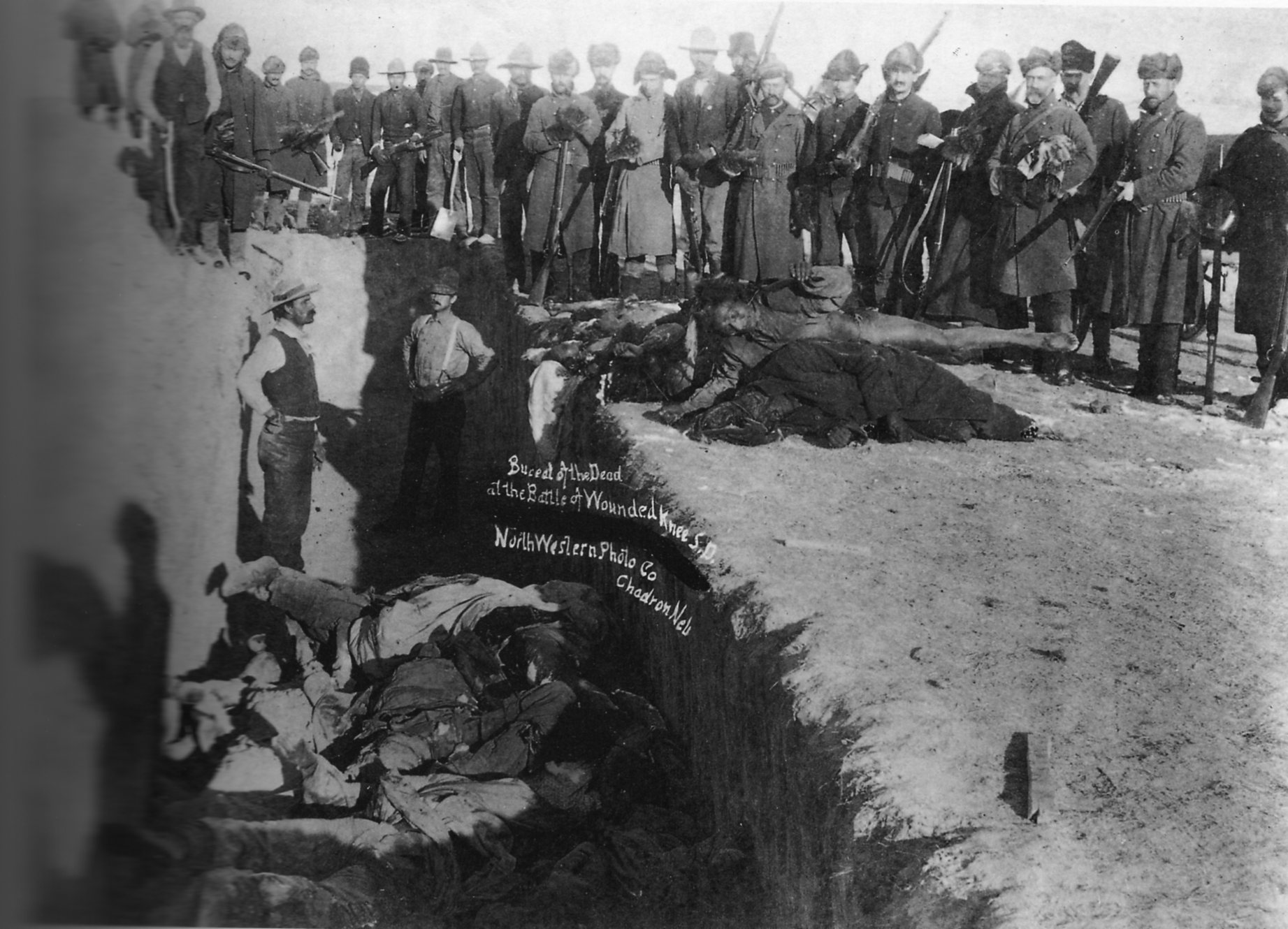
On December 29, 1890, soldiers of the U.S. Seventh Cavalry massacred Miniconjou Lakota leader Spotted Elk and roughly 250–300 Lakota men, women and children near Wounded Knee Creek on the Pine Ridge Reservation. The killings followed forced confinement, treaty violations, land seizure and a federal campaign against the Ghost Dance. Twenty-five soldiers died, many probably struck by their own side's crossfire.
Although the U.S. Army officially called Wounded Knee a battle, the encirclement of a largely disarmed camp and indiscriminate Hotchkiss-gun fire made it the culminating massacre of the late nineteenth-century wars of U.S. conquest. It belongs within the archive's wider histories of colonial expansion, documented atrocities and contested casualty data.
Key takeaways
- U.S. Seventh Cavalry troops killed approximately 250–300 Lakota at Wounded Knee on December 29, 1890, including women and children.
- Wounded Knee culminated decades of treaty violation, Black Hills seizure, reservation division, ration control and armed suppression of Lakota autonomy.
- Twenty-five U.S. soldiers died and 39 were wounded; the Army's encircling formation made deadly crossfire highly probable.
- The Supreme Court awarded $105 million in 1980 for the unlawful Black Hills taking, but the Sioux Nation rejected payment.
- Twenty Medals of Honor remain associated with the Pine Ridge Campaign, including 19 specifically awarded for conduct at Wounded Knee.
What happened at Wounded Knee
The mechanism was settler colonialism enforced by hunger, policing and military power. The 1868 Fort Laramie Treaty recognized the Great Sioux Reservation, including the Black Hills, for Lakota use. After gold was confirmed there in 1874, miners invaded; Congress seized the Black Hills in 1877 without the consent required by the treaty. The Dawes Act of 1887 accelerated allotment, while a further agreement imposed in 1889 divided the Great Sioux Reservation.
Amid crop failure and ration cuts, Lakota communities adopted the Ghost Dance, a nonviolent religious movement promising renewal. Federal officials represented it as an uprising. On December 15, 1890, Indian police killed Hunkpapa leader Sitting Bull during an attempted arrest. Spotted Elk—also called Big Foot—then led his band toward Pine Ridge. Seventh Cavalry troops intercepted them on December 28 and surrounded their camp.
On December 29, Colonel James W. Forsyth ordered the Lakota disarmed. During a search, a struggle reportedly developed around Black Coyote, a deaf Lakota man who possessed a rifle. A shot was fired; its origin remains disputed. Soldiers opened fire at close range, while four Hotchkiss M1875 revolving cannon on overlooking ground fired explosive shells into people fleeing the camp.
“A people's dream died there. It was a beautiful dream.” — Black Elk, as told to John G. Neihardt, 1932, Black Elk Speaks
The numbers: deaths, wounds and disputed counts
No complete roll of Lakota dead exists. The Army's immediate count understated deaths because bodies lay scattered beneath snow and some wounded died later. General Nelson A. Miles reported approximately 300 Lakota dead in an 1891 letter to Commissioner of Indian Affairs Thomas J. Morgan. Historian Robert M. Utley estimated at least 150 in 1963; Dee Brown popularized a figure of about 300 in 1970. Modern reference works commonly give 250–300.
| Measure | Number | Year and source |
|---|---|---|
| Lakota killed | 250–300 | Modern scholarly/reference range for December 29, 1890 |
| Lakota dead | About 300 | Nelson A. Miles, 1891 report/letter |
| Lakota killed | At least 150 | Robert M. Utley, 1963 |
| Lakota wounded | 51 recorded; likely more | Official 1890–1891 accounting |
| U.S. soldiers killed | 25 | U.S. Army, 1890 |
| U.S. soldiers wounded | 39 | U.S. Army, 1890 |
The best-supported interpretation is therefore not a choice between 150 and 300: 150 is a documented minimum, while 250–300 reflects unrecovered bodies and later deaths. Of approximately 350 Lakota in Spotted Elk's party, the higher estimate would mean roughly 71–86% were killed.
Key facts
- The massacre occurred at Wounded Knee Creek, South Dakota, on December 29, 1890.
- Approximately 250–300 Lakota were killed; recorded victims included men, women and children.
- The Army deployed four Hotchkiss guns against the encircled camp.
- Twenty-five soldiers were killed and 39 wounded, with crossfire contributing to Army casualties.
- Congress never rescinded the 20 Medals of Honor associated with the action and campaign.
Land, money and who profited
Wounded Knee was not primarily a raid for immediate loot. It enforced a political economy that transferred Lakota land and resources to the United States, railroads, miners, ranchers and homesteaders. Federal coercion opened reservation territory while making Lakota survival dependent on rations administered by the same state.
| Transfer or value | Concrete figure | Date and evidentiary basis |
|---|---|---|
| Great Sioux Reservation recognized | About 60 million acres | Fort Laramie Treaty, 1868 |
| Black Hills taken | About 7.3 million acres | Congressional act, 1877 |
| Reservation land opened after division | About 9 million acres | Agreement implemented in 1889–1890 |
| Court award for Black Hills seizure | $105 million | United States v. Sioux Nation, 1980 |
| Unaccepted trust value | Over $1.3 billion | Federal accounting reported in 2011 |
The Supreme Court ruled in 1980 that the Black Hills had been taken unlawfully and awarded $105 million, comprising 1877 value plus interest. The Sioux Nation refused payment because accepting money would extinguish its land claim. No single corporation caused the massacre; the beneficiaries were the settler institutions that converted treaty land into taxable property, mineral access, transport corridors and private holdings.
Wounded Knee enforced dispossession: military violence protected a land transfer that the Supreme Court, 90 years later, held had violated the Fifth Amendment.
Resistance, survival and accountability
Lakota resistance took military, spiritual, legal and cultural forms. The Ghost Dance asserted survival under conditions designed to dissolve Indigenous sovereignty. Survivors and relatives preserved names and testimony despite official descriptions of a “battle.”
A concise chronology shows continuity rather than closure:
- 1868: The Fort Laramie Treaty recognized the Great Sioux Reservation and Lakota rights in the Black Hills.
- 1877: Congress confiscated the Black Hills after the Great Sioux War.
- 1889: The federal government broke the reservation into smaller units and opened about 9 million acres.
- 1890: Sitting Bull was killed on December 15; Spotted Elk's band was massacred on December 29.
- 1973: American Indian Movement activists and Oglala residents occupied Wounded Knee for 71 days, from February 27 to May 8.
- 1990: Congress expressed “deep regret” on the massacre's centennial but created no binding reparations.
The 1973 occupation linked treaty enforcement, tribal governance and federal violence to the 1890 site. In 2022, the Oglala Sioux Tribe purchased a 40-acre parcel at Wounded Knee for $500,000, returning control of commercially held ground to Lakota ownership.
Denial, medals and public memory
Official language converted slaughter into combat. The Army designated the event a “battle,” investigated Colonel Forsyth and reinstated him after General Miles had removed him. Miles nevertheless described the action as “the most abominable criminal military blunder and a horrible massacre of women and children” in a March 13, 1917, letter.
Twenty soldiers received Medals of Honor connected to the Pine Ridge Campaign: 19 specifically for conduct at Wounded Knee and 1 for an engagement at White Clay Creek on December 30, 1890. That concentration—20 awards for an operation ending in mass civilian death—became an official monument to impunity. In 2001, the National Congress of American Indians called for rescission. The House passed the Remove the Stain Act in 2021, but it did not become law; as of 2026, the medals remain in force.
Memory also survives in the mass grave, oral histories and descendants' work. Calling Wounded Knee a massacre is not retrospective exaggeration. It identifies command, asymmetric firepower and the killing of noncombatants that the “battle” label obscures.
What Wounded Knee means now
Wounded Knee marks the violent consolidation of U.S. rule over Lakota territory, not the disappearance of Lakota political life. Its present meanings include unresolved Black Hills title, federal treaty obligations, memorial stewardship and the demand that military honors not reward participation in atrocities.
The massacre also demonstrates how administrative acts—ration policy, reservation boundaries, policing and official vocabulary—prepare and conceal mass violence. The 1980 Supreme Court judgment established illegality but substituted compensation for land; the Sioux Nation's refusal preserved the distinction between a debt and consent. Accurate commemoration therefore requires more than counting bodies: it must connect the December 29, 1890, killings to the 1868 treaty, the 1877 seizure and living Lakota sovereignty.
Sources & further reading
- National Park Service: Wounded Knee Massacre
- Encyclopaedia Britannica: Wounded Knee Massacre
- Smithsonian: How the Battle of Little Bighorn Was Won
- U.S. Supreme Court: United States v. Sioux Nation of Indians (1980)
- National Congress of American Indians: Rescind Wounded Knee Medals
- Library of Congress: Treaty of Fort Laramie (1868)
Frequently asked questions
- How many people died in the Wounded Knee Massacre?
- Approximately 250–300 Lakota men, women and children were killed on December 29, 1890, according to the range commonly used by modern historians and reference works. General Nelson A. Miles estimated about 300 in 1891; historian Robert M. Utley gave a documented minimum of 150 in 1963. The U.S. Army recorded 25 soldiers killed and 39 wounded.
- Why did the Wounded Knee Massacre happen?
- The massacre followed decades of U.S. land seizure and treaty violation. Congress took the Black Hills in 1877, and the Great Sioux Reservation was divided in 1889. Federal agents then portrayed the Ghost Dance as a military threat. After Sitting Bull was killed on December 15, 1890, troops intercepted Spotted Elk's band, surrounded it and attempted disarmament on December 29.
- Who ordered the troops at Wounded Knee?
- Colonel James W. Forsyth commanded roughly 500 soldiers of the U.S. Seventh Cavalry at Wounded Knee on December 29, 1890. Major Samuel Whitside had intercepted Spotted Elk's band the previous day. General Nelson A. Miles commanded the wider Division of the Missouri; he later condemned the killings and temporarily relieved Forsyth, but the Army reinstated him after an inquiry.
- Were Medals of Honor awarded for Wounded Knee?
- Yes. Nineteen U.S. soldiers received Medals of Honor specifically for actions at Wounded Knee on December 29, 1890; 20 were associated with the wider Pine Ridge Campaign. Indigenous organizations have repeatedly demanded rescission. The U.S. House passed the Remove the Stain Act in 2021, but it did not become law, and the medals remained in force as of 2026.
- Was Wounded Knee a battle or a massacre?
- The U.S. Army officially called Wounded Knee a battle, but the evidence supports “massacre.” On December 29, 1890, troops surrounded a Lakota camp, attempted disarmament and used four Hotchkiss guns as people fled. Approximately 250–300 Lakota died, including women and children. General Nelson A. Miles himself called it a “horrible massacre” in a 1917 letter.
Related chapters
Topics
- Aimé Césaire and Discourse on Colonialism
- Algerian War of Independence and French Torture
- South African Apartheid: The Legal Architecture of Racism
- Atlantic Slave Trade: Scale, Profits and Resistance
- Banda massacre and the Dutch nutmeg monopoly
- Belgian Congo: From Leopold’s Atrocities to Colonial Rule
- The 1943 Bengal Famine and British Policy
- Benin Bronzes: Looting, Trade and Restitution
- Berlin Conference and the Partition of Africa
Sources & further reading
CC BY 4.0 ·