Elmina Castle: Gold, Slavery and Colonial Power
Elmina Castle history: Portuguese construction in 1482, Dutch conquest, Atlantic slave trafficking, British rule, surviving dungeons and memory.
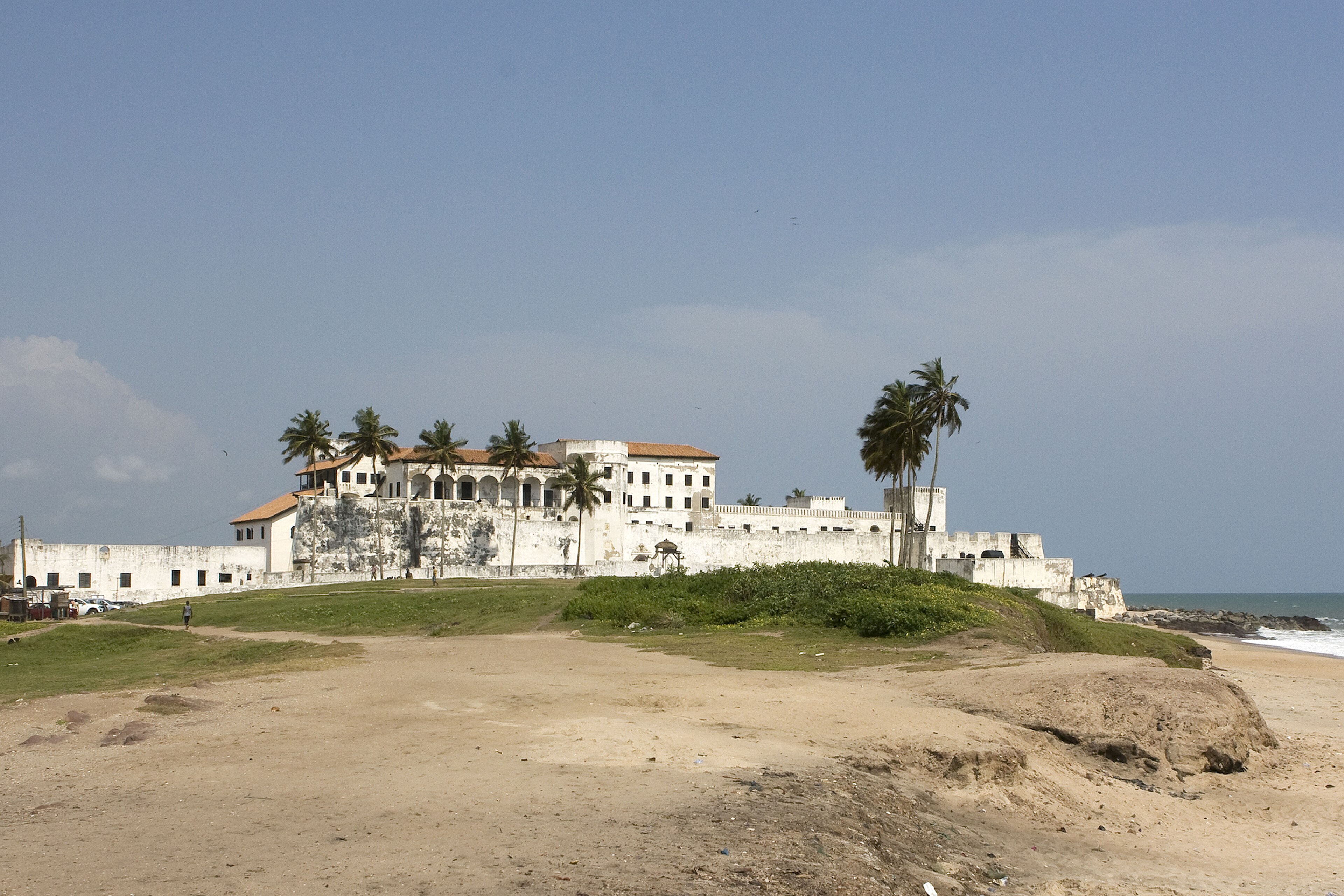
Elmina Castle was a Portuguese, Dutch and British fortified trading institution on the coast of present-day Ghana from 1482 to 1957, built for the gold trade and later used to imprison and export enslaved Africans.
Founded as Castelo de São Jorge da Mina, it was the first permanent European trading post on the Gulf of Guinea and remains the oldest surviving European building south of the Sahara. Its architecture joined warehouses, guns, chapels, official residences and dungeons in one system of commercial coercion. Explore the wider histories of colonialism and slavery and the archive's visual record.
Key takeaways
- Portugal built Elmina Castle in 1482 to secure Akan gold and enforce a royal trading monopoly on the Gulf of Guinea.
- The Dutch West India Company captured Elmina in 1637 and incorporated it into commerce linking West Africa, Europe and American slave colonies.
- Slave Voyages estimated in 2019 that roughly 1.2 million captives embarked from the wider Gold Coast region between 1501 and 1866.
- No reliable surviving dataset establishes a total number imprisoned, exported or killed specifically at Elmina Castle.
- Britain acquired Elmina in 1872, bombarded the adjacent town in 1873 and retained the castle until Ghanaian independence in 1957.
- UNESCO listed Elmina with Ghana's other forts and castles in 1979, making it a major site of education, mourning and contested memory.
What Elmina Castle was
King João II of Portugal ordered the fortress built at Edina, called Elmina by Europeans, in 1482. Diogo de Azambuja arrived with roughly 600 men in 10 ships that year, according to early Portuguese chronicles; the force included soldiers, artisans and laborers. The Portuguese sought direct access to Akan gold and named the stronghold São Jorge da Mina—Saint George of the Mine. It became the administrative center of Portugal's West African trade.
Elmina was neither an isolated European creation nor evidence that Europeans controlled inland Africa. Its operation depended on agreements and conflict with local authorities, especially the ruler Portuguese accounts called Caramansa, and on African merchants who controlled routes linking the coast to gold-producing regions. Portugal nevertheless claimed a crown monopoly, fortified the shoreline and used armed shipping to exclude competitors.
| Date | Event |
|---|---|
| 1482 | Diogo de Azambuja begins the Portuguese fortress for João II. |
| 1503 | Portugal establishes nearby Fort São Tiago to strengthen Elmina's defenses. |
| 1637 | A Dutch West India Company assault captures Elmina on 29 August. |
| 1642 | The Treaty of The Hague transfers Portugal's Gold Coast possessions to the Dutch. |
| 1814 | The Netherlands legally abolishes its transatlantic slave trade. |
| 1872 | The Netherlands transfers Elmina and its other Gold Coast forts to Britain. |
| 1873 | British forces bombard Elmina town during the Anglo-Asante conflict. |
| 1957 | Ghana becomes independent on 6 March; the castle passes to the Ghanaian state. |
| 1979 | Elmina Castle enters UNESCO's World Heritage List with other Ghanaian forts and castles. |
How its power worked
The castle converted maritime force into controlled exchange. Cannon covered the anchorage; officials inspected goods and enforced monopoly rules; storerooms held gold, ivory, textiles, firearms and alcohol. European merchants relied on African brokers and political authorities, but fortification gave them a defensible coastal base, access to Atlantic credit and armed vessels able to attack rival shipping.
Under the Dutch West India Company, which seized the castle in 1637, Elmina became part of a corporate empire stretching between Europe, West Africa and the Americas. Captives acquired through regional wars, raids, judicial enslavement, kidnapping and markets were confined while ships assembled human cargoes. Men and women were separated in poorly ventilated rooms; confinement, disease, violence and sexual exploitation preceded embarkation through exits now memorialized as the “Door of No Return.”
The placement of a Christian chapel above spaces used for confinement exposed the institution's moral structure: European worship and official comfort coexisted with commodification below. See related material in the archive's history hub.
The documented record and human cost
The Slave Voyages database estimated in its 2019 release that approximately 12.5 million captives embarked from Africa for the Americas between 1501 and 1866 and about 10.7 million disembarked alive. Those Atlantic-wide figures cannot be assigned to Elmina. For the Gold Coast embarkation region, Slave Voyages voyage reconstructions indicate roughly 1.2 million people embarked between 1501 and 1866, but port attribution is often uncertain and the regional category includes multiple forts and anchorages.
The approximately 1.8 million difference between Atlantic embarkations and landings in the 2019 dataset represents about 14.4% of those embarked, although estimates vary as voyages are added or revised. It excludes deaths during capture, forced marches, coastal confinement and the “seasoning” period after arrival. Elmina-specific mortality cannot be responsibly quantified from present evidence.
“The trade of slaves is the ruling principle of my people.” — Willem Bosman, Dutch West India Company factor at Elmina, 1704, A New and Accurate Description of the Coast of Guinea.
Bosman's formulation recorded a merchant's worldview, not an impartial African consensus. His book also documents European demand, bargaining and violence while presenting enslaved people through a slave trader's racial prejudices.
The defenses made for Elmina
Portuguese monarchs presented Elmina as a lawful crown factory serving commerce, Christianity and diplomacy. The Dutch West India Company defended its occupation as conquest from an Iberian enemy and treated captive trafficking as legitimate business under corporate charter. British officials later framed their 1872 acquisition as orderly consolidation and invoked suppression of the overseas slave trade to justify expanding colonial authority.
Elmina's changing flags did not end coercion; they redistributed its profits and supplied new legal languages for domination.
Abolitionist policy was also selective. The British Parliament prohibited British participation in the transatlantic trade in 1807, while the Slavery Abolition Act of 1833 took effect across most British colonies on 1 August 1834. Britain then paid £20 million in 1835 compensation to slave owners—not to enslaved people—according to UK Treasury records. The Netherlands prohibited its transatlantic traffic in 1814 but did not abolish slavery in its Caribbean colonies until 1 July 1863, with compulsory state supervision continuing in Suriname until 1873.
Afterlife, conservation and memory
The Anglo-Dutch treaties signed in 1871 took effect in 1872, placing Elmina under British rule. Resistance and conflict followed. During the Anglo-Asante war, British forces bombarded Elmina town on 13 June 1873 and destroyed sections around the castle, displacing inhabitants and breaking the town's relationship with the neighboring Asante state. Colonial authorities subsequently used the building for administration, policing and imprisonment.
After Ghanaian independence in 1957, the state inherited a monument whose fabric embodied foreign occupation but whose meanings also belonged to local history. UNESCO listed the “Forts and Castles, Volta, Greater Accra, Central and Western Regions” in 1979; the serial property comprises 3 castles, 15 forts, 4 partly ruined forts and 4 ruins, totaling 26 components in UNESCO's current description.
Today the Ghana Museums and Monuments Board manages Elmina Castle. It is a site of tourism, education, Pan-African pilgrimage and diaspora mourning, but interpretation remains contested. Local histories include fishing, commerce, warfare and colonial urban destruction alongside Atlantic slavery. Conservation can preserve masonry while obscuring the networks of African intermediaries, European companies and American plantation buyers that made confinement profitable. Photographs should therefore be read against records, not substituted for them; consult the archive gallery and broader historical index.
Sources & further reading
- UNESCO World Heritage Centre: Forts and Castles, Ghana
- Slave Voyages: The Trans-Atlantic Slave Trade Database
- Ghana Museums and Monuments Board: Elmina Castle
- Encyclopaedia Britannica: Elmina Castle
- University College London: Legacies of British Slavery
- Christopher R. DeCorse, An Archaeology of Elmina
Frequently asked questions
- What was Elmina Castle built for?
- Portugal built Elmina Castle in 1482 primarily to control trade in Akan gold, not originally as a purpose-built slave prison. João II commissioned Diogo de Azambuja to establish a fortified crown trading post. As Atlantic plantation slavery expanded, especially under the Dutch West India Company after 1637, the castle's warehouses and dungeons became infrastructure for confining and exporting enslaved Africans.
- How many enslaved Africans passed through Elmina Castle?
- No defensible Elmina-only total survives. The Slave Voyages database's 2019 release indicates roughly 1.2 million captives embarked from the wider Gold Coast region between 1501 and 1866, but that region contained numerous forts and anchorages. Claims assigning millions specifically to Elmina generally exceed what voyage records can establish and should not be repeated as settled fact.
- Who controlled Elmina Castle?
- Portugal controlled Elmina from its construction in 1482 until the Dutch West India Company captured it on 29 August 1637. The 1642 Treaty of The Hague formalized Dutch possession. The Netherlands transferred the castle to Britain in 1872. British colonial control ended when Ghana became independent on 6 March 1957.
- Is Elmina Castle the oldest European building in Africa?
- Elmina Castle, founded in 1482, is widely described by UNESCO and reference works as the oldest surviving European building south of the Sahara. It is not the oldest European-built structure anywhere in Africa, where Roman, Byzantine and later European structures predate it. Its distinction concerns an extant European building in sub-Saharan Africa.
- Can visitors see the slave dungeons at Elmina Castle today?
- Yes. Elmina Castle is managed by the Ghana Museums and Monuments Board and opened as a heritage site presenting its male and female dungeons, courtyards, trading rooms and so-called Door of No Return. UNESCO added it to the World Heritage List in 1979 as part of a serial property currently described as 26 castles, forts and ruins along Ghana's coast.
Related chapters
People & institutions
- Jallianwala Bagh massacre: Amritsar, 1919
- Cecil Rhodes: Empire, Mining and Colonial Rule
- Christopher Columbus: Voyages, Enslavement and Colonial Rule
- Frantz Fanon: Psychiatrist of Colonial Violence
- Hernán Cortés: Conquest, Colonial Rule and Legacy
- Force Publique: Leopold II’s Colonial Army in Congo
- Kwame Nkrumah: Independence, Pan-Africanism and Power
- Leopold II of Belgium: Rule, Atrocities and Legacy
- Lothar von Trotha: Architect of Colonial Extermination
Sources & further reading
CC BY 4.0 ·