Kwame Nkrumah: Independence, Pan-Africanism and Power
Kwame Nkrumah led Ghana to independence in 1957, promoted Pan-African unity and built a one-party state before his overthrow in the 1966 coup.
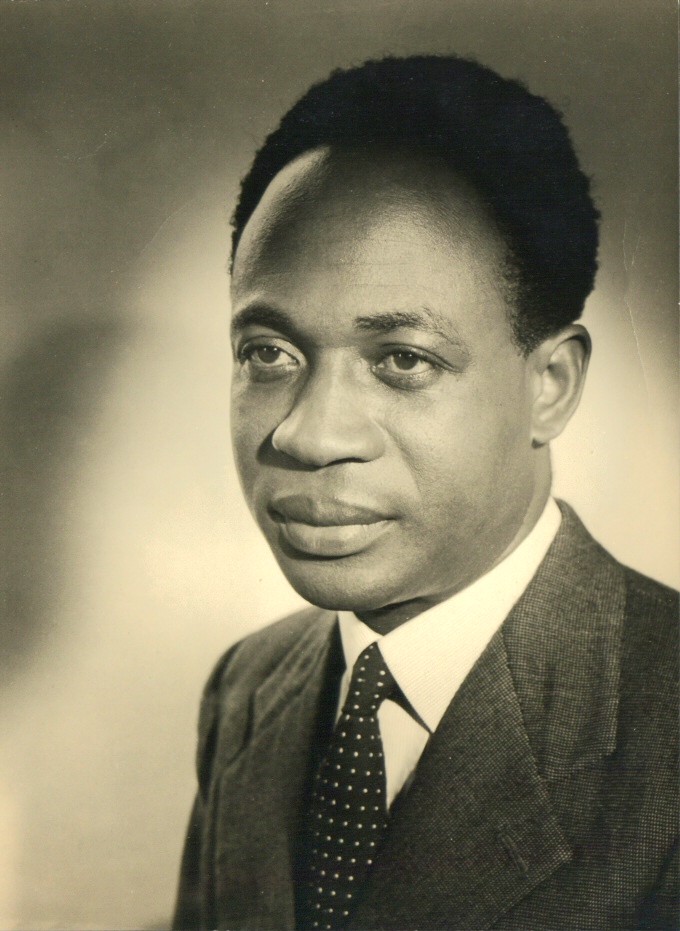
Kwame Nkrumah (1909–1972) was a Ghanaian nationalist, political theorist and revolutionary who led the Gold Coast to independence in 1957, governed Ghana until 1966 and made Pan-African unity central to postcolonial politics.
As leader of the Convention People’s Party (CPP), prime minister and then president, Nkrumah replaced British colonial rule with African government, expanded infrastructure and social provision, and supported liberation movements across the continent. He also concentrated executive power, detained opponents without trial and imposed a one-party state. His career therefore joins two inseparable histories: emancipation from empire and authoritarian state-building after independence.
Key takeaways
- Kwame Nkrumah led the Gold Coast to independence as Ghana on 6 March 1957 and governed until his overthrow in 1966.
- His CPP mobilised constituencies marginalised by colonial politics, then eliminated competitive national politics through detention, coercion and the 1964 one-party referendum.
- Nkrumah’s government expanded primary education from roughly 571,000 pupils in 1957 to about 1.14 million in 1965.
- The Akosombo Dam supported electrification and industry but its 1966 reservoir displaced approximately 80,000 people and submerged about 8,500 square kilometres.
- Nkrumah’s theory of neo-colonialism explained how formally independent states could remain constrained by foreign finance, trade and corporate ownership.
- His legacy combines anti-colonial liberation and Pan-African institution-building with an authoritarian assault on courts, opposition parties and civil liberties.
Who Nkrumah was
Born at Nkroful in the British colony of the Gold Coast on 21 September 1909, Nkrumah trained as a teacher before studying in the United States from 1935 and Britain from 1945. In London, he helped organise the Fifth Pan-African Congress in Manchester in October 1945, where delegates demanded an end to colonial government.
Nkrumah returned home in December 1947 as general secretary of the United Gold Coast Convention. Breaking with its more cautious leadership, he founded the CPP on 12 June 1949 and demanded “self-government now.” Britain imprisoned him after the CPP’s Positive Action campaign began in January 1950, but his party won 34 of 38 popularly elected Legislative Assembly seats in February 1951. Released that month, he became Leader of Government Business and, in March 1952, prime minister.
| Date | Event |
|---|---|
| 21 September 1909 | Born at Nkroful, Gold Coast |
| October 1945 | Helps organise the Fifth Pan-African Congress in Manchester |
| 12 June 1949 | Founds the Convention People’s Party |
| January 1950 | Positive Action begins; colonial authorities imprison him |
| February 1951 | CPP wins 34 of 38 elected seats; Nkrumah is released |
| 6 March 1957 | Gold Coast becomes independent Ghana |
| 1 July 1960 | Ghana becomes a republic; Nkrumah becomes president |
| 25 May 1963 | Helps found the Organisation of African Unity |
| 24 February 1966 | Military and police coup removes him while abroad |
| 27 April 1972 | Dies in Bucharest, Romania |
How Nkrumah acquired and exercised power
Nkrumah built power through mass organisation: CPP branches, newspapers, trade-union links, rallies and a direct anti-colonial message mobilised workers, farmers, veterans, women and younger voters excluded from elite constitutional politics. Electoral victories in 1951, 1954 and 1956 gave the CPP the mandate Britain required before independence on 6 March 1957.
In office, power increasingly moved toward the presidency. The Preventive Detention Act of 1958 permitted detention without trial for up to 5 years; a 1962 amendment extended the possible period to 10 years. After a constitutional referendum held from 19 to 23 June 1964, the government reported 2,773,920 votes for a one-party system and 2,452 against—more than 99.9% approval. The implausible margin, absence of a secret ballot in parts of the process and suppression of opposition made it an instrument of political closure, not credible evidence of unanimity.
“The essence of neo-colonialism is that the State which is subject to it is, in theory, independent and has all the outward trappings of international sovereignty.” — Kwame Nkrumah, 1965, Neo-Colonialism: The Last Stage of Imperialism
The documented record: development, repression and overthrow
Nkrumah’s government funded roads, schools, hospitals, industrial projects and the Volta River Project. The Akosombo Dam, opened in January 1966, created a reservoir covering about 8,500 square kilometres in 1966 and displaced approximately 80,000 people, according to the Volta River Authority’s historical account. Its electricity supported national electrification but also supplied the foreign-controlled Volta Aluminium Company smelter under agreements criticised for favourable power terms.
Education expanded rapidly: World Bank historical series record Ghanaian primary enrolment rising from roughly 571,000 pupils in 1957 to about 1.14 million in 1965. Cocoa revenue and foreign borrowing financed development, but falling cocoa prices, import dependence and expensive prestige projects produced severe external pressures. World Bank data place Ghana’s external public debt at about US$540 million in 1965, compared with about US$27 million in 1957, in current dollars for those years.
The political record was coercive. Historians disagree over the prisoner total because detention changed over time: Dennis Austin reported roughly 1,000 preventive detainees by 1961, while the military government claimed it released 1,700 political detainees after the February 1966 coup. Neither figure proves every case, but both establish repression on a mass scale. Five judges were dismissed in December 1963 after acquittals in the Kulungugu bombing trial.
Nkrumah’s government combined “remarkable achievements” with the destruction of competitive politics; neither record cancels the other.
The defence made for Nkrumah’s rule
Nkrumah and his defenders argued that Ghana faced assassination attempts, bombings, secessionist pressures and foreign destabilisation while trying to transform a colonial export economy. The Kulungugu bombing of 1 August 1962 killed at least 1 person and injured dozens, including Nkrumah. Supporters presented preventive detention and party centralisation as emergency measures against violent subversion rather than ends in themselves.
They also argued that rapid industrialisation required national planning and that Ghana’s resources should finance continental liberation. Nkrumah hosted the All-African Peoples’ Conference in Accra in December 1958, supported anti-colonial movements and became a founding head of state of the Organisation of African Unity on 25 May 1963. The Soviet Union awarded him the Lenin Peace Prize in 1962.
This defence explains the pressures on the government but does not excuse imprisonment without trial, manipulated voting or judicial interference. Anti-imperial purpose is not a substitute for accountable power. Nor does the coup vindicate its perpetrators: on 24 February 1966, the National Liberation Council suspended the constitution, banned the CPP and ruled without an electoral mandate.
Afterlife, contested memory and significance today
The 1966 coup occurred while Nkrumah was travelling to Hanoi. Declassified US records show that American officials welcomed his removal and had maintained contacts with plotters; the available record demonstrates foreknowledge and encouragement, although historians distinguish that from proof that the Central Intelligence Agency operationally directed the coup. Nkrumah lived in Guinea as honorary co-president under Ahmed Sékou Touré until illness took him to Romania, where he died on 27 April 1972, aged 62.
His books—including Africa Must Unite (1963), Consciencism (1964) and Neo-Colonialism (1965)—continue to shape arguments about foreign capital, debt, military bases and commodity dependence. The Organisation of African Unity, which he considered too cautious, was replaced by the African Union on 9 July 2002. Ghana restored his public standing gradually; Parliament established 21 September as Founders’ Day in 2010, while legislation enacted in 2019 redesignated it Kwame Nkrumah Memorial Day.
Nkrumah remains neither an uncomplicated liberator nor merely a dictator. He helped destroy British colonial government, widened access to education and gave institutional force to Pan-Africanism. He also dismantled plural politics and authorised detention without trial. His warning that sovereignty without economic control can remain hollow connects his history directly to modern neocolonial extraction and choices about organised public action.
Sources & further reading
- Encyclopaedia Britannica: Kwame Nkrumah
- US Office of the Historian: Foreign Relations, Ghana and the 1966 coup
- World Bank DataBank: Education statistics
- Volta River Authority: Resettlement history
- Jeffrey S. Ahlman, Living with Nkrumahism
- Kwame Nkrumah, Neo-Colonialism: The Last Stage of Imperialism
Frequently asked questions
- Why is Kwame Nkrumah important?
- Kwame Nkrumah led the Gold Coast to independence as Ghana on 6 March 1957 and became independent Ghana’s first prime minister and, in 1960, its first president. He helped found the Organisation of African Unity in 1963, supported liberation movements and theorised neo-colonial economic control. His government also detained opponents without trial and established a one-party state in 1964.
- Was Kwame Nkrumah a dictator?
- Nkrumah entered government through competitive elections beginning in 1951, but his rule became authoritarian. The 1958 Preventive Detention Act authorised imprisonment without trial for up to 5 years, extended to 10 years in 1962. A heavily manipulated June 1964 referendum made Ghana a one-party state, and the CPP suppressed opposition, restricted the press and interfered with judicial independence.
- What did Kwame Nkrumah mean by neo-colonialism?
- In *Neo-Colonialism: The Last Stage of Imperialism* (1965), Nkrumah described states that possessed formal sovereignty but remained constrained by external finance, investment, military influence and commodity markets. He argued that political flags and constitutions did not guarantee economic independence. The concept remains influential in analysis of debt, multinational corporations, resource extraction and unequal trade.
- How was Kwame Nkrumah overthrown?
- On 24 February 1966, while Nkrumah was travelling to Hanoi, Ghanaian military and police officers seized power and formed the National Liberation Council. Declassified US documents show American foreknowledge, contacts with plotters and satisfaction at his removal, although the surviving evidence does not conclusively establish that the CIA operationally commanded the coup. Nkrumah never returned to power.
- What were Kwame Nkrumah’s main achievements and failures?
- His government secured independence in 1957, expanded primary enrolment from roughly 571,000 pupils in 1957 to 1.14 million in 1965, built infrastructure and promoted African liberation. Its failures included rising debt, costly projects, detention without trial and destruction of multiparty politics. The Akosombo reservoir, completed in 1966, enabled electrification but displaced approximately 80,000 people.
Related chapters
People & institutions
- Jallianwala Bagh massacre: Amritsar, 1919
- Cecil Rhodes: Empire, Mining and Colonial Rule
- Christopher Columbus: Voyages, Enslavement and Colonial Rule
- Elmina Castle: Gold, Slavery and Colonial Power
- Frantz Fanon: Psychiatrist of Colonial Violence
- Hernán Cortés: Conquest, Colonial Rule and Legacy
- Force Publique: Leopold II’s Colonial Army in Congo
- Leopold II of Belgium: Rule, Atrocities and Legacy
- Lothar von Trotha: Architect of Colonial Extermination
Sources & further reading
CC BY 4.0 ·