Dutch East India Company: Trade, War and Colonial Rule
The Dutch East India Company used monopoly, war, slavery and forced production to build an Asian empire from 1602 until its dissolution in 1799.
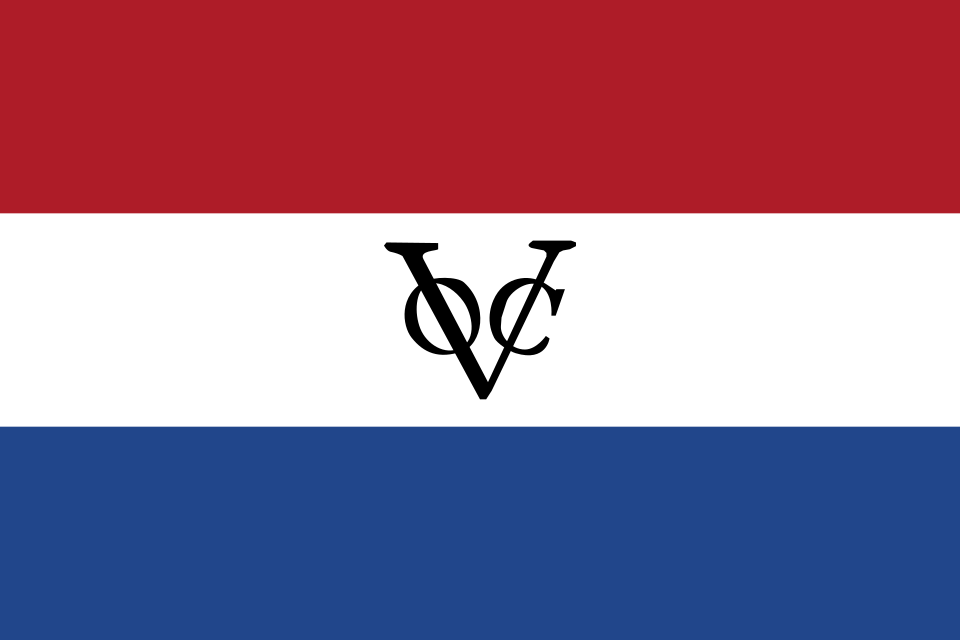
The Dutch East India Company (1602–1799), formally the United East India Company or VOC, was a state-chartered joint-stock corporation that used monopoly, armed force, coerced labor and colonial government to control Asian trade.
Created by the States General on 20 March 1602, the VOC joined six Dutch trading groups under one charter. Its history belongs both to global capitalism and to the Dutch Empire: investors could trade permanent shares, while company officials could make treaties, wage war, build forts, govern territories, enslave people and execute opponents.
Key takeaways
- The VOC was a state-chartered corporation that combined shareholder capital with monopoly, warfare, treaty-making, colonial government and coerced labor.
- Between 1602 and 1795, VOC outward fleets transported about 995,000 people from Europe to Asia across 4,721 voyages.
- The 1621 conquest of Banda killed, expelled or enslaved most inhabitants to secure the company’s global nutmeg monopoly.
- VOC troops and allied civilians killed an estimated 10,000 ethnic Chinese people in Batavia beginning on 9 October 1740.
- When the VOC ended on 31 December 1799, the Dutch state inherited both its colonies and about 134 million guilders of debt.
What the VOC was
The Dutch name Vereenigde Oostindische Compagnie produced the initials VOC. Its governing board, the Heeren XVII, represented six regional chambers. The largest, Amsterdam, subscribed 3.67 million guilders of the initial 6.44 million-guilder capital raised in 1602, according to economic historian Oscar Gelderblom’s reconstruction.
The charter granted a monopoly east of the Cape of Good Hope and west of the Strait of Magellan for 21 years beginning in 1602. Unlike a modern company confined to commerce, the VOC exercised delegated sovereignty. Batavia—founded after Jan Pieterszoon Coen destroyed Jayakarta in 1619—became its Asian headquarters. The network connected the Netherlands with southern Africa, Persia, India, Ceylon, Southeast Asia, China and Japan.
“Trade cannot be maintained without war, nor war without trade.” — Jan Pieterszoon Coen, letter to the Heeren XVII, 1614.
Coen’s formula accurately described the institution: commercial profit and organized violence were mutually sustaining, not separate phases of VOC expansion.
How corporate power worked
VOC power rested on a union of public authority and private investment. The States General supplied legal monopoly and diplomatic standing; shareholders supplied capital; Asian revenues financed fleets, soldiers and forts. Armed blockades and treaties then excluded competitors and compelled producers to sell specified goods at company prices.
In the Banda Islands, the VOC pursued a nutmeg monopoly by destroying trees outside approved areas, deporting survivors and establishing plantations called perken. Enslaved workers cultivated these estates under European leaseholders. In the Moluccas, annual hongi expeditions inspected islands and uprooted unauthorized clove trees. Elsewhere, the company collected taxes, demanded corvée, delivered commodities under quota and exploited political divisions.
The system also depended on slavery. People were purchased, captured or transported from South and Southeast Asia, Madagascar and East Africa to Batavia, the Cape, Ceylon and other settlements. Matthias van Rossum and other historians stress that VOC slavery was an interconnected Indian Ocean system rather than a marginal adjunct to Atlantic slavery.
For the larger structures that enabled this regime, see Dutch colonial expansion and the archive’s history hub.
Documented record: scale, coercion and death
At its height the VOC was an immense shipping and military organization. Between 1602 and 1795, its outward fleets carried about 995,000 people from Europe to Asia on 4,721 voyages, according to the Huygens Institute’s Dutch-Asiatic Shipping database. About 366,900 returned to Europe during 1602–1795; death in service, settlement in Asia and desertion account for much of the difference, so it is not itself a mortality total.
The conquest of Banda in 1621 was among the company’s clearest atrocities. Coen’s forces killed, deported or enslaved much of the population. Historian Willard Hanna estimated a preconquest population of about 15,000 in 1621 and only roughly 1,000 survivors remaining on the islands after the campaign; precise counts are disputed because VOC records categorized escapees, captives and deaths unevenly. Coen ordered 44 Bandanese orang kaya condemned in 1621; Japanese mercenaries carried out their execution and quartering.
The Batavia massacre followed Chinese workers’ unrest and official fears. Beginning on 9 October 1740, VOC troops and civilians killed ethnic Chinese residents. Contemporary and later estimates commonly place the dead at about 10,000 in October 1740, although surviving records do not permit a definitive count.
| Date | Event |
|---|---|
| 20 March 1602 | The States General charters the VOC for an initial 21-year monopoly. |
| 1605 | VOC forces capture Ambon from the Portuguese and consolidate a clove base. |
| 1619 | Coen destroys Jayakarta and establishes Batavia as VOC headquarters. |
| 1621 | VOC forces conquer Banda; 44 leaders are executed and most inhabitants are killed, expelled or enslaved. |
| 1652 | Jan van Riebeeck establishes the VOC station at the Cape of Good Hope. |
| 1658 | The VOC imports 228 enslaved people to the Cape aboard the Amersfoort and Hasselt, according to South African History Online. |
| October 1740 | VOC forces and allied civilians massacre about 10,000 Chinese people in Batavia. |
| 31 December 1799 | The VOC charter expires; the Batavian Republic assumes its debts and possessions. |
These events connect company history to the longer history of colonial violence, not only to innovations in finance.
The defence made for the VOC
Defenders present the VOC as an engine of Dutch prosperity, maritime knowledge and institutional innovation. They point to transferable shares, a secondary securities market, long-distance logistics and sustained commerce between Asian ports. The company did create durable financial and administrative techniques, and much of its trade was intra-Asian rather than a simple Europe–Asia exchange.
The VOC was neither merely a modern business operating ahead of its time nor simply a state overseas: it was a chartered war-making corporation whose profits depended on political privilege and coercion.
That distinction matters. Calling it the “world’s first multinational” can obscure the 1602 monopoly, military conquest and unfree labor that distinguished it from an ordinary competitive enterprise. Claims that violence merely reflected the standards of the period also fail historically: Bandanese communities resisted dispossession, Chinese survivors documented the 1740 killings, and VOC directors repeatedly debated abuses because contemporaries understood their human and political consequences.
Profitability was not permanent. After the Fourth Anglo-Dutch War of 1780–1784 disrupted shipping, debt and administrative weakness deepened. When the charter expired on 31 December 1799, the Batavian Republic inherited company possessions and liabilities estimated by historian Femme Gaastra at about 134 million guilders in 1799.
Afterlife and memory today
The VOC’s territorial apparatus passed into Dutch state empire. Batavia became the center of the Netherlands East Indies, while the Cape settlement shaped dispossession and racialized labor in southern Africa. Plantation systems, commodity controls, archival categories and legal distinctions between European, enslaved and colonized populations outlived the company. See the wider Dutch Empire for that transition.
Public memory remains contested. The reconstructed ship Batavia, VOC warehouses and corporate monograms can turn conquest into maritime spectacle unless interpretation names slavery and massacre. In 2006, Dutch prime minister Jan Peter Balkenende praised a supposed “VOC mentality”; parliamentary critics objected that the phrase ignored colonial violence. Museums including the Rijksmuseum and Amsterdam Museum have since expanded attention to slavery, coerced production and Asian perspectives.
The VOC should therefore be remembered neither as an isolated villain nor as a neutral ancestor of globalization. It was a specific institution created in 1602 by the Dutch state, funded by investors and empowered to convert armed supremacy into private returns. Its archives are unusually extensive, but they predominantly preserve the language of governors, merchants and soldiers. Reading them critically requires recovering the people those officials classified as commodities, labor supplies, rebels or obstacles.
Sources & further reading
- Huygens Institute — Dutch-Asiatic Shipping
- Encyclopaedia Britannica — Dutch East India Company
- Rijksmuseum — Slavery
- South African History Online — The Dutch Settlement
- Cambridge University Press — The Dutch East India Company in Early Modern Japan
- JSTOR — The Massacre of the Chinese in Batavia in 1740
Frequently asked questions
- What was the Dutch East India Company?
- The Dutch East India Company, or VOC, was a joint-stock trading and colonial corporation chartered by the States General on 20 March 1602. Its 21-year monopoly covered Dutch trade east of the Cape of Good Hope and west of the Strait of Magellan. It could wage war, conclude treaties, maintain forts and govern conquered populations before its charter expired on 31 December 1799.
- Why was the VOC so powerful?
- The VOC combined private capital with sovereign powers granted in 1602 by the Dutch Republic. Its Heeren XVII directed fleets, armies, forts and commercial agents across Asia. Monopoly contracts, blockades, conquest, forced deliveries, corvée and enslaved labor enabled it to control commodities including nutmeg and cloves rather than relying solely on voluntary market exchange.
- How many people did the VOC kill in the Banda Islands?
- No complete death register survives. Willard Hanna estimated that Banda had about 15,000 inhabitants before Jan Pieterszoon Coen’s 1621 conquest and roughly 1,000 remained afterward. The remainder were killed, enslaved, deported or escaped, so the difference cannot be treated solely as deaths. The VOC separately executed 44 Bandanese leaders in 1621.
- Did the Dutch East India Company use enslaved labor?
- Yes. During its 1602–1799 existence, the VOC bought, captured and transported enslaved people across the Indian Ocean, including to Batavia, Ceylon, Banda and the Cape. In 1658 alone, the ships *Amersfoort* and *Hasselt* delivered 228 enslaved people to the Cape, according to South African History Online. Enslaved workers were central to households, docks, farms and plantations.
- Why did the VOC collapse?
- The VOC declined through mounting debt, corruption, high military costs, changing commodity markets and British competition. The Fourth Anglo-Dutch War of 1780–1784 severely disrupted shipping. Its charter expired on 31 December 1799, when the Batavian Republic absorbed its territories and liabilities; historian Femme Gaastra places the company’s debt at about 134 million guilders in 1799.
Related chapters
People & institutions
- Jallianwala Bagh massacre: Amritsar, 1919
- Cecil Rhodes: Empire, Mining and Colonial Rule
- Christopher Columbus: Voyages, Enslavement and Colonial Rule
- Elmina Castle: Gold, Slavery and Colonial Power
- Frantz Fanon: Psychiatrist of Colonial Violence
- Hernán Cortés: Conquest, Colonial Rule and Legacy
- Force Publique: Leopold II’s Colonial Army in Congo
- Kwame Nkrumah: Independence, Pan-Africanism and Power
- Leopold II of Belgium: Rule, Atrocities and Legacy
Sources & further reading
CC BY 4.0 ·