The Berlin Conference, 1884–1885
How the Berlin Conference created rules for European conquest in Africa, excluded Africans, and accelerated partition, forced labor, and colonial rule.
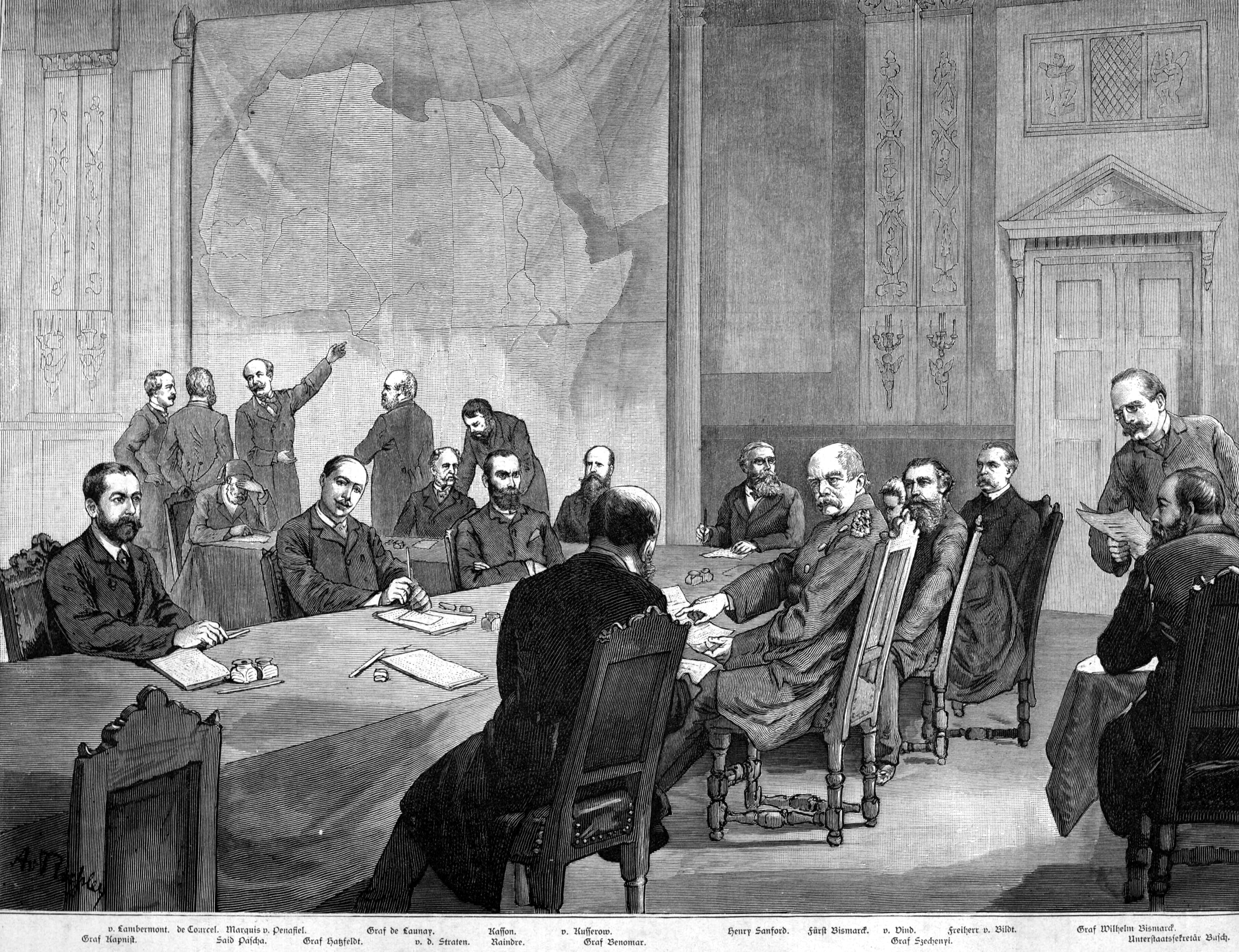
The Berlin Conference was a diplomatic meeting of 14 states held from 15 November 1884 to 26 February 1885 that established rules for European trade, navigation, and colonial occupation in Africa.
Convened in Berlin by German chancellor Otto von Bismarck at the urging of Belgium’s King Leopold II, it did not literally draw every later African border. It did something more immediately consequential: its General Act converted imperial rivalry into a shared legal framework for claiming territory. No African ruler or representative participated, although the decisions concerned African land, sovereignty, labor, and commerce.
Key takeaways
- The Berlin Conference met from 15 November 1884 to 26 February 1885 and excluded every African ruler and representative.
- Its General Act made European notification and effective authority—not African consent—the basis for recognizing new colonial occupations.
- European control expanded from roughly 10% of African territory in 1870 to nearly 90% by 1914.
- Berlin did not draw every colonial border, but it accelerated the invasions and agreements through which those borders emerged.
- Humanitarian claims against slavery coexisted with forced labor, land seizure, punitive taxation, mass killing, and racialized colonial government.
What the Berlin Conference was
Delegates from Austria-Hungary, Belgium, Denmark, France, Germany, Italy, the Netherlands, the Ottoman Empire, Portugal, Russia, Spain, Sweden–Norway, the United Kingdom, and the United States attended. The United States signed the General Act in 1885 but never ratified it. Bismarck chaired proceedings at the German Chancellery on Wilhelmstrasse.
The immediate disputes concerned the Congo Basin, Portuguese claims around the Congo River mouth, commercial access, and the danger that competing European occupations might trigger war. Leopold II’s International Association of the Congo secured recognition from major states during this diplomatic process; it became the Congo Free State in 1885, under Leopold’s personal sovereignty rather than Belgian state administration.
“All the Powers exercising sovereign rights or influence in the aforesaid territories bind themselves to watch over the preservation of the native tribes.” — General Act of the Berlin Conference, Article VI, 1885.
This promise coexisted with a system that denied those peoples representation and treated European authority as the source of internationally recognizable title. See the archive’s broader histories of colonial expansion and racialized domination.
How the mechanism of power worked
The General Act declared commercial freedom across the conventional Congo Basin, free navigation on the Congo and Niger rivers, procedures for future coastal claims, and a stated commitment to suppress the slave trade. Its decisive mechanism was the principle commonly called effective occupation: a power making a new claim on an African coast had to notify the other signatories and demonstrate sufficient authority to protect existing rights and commercial freedom.
The text did not require African consent. European recognition, treaties obtained under coercive or deceptive conditions, military posts, taxation, chartered companies, and armed expeditions became instruments for converting claims into possession. Although Articles XXXIV and XXXV formally addressed new occupations on African coasts, the ensuing scramble extended far inland.
Chartered enterprises and concessionary regimes shifted conquest costs onto investors while granting them coercive powers. European states then used African troops, porters, taxes, forced cultivation, and compulsory labor to make occupation pay. This architecture connected diplomacy in Europe to violence documented throughout the archive’s pages on empires and colonial history.
The documented record and human consequences
In 1870, European powers controlled roughly 10% of Africa’s territory, according to the historical synthesis used by Encyclopaedia Britannica; by 1914 they controlled nearly 90%, with Ethiopia and Liberia remaining the principal independent states. Such percentages vary with definitions of nominal claim and actual administration, but the direction and speed are uncontested.
The conference itself has no defensible standalone death toll: the killing occurred through the conquests and labor systems its framework facilitated. In the Congo Free State, demographic catastrophe resulted from killings, hostage-taking, forced rubber collection, famine, flight, and falling births. Historian Adam Hochschild estimated in 1998 that the population fell by about 10 million between approximately 1880 and 1920, while scholars including Jan Vansina cautioned that absent reliable precolonial censuses, no precise death total can be established. The Royal Museum for Central Africa summarizes scholarly estimates as a population loss ranging from several million to approximately 10 million during Leopoldian rule and its aftermath.
Across German South West Africa, German forces pursued the Herero and Nama in 1904–1908. Germany’s government stated in its 2021 recognition of genocide that about 65,000 of approximately 80,000 Herero and at least 10,000 of approximately 20,000 Nama were killed. These crimes were not clauses in the General Act; they were consequences of the wider conquest order that Berlin regularized.
| Date | Event |
|---|---|
| 1876 | Leopold II convenes the Brussels Geographical Conference and establishes an ostensibly humanitarian vehicle for expansion in Central Africa. |
| 15 November 1884 | Bismarck opens the conference in Berlin with delegates from 14 states and no African representatives. |
| 26 February 1885 | Delegates sign the General Act after 104 days, including the adjournment period. |
| 1 July 1885 | Leopold II formally proclaims the Congo Free State under his personal rule. |
| 1890 | The Brussels Conference Act expands international rules against slave trading while legitimizing deeper colonial intervention. |
| 1904–1908 | German colonial forces commit genocide against the Herero and Nama in German South West Africa. |
| 15 November 1908 | Belgium annexes the Congo Free State after international exposure of atrocities. |
| 1914 | European empires control nearly 90% of African territory, according to Encyclopaedia Britannica’s historical estimate. |
The defense made for the conference
Bismarck presented the meeting as a means to protect commerce, navigation, peace, missionary activity, and African welfare. Leopold’s agents claimed that their association would suppress East African and internal slave trading, open Central Africa to legitimate commerce, and promote civilization. The General Act condemned slave trading and required powers to aid its suppression.
The conference’s humanitarian language functioned as authorization: European powers defined “civilization,” judged African governments, and reserved enforcement to themselves.
Some outcomes—especially international navigation rules and formal condemnation of slave trading—were defended as multilateral restraints. Yet the same agreement protected merchants and missionaries without recognizing African political equality. Colonial administrations frequently replaced or compounded existing enslavement with forced labor, punitive taxation, land seizure, and coerced commodity production. The defense therefore fails against the institutional design and documented practice: humanitarian obligations were weak, while mechanisms securing occupation and commerce were actionable.
Afterlife, responsibility, and memory today
The partition intensified after 1885 through war and treaties negotiated without meaningful consent. Colonial borders often consolidated distinct societies or divided existing polities; post-independence governments generally retained them to avoid territorial wars. In 1964, the Organization of African Unity adopted its Cairo resolution committing member states to respect borders existing at independence.
Public memory now treats Berlin as shorthand for the Scramble for Africa. That shorthand is useful if it does not erase African resistance, earlier imperial projects, or the later decisions of named governments and companies. Responsibility belongs not to an abstract “Europe” alone but to monarchs, ministers, officers, concessionaires, financiers, and institutions that designed and enforced particular regimes.
Germany has increasingly acknowledged colonial crimes but has not converted remembrance of the conference into comprehensive reparative settlement. In 2021, Germany recognized the 1904–1908 Herero and Nama killings as genocide and announced a €1.1 billion development program over 30 years; Herero and Nama representatives criticized both their exclusion from direct negotiations and the refusal to frame the money as legally enforceable reparations. Current debates encompass restitution of looted objects and human remains, archival access, debt, borders, land, and compensation. They connect the conference to the unfinished record of empire rather than treating 1885 as a closed episode.
Sources & further reading
- General Act of the Berlin Conference, 1885 — Avalon Project, Yale Law School
- Berlin West Africa Conference — Encyclopaedia Britannica
- The Berlin Conference — German Historical Institute
- Conrad’s Heart of Darkness and the Historians — Journal of African History, Cambridge Core
- Germany apologises for genocide in Namibia — United Nations
- General History of Africa — UNESCO
Frequently asked questions
- What was the Berlin Conference and when did it happen?
- The Berlin Conference was a meeting of 14 states held in Berlin from 15 November 1884 to 26 February 1885. Convened by German chancellor Otto von Bismarck at King Leopold II’s urging, it adopted the General Act regulating trade, navigation, and recognition of new European occupations in Africa. No African representative participated.
- Did the Berlin Conference divide Africa?
- Not by drawing a complete continental map in 1885. The 14 participating states created rules for notifying claims and demonstrating effective authority, while recognizing commercial and navigational arrangements in the Congo and Niger regions. The practical division followed through bilateral treaties, military conquests, company rule, and occupations that left European empires controlling nearly 90% of Africa by 1914.
- Which countries attended the Berlin Conference?
- Fourteen states attended in 1884–1885: Austria-Hungary, Belgium, Denmark, France, Germany, Italy, the Netherlands, the Ottoman Empire, Portugal, Russia, Spain, Sweden–Norway, the United Kingdom, and the United States. The United States signed the 1885 General Act but did not ratify it. No African kingdom, state, ruler, or community received representation.
- What did effective occupation mean after the Berlin Conference?
- Under Articles XXXIV and XXXV of the 1885 General Act, a European power claiming new African coastal territory had to notify other signatories and establish authority capable of protecting rights and commercial freedom. In practice, states demonstrated control through treaties, military posts, taxation, administrations, and armed coercion. African consent was not the international legal test.
- How many people died because of the Berlin Conference?
- There is no credible single death toll for the conference itself. Its colonial order facilitated separately documented catastrophes. Adam Hochschild estimated in 1998 that Congo’s population declined by about 10 million between approximately 1880 and 1920, though Jan Vansina and others stress severe data limits. Germany stated in 2021 that about 65,000 Herero and at least 10,000 Nama were killed in 1904–1908.
Related chapters
People & institutions
- Jallianwala Bagh massacre: Amritsar, 1919
- Cecil Rhodes: Empire, Mining and Colonial Rule
- Christopher Columbus: Voyages, Enslavement and Colonial Rule
- Elmina Castle: Gold, Slavery and Colonial Power
- Frantz Fanon: Psychiatrist of Colonial Violence
- Hernán Cortés: Conquest, Colonial Rule and Legacy
- Force Publique: Leopold II’s Colonial Army in Congo
- Kwame Nkrumah: Independence, Pan-Africanism and Power
- Leopold II of Belgium: Rule, Atrocities and Legacy
Sources & further reading
CC BY 4.0 ·