The Sykes–Picot Agreement: Partition by Empire
How Britain and France secretly negotiated the 1916 Sykes–Picot Agreement, divided Ottoman Arab lands, and shaped later mandates and borders.
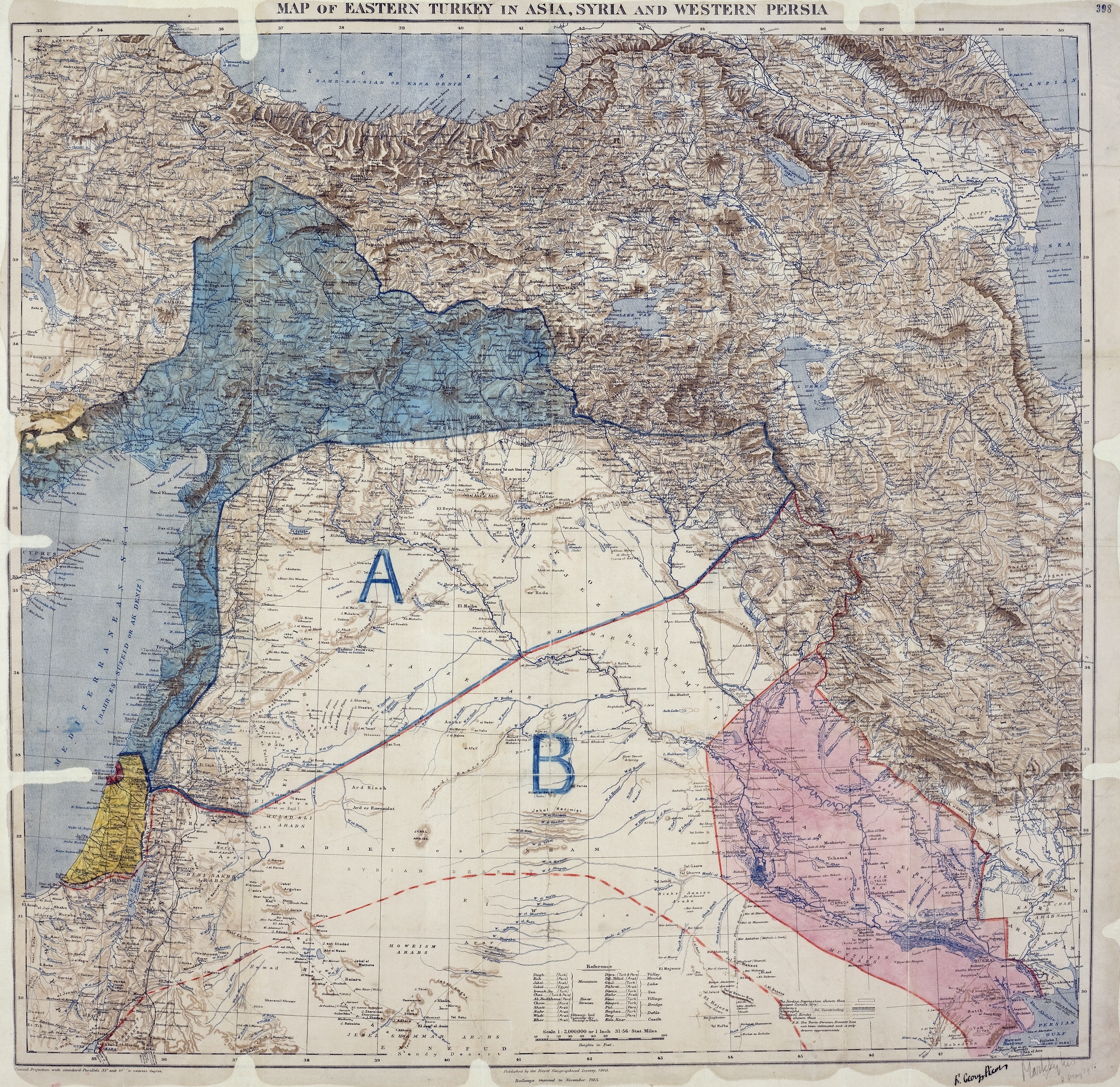
The Sykes–Picot Agreement was a secret Anglo-French partition agreement negotiated from November 1915 to May 1916 and concluded on 16 May 1916, with Russian assent, to allocate control and influence across Ottoman Arab territories after an anticipated Allied victory.
Named after British diplomat Sir Mark Sykes and French diplomat François Georges-Picot, it did not itself draw every modern Middle Eastern border. It did expose the imperial logic behind the postwar settlement: European governments assigned territories inhabited by millions without consulting their populations, while Britain separately encouraged an Arab revolt against Ottoman rule. Its substance belongs to the archive of colonial history; its political afterlife extends into debates over mandates, oil, borders and neocolonial power.
Key takeaways
- The 1916 Sykes–Picot Agreement secretly allocated Ottoman Arab territories between British and French zones of direct control and privileged influence.
- It conflicted with Arab expectations created during the 1915–1916 Hussein–McMahon correspondence and exposed the imperial limits of Allied promises.
- The agreement influenced, but did not single-handedly create, the borders established through war, San Remo and the 1922 mandate system.
- Contemporary records indicate that postwar mandate decisions affected at least about 6.6 million residents across Iraq, Palestine, Syria and Lebanon by 1922.
- Sykes–Picot endures as evidence that European powers assigned sovereignty, economic privilege and strategic territory without obtaining popular consent.
What the agreement was
Sykes–Picot was an exchange of diplomatic notes between British foreign secretary Sir Edward Grey and French ambassador Paul Cambon, completed on 16 May 1916. Sykes and Picot had negotiated its map and terms. Russia approved the settlement in 1916 after securing Allied recognition of its claims to Constantinople and Ottoman Armenian territories; Italy was subsequently accommodated through the 1917 Agreement of Saint-Jean-de-Maurienne.
The agreement envisaged direct French control in a coastal “blue area,” including much of present-day Lebanon and coastal Syria, and direct British control in a southern “red area,” including Basra and Baghdad. Inland “A” and “B” zones would contain an Arab state or confederation, but France and Britain would respectively enjoy priority in enterprises, loans, advisers and administration. Palestine was assigned an international administration, except for specified ports and adjustments.
“France and Great Britain are prepared to recognize and protect an independent Arab state or a confederation of Arab states … under the suzerainty of an Arab chief.” — Sir Edward Grey to Paul Cambon, 9 May 1916, annex to the Sykes–Picot correspondence
The promised “independence” was therefore constrained at inception. The powers reserved preferential economic and administrative rights before any Arab government existed.
How partition operated as a mechanism of power
The agreement converted wartime diplomacy into a hierarchy of territorial control. Its colored map separated direct rule from indirect dominance: occupation and administration in the red and blue areas; exclusive advisory and commercial privilege in zones A and B; and internationalized government in Palestine. Ports, railways, customs and access to Mediterranean trade mattered as much as formal sovereignty.
Britain was simultaneously conducting the Hussein–McMahon correspondence from 14 July 1915 to 10 March 1916. Sharif Hussein ibn Ali understood those exchanges as supporting broad Arab independence in return for revolt against the Ottoman Empire; London later argued that territorial reservations excluded key areas. The Arab Revolt began on 10 June 1916, less than one month after Sykes–Picot was concluded.
The arrangement also intersected with oil strategy. The Turkish Petroleum Company, reorganized in 1914, held an Ottoman concession claim in Mesopotamia; after war and further negotiation, the 1928 Red Line Agreement distributed its ownership among British, French, American and other interests. This longer history links formal partition to the extractive structures examined in the archive’s neocolonies hub.
Documented record and dated timeline
The diplomatic record shows overlapping commitments rather than one seamless blueprint. Sykes–Picot was superseded and modified by military occupation, the 1917 Balfour Declaration, the 1920 San Remo decisions and League of Nations mandates approved in 1922. Yet personnel and strategic assumptions carried forward.
| Date | Documented event |
|---|---|
| 14 July 1915 | Hussein–McMahon correspondence begins between Sharif Hussein and Sir Henry McMahon. |
| 23 November 1915 | Sykes and Picot begin formal discussions over Ottoman partition. |
| 9–16 May 1916 | Grey and Cambon exchange notes concluding the agreement on 16 May. |
| 10 June 1916 | The Arab Revolt begins in the Hejaz. |
| 2 November 1917 | Britain issues the Balfour Declaration supporting a “national home for the Jewish people” in Palestine. |
| 23 November 1917 | Izvestia publishes the secret agreement after the Bolsheviks release tsarist diplomatic records. |
| 25 April 1920 | San Remo assigns Britain mandates for Iraq and Palestine and France mandates for Syria and Lebanon. |
| 24 July 1922 | The League of Nations Council approves the Palestine and Syria-Lebanon mandates. |
| 3 October 1932 | Iraq enters the League of Nations after formal termination of the British mandate. |
The territorial scale was vast. The League’s 1922 mandate instruments covered Iraq, Palestine and Transjordan under Britain, and Syria and Lebanon under France. For population context—not a count of people governed by Sykes–Picot itself—the British Report on the Administration of Iraq estimated Iraq’s population at approximately 2.85 million in 1920; the British 1922 Palestine census counted 757,182 people; and the French 1921 census reported roughly 3.0 million across the mandated states of Syria and Lebanon, though its categories and coverage were contested. These contemporary totals indicate that European decisions affected at least about 6.6 million residents across the principal mandate territories by 1922, without constituting a single harmonized census estimate.
These figures must not be mistaken for a death toll. Sykes–Picot was a diplomatic instrument, not a single killing operation, and historians do not assign it an attributable mortality figure. Subsequent mandate conquest and repression caused documented deaths: French forces killed roughly 400 Syrian fighters at Maysalun on 24 July 1920, according to commonly cited military histories; estimates for deaths during the 1920 Iraqi Revolt range from about 6,000 to 10,000 Iraqis, while British official figures recorded 426 British and Indian military dead.
The imperial defence and its limits
British and French officials defended partition as wartime necessity, compensation for military burdens, protection of communications and a framework for governing former Ottoman provinces. The later mandate system claimed a tutelary purpose rather than annexation. Article 22 of the League Covenant, adopted on 28 June 1919, described former Ottoman communities as having reached a stage where their existence as independent nations could be “provisionally recognized,” subject to administrative advice.
“The wishes of these communities must be a principal consideration in the selection of the Mandatory.” — Covenant of the League of Nations, Article 22, 1919
That principle was not honored through free regional consent. Britain and France selected the settlement through Allied conferences and then suppressed resistance. The 1919 King–Crane Commission found strong opposition in Syria to French control and to the Zionist program as then understood, but its report was not published until 1922, after the 1920 San Remo allocation. The defence of orderly tutelage concealed a racial hierarchy: European governments treated Arabs as politically immature while claiming their territory, revenues and strategic routes.
Afterlife, borders and public memory
Sykes–Picot became shorthand for externally imposed borders, betrayal and the wider dismantling of Ottoman sovereignty. That shorthand is useful only with qualification. The final frontiers emerged through the 1918–1923 military and diplomatic settlement, including San Remo in 1920, the mandates approved in 1922, the 1921 creation of Transjordan’s administration, and the 1926 settlement of the Mosul dispute in Iraq’s favor. Local rulers, anti-colonial movements and regional conflicts also shaped outcomes.
The agreement’s secrecy magnified its symbolic force. Bolshevik publication on 23 November 1917 embarrassed Britain and France and gave Arab leaders documentary evidence that Allied professions of self-determination coexisted with plans for imperial control. In June 2014, the Islamic State group filmed militants breaching the Iraq–Syria frontier under the slogan “the end of Sykes–Picot.” The claim was historically misleading: that precise border was not simply a line fixed by the 1916 agreement, and destroying it inaugurated coercive rule rather than liberation.
Memory should therefore distinguish document from system. Sykes–Picot neither explains every conflict nor absolves later governments and armed groups. It remains decisive evidence of how imperial states negotiated sovereignty over populations absent from the room. Its archive belongs alongside the broader histories of empire and resistance and the continuing study of strategic extraction under neocolonialism.
Sources & further reading
- The Sykes–Picot Agreement, Avalon Project, Yale Law School
- The 1919 King–Crane Commission Report, Oberlin College archive
- Covenant of the League of Nations, United Nations Office at Geneva
- James Barr, A Line in the Sand, Simon & Schuster
- David Fromkin, A Peace to End All Peace, Macmillan
- The Sykes–Picot Agreement and the making of the modern Middle East, Encyclopaedia Britannica
Frequently asked questions
- What was the Sykes–Picot Agreement?
- The Sykes–Picot Agreement was a secret British-French arrangement concluded on 16 May 1916. Negotiated by Sir Mark Sykes and François Georges-Picot, with Russian assent, it allocated prospective zones of direct control and privileged influence in Ottoman Arab territories. It envisaged French and British areas, constrained Arab statehood and an international administration for most of Palestine.
- Did Sykes–Picot create the modern borders of the Middle East?
- Not by itself. The 1916 agreement established imperial claims and spheres, but war and later decisions altered its map. San Remo allocated mandates on 25 April 1920; the League approved mandate instruments in 1922; Transjordan received a separate administration in 1921; and the Mosul dispute was settled in 1926. Sykes–Picot shaped the framework, not every final frontier.
- Did Britain promise the same land to Arabs and France?
- The commitments overlapped and their wording remains disputed. During the Hussein–McMahon correspondence of 14 July 1915 to 10 March 1916, Britain encouraged expectations of Arab independence while reserving certain districts. On 16 May 1916, it concluded Sykes–Picot with France, assigning zones of control and influence. Arab leaders were neither parties to nor informed of that secret agreement.
- Why was the Sykes–Picot Agreement secret?
- Secrecy allowed Britain and France to coordinate imperial claims during World War I without public scrutiny or Arab consent. After the Bolsheviks took power in Russia, they released tsarist diplomatic documents; *Izvestia* published the agreement on 23 November 1917. Its disclosure demonstrated that Allied rhetoric about liberation coexisted with plans for partition and preferential economic control.
- How many people did the Sykes–Picot Agreement affect?
- No single census measured the agreement’s population. Contemporary administrative figures counted or estimated about 2.85 million people in Iraq in 1920, roughly 3.0 million in Syria and Lebanon in 1921, and exactly 757,182 in Palestine in the 1922 British census. Together these indicate at least about 6.6 million residents in principal mandate territories, although methodologies differed.
Related chapters
People & institutions
- Jallianwala Bagh massacre: Amritsar, 1919
- Cecil Rhodes: Empire, Mining and Colonial Rule
- Christopher Columbus: Voyages, Enslavement and Colonial Rule
- Elmina Castle: Gold, Slavery and Colonial Power
- Frantz Fanon: Psychiatrist of Colonial Violence
- Hernán Cortés: Conquest, Colonial Rule and Legacy
- Force Publique: Leopold II’s Colonial Army in Congo
- Kwame Nkrumah: Independence, Pan-Africanism and Power
- Leopold II of Belgium: Rule, Atrocities and Legacy
Sources & further reading
CC BY 4.0 ·