Thomas Sankara: Revolution, Record and Assassination
Thomas Sankara led Burkina Faso from 1983 to 1987, pursuing vaccination, land reform and women’s emancipation before his assassination.
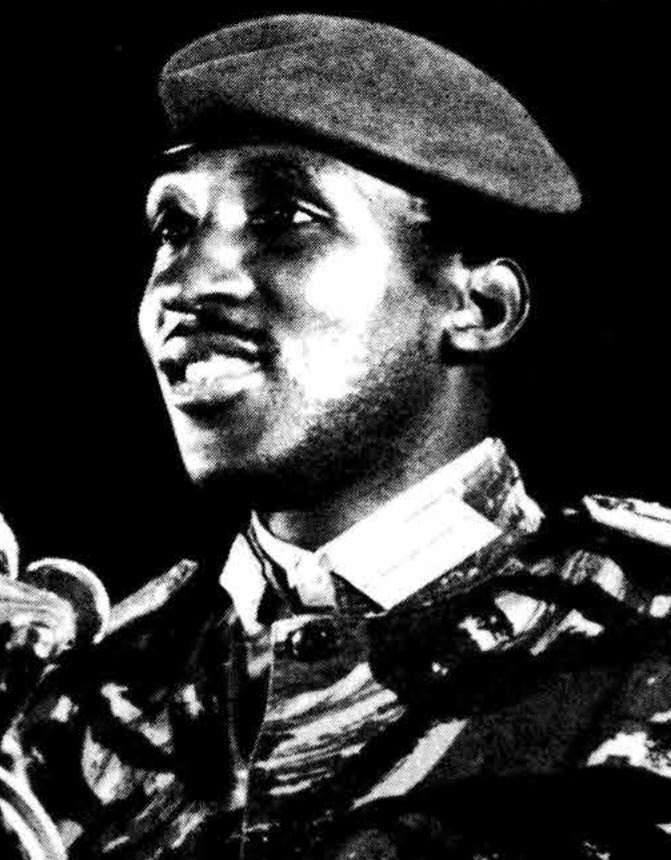
Thomas Isidore Noël Sankara (1949–1987) was a Burkinabè army officer, Marxist revolutionary and Pan-Africanist who governed Burkina Faso from 4 August 1983 until his assassination on 15 October 1987.
Sankara renamed Upper Volta as Burkina Faso, rejected foreign tutelage and used a military-backed revolutionary state to pursue mass vaccination, land redistribution, public works and women’s emancipation. His government also suppressed unions, opposition parties and independent media through exceptional tribunals and Committees for the Defence of the Revolution. His record therefore joins consequential social reform to coercive one-party rule—and ends with a killing for which his former ally Blaise Compaoré was convicted in absentia in 2022.
Key takeaways
- Thomas Sankara governed Burkina Faso from 1983 until his assassination in 1987, combining anti-imperialist reform with unelected, coercive revolutionary rule.
- A 15-day vaccination campaign in 1984 reached approximately 2.5 million children against measles, meningitis and yellow fever.
- Sankara advanced land reform, local production and women’s emancipation, while revolutionary committees and tribunals curtailed opposition, unions and due process.
- Armed men assassinated Sankara and 12 colleagues on 15 October 1987, enabling Blaise Compaoré to seize and retain power.
- In 2022, a Burkinabè military court convicted Compaoré and two senior associates of complicity in Sankara’s murder, imposing life sentences.
Who Thomas Sankara was
Born in Yako on 21 December 1949, Sankara trained as an officer in Madagascar, where he witnessed the 1972 uprising against President Philibert Tsiranana. In Upper Volta he helped form the clandestine Communist Officers’ Group and acquired a reputation for personal austerity.
Colonel Saye Zerbo appointed him secretary of state for information in September 1981; Sankara resigned in April 1982 while denouncing authoritarian government. Major Jean-Baptiste Ouédraogo made him prime minister in January 1983, but removed and detained him in May 1983. Captain Blaise Compaoré and allied soldiers seized Ouagadougou on 4 August 1983 and installed Sankara as president of the National Council of the Revolution.
His administration renamed the country Burkina Faso—commonly translated as “land of upright people”—on 4 August 1984. Sankara framed the revolution as anti-imperialist: political independence meant little, he argued, while debt, imported goods and donor priorities constrained African states. This history belongs within the archive’s account of neocolonies, not merely Cold War biography.
How revolutionary power worked
Sankara governed through the National Council of the Revolution, the armed forces and local Committees for the Defence of the Revolution, rather than competitive elections. The committees mobilised residents for vaccination, literacy, policing and public works, but also monitored opponents and displaced established chiefs, civil servants, unions and parties.
Popular Revolutionary Tribunals publicly tried officials accused of corruption and political offences. Proceedings were popular with some citizens because they challenged impunity, yet defendants lacked ordinary judicial safeguards. The government dismissed about 2,500 striking teachers in March 1984, according to contemporary reporting and later historical accounts, replacing many with hurriedly trained recruits. Trade-union activists were arrested, newspapers constrained and political organisations outside the revolutionary structure prohibited.
His government reduced ministerial privileges, promoted locally woven Faso dan fani, opposed female genital cutting and forced marriage, and appointed women to senior office. It also organised mass labour for roads, schools, wells and the 1984–1985 “Battle for the Railway.” Participation mixed enthusiasm, social pressure and state command.
Documented social and economic record
The clearest measurable achievement was preventive medicine. UNICEF and World Health Organization accounts report that approximately 2.5 million children were vaccinated during a 15-day campaign in 1984 against measles, meningitis and yellow fever. World Bank historical series record life expectancy rising from about 49 years in 1983 to about 52 years in 1987; this national indicator reflects multiple causes and cannot be attributed solely to Sankara.
The government redistributed land and challenged chiefly control, promoted cereal production and planted trees against desertification. Claims that wheat output reached 3,900 kilograms per hectare in 1986, often attributed to UN reporting, concern selected projects rather than a secure nationwide yield and should not be treated as national proof of food self-sufficiency. Burkina Faso still faced drought, limited state capacity and dependence on commodity earnings.
“Debt cannot be repaid, first because if we don’t repay, lenders will not die. That is for sure. But if we repay, we are going to die.” — Thomas Sankara, 1987, address to the Organisation of African Unity summit in Addis Ababa
His debt speech connected repayment demands to colonial extraction and urged collective African refusal. See neocolonies for the wider structure and action for responsible ways to support historical documentation.
Defences, criticisms and the assassination
Supporters defend Sankara as an unusually austere leader who redirected scarce resources toward public health, women and rural communities while confronting French influence. They argue that revolutionary mobilisation was necessary because Upper Volta’s inherited state served urban elites, chiefs and external creditors. Sankara himself treated emancipation as inseparable from gender equality:
“The revolution and women’s liberation go together. We do not talk of women’s emancipation as an act of charity.” — Thomas Sankara, 1987, “The Revolution Cannot Triumph Without the Emancipation of Women”
That defence does not answer evidence of authoritarian rule. Unions and former comrades accused the committees of denunciation, assault and arbitrary punishment; dismissed teachers and detained critics bore direct costs. Sankara acknowledged “excesses” but retained the institutions enabling them.
On 15 October 1987, armed men killed Sankara and 12 colleagues during a meeting in Ouagadougou. Compaoré immediately took power and ruled for 27 years, from 1987 until a popular uprising removed him in 2014. Burkina Faso’s military court convicted Compaoré, Hyacinthe Kafando and Gilbert Diendéré of complicity in Sankara’s murder on 6 April 2022; each received a life sentence, with Compaoré and Kafando tried in absentia. The court convicted eight other defendants and acquitted three in 2022. No judicial finding has established that France ordered the assassination, despite longstanding suspicions about regional and foreign interests.
| Date | Event |
|---|---|
| 21 December 1949 | Sankara is born in Yako, French Upper Volta. |
| January 1983 | President Ouédraogo appoints Sankara prime minister. |
| 17 May 1983 | Sankara is removed and detained. |
| 4 August 1983 | A coup installs him as head of the National Council of the Revolution. |
| 4 August 1984 | Upper Volta becomes Burkina Faso. |
| November 1984 | A 15-day campaign vaccinates about 2.5 million children, according to UNICEF and WHO accounts. |
| 29 July 1987 | Sankara calls at the OAU summit for collective resistance to African debt. |
| 15 October 1987 | Sankara and 12 colleagues are assassinated. |
| 6 April 2022 | A military court convicts Compaoré and others in the murder case. |
Afterlife and memory today
Sankara became a transnational symbol of anti-imperialism after Compaoré’s government reversed many policies, restored relations with international lenders and marginalised investigation of the murder. His speeches circulate among African social movements, while his image is invoked by parties with sharply different commitments.
Burkina Faso’s 2014 uprising renewed demands for justice. Sankara’s remains were exhumed in 2015, and the 2021–2022 trial established individual criminal responsibility after decades of obstruction. In October 2023, Burkina Faso’s transitional authorities declared Sankara a “Hero of the Nation”; the state also renamed Ouagadougou’s principal boulevard after him in October 2023. Such official commemoration can illuminate suppressed history, but it can also convert a contested revolutionary into usable state symbolism.
Remembering Sankara responsibly requires holding together his anti-colonial programme, measurable health intervention and advocacy for women with his unelected seizure of power and repression of organised dissent. Historical solidarity is not leader worship: readers can consult action and the archive’s analysis of neocolonies.
Sources & further reading
- Britannica: Thomas Sankara
- Encyclopedia.com: Thomas Sankara
- World Bank: Life expectancy at birth, Burkina Faso
- Reuters: Burkina Faso court sentences ex-president Compaoré over Sankara murder
- BBC News: Thomas Sankara murder trial in Burkina Faso
- African Studies Quarterly: Thomas Sankara and the Burkinabè Revolution
Frequently asked questions
- Who was Thomas Sankara?
- Thomas Sankara was a Burkinabè army officer, Marxist and Pan-Africanist born in 1949. Installed by a coup on 4 August 1983, he governed Burkina Faso until armed men assassinated him and 12 colleagues on 15 October 1987. His government pursued vaccination, land reform, women’s emancipation and economic self-reliance while suppressing political opposition and independent unions.
- What did Thomas Sankara achieve in Burkina Faso?
- Sankara’s government organised a 15-day vaccination campaign in 1984 that UNICEF and WHO accounts say reached about 2.5 million children. It redistributed land, promoted locally made clothing, built infrastructure, challenged female genital cutting and forced marriage, and elevated women politically. These reforms operated within an unelected revolutionary state that dismissed about 2,500 striking teachers in 1984 and restricted organised opposition.
- Was Thomas Sankara a dictator?
- Sankara took power through a military coup on 4 August 1983 and faced no competitive national election before his death in 1987. His government ruled through the National Council of the Revolution, revolutionary committees and exceptional tribunals. Although it delivered popular reforms and attacked elite privilege, it also banned rival politics, detained critics, constrained unions and permitted serious abuses, making its rule authoritarian.
- Who killed Thomas Sankara?
- A commando killed Thomas Sankara and 12 colleagues in Ouagadougou on 15 October 1987. On 6 April 2022, a Burkinabè military court convicted former president Blaise Compaoré, Hyacinthe Kafando and Gilbert Diendéré of complicity; all three received life sentences. Compaoré and Kafando were tried in absentia. The court did not establish that France ordered the assassination.
- Why is Thomas Sankara still important?
- Sankara remains influential because his 1983–1987 programme linked African sovereignty to debt resistance, public health, women’s liberation, land reform and reduced official privilege. His 1987 Organisation of African Unity speech warned that servicing foreign debt could be lethal for African societies. His legacy also poses a continuing question: whether transformative social policy can be separated from coercive, unelected political power.
Related chapters
People & institutions
- Jallianwala Bagh massacre: Amritsar, 1919
- Cecil Rhodes: Empire, Mining and Colonial Rule
- Christopher Columbus: Voyages, Enslavement and Colonial Rule
- Elmina Castle: Gold, Slavery and Colonial Power
- Frantz Fanon: Psychiatrist of Colonial Violence
- Hernán Cortés: Conquest, Colonial Rule and Legacy
- Force Publique: Leopold II’s Colonial Army in Congo
- Kwame Nkrumah: Independence, Pan-Africanism and Power
- Leopold II of Belgium: Rule, Atrocities and Legacy
Sources & further reading
CC BY 4.0 ·