1492 and the Opening of the Atlantic World
How Columbus’s 1492 voyage connected Atlantic worlds, initiated Spanish invasion, and accelerated colonization, slavery, disease and ecological exchange.
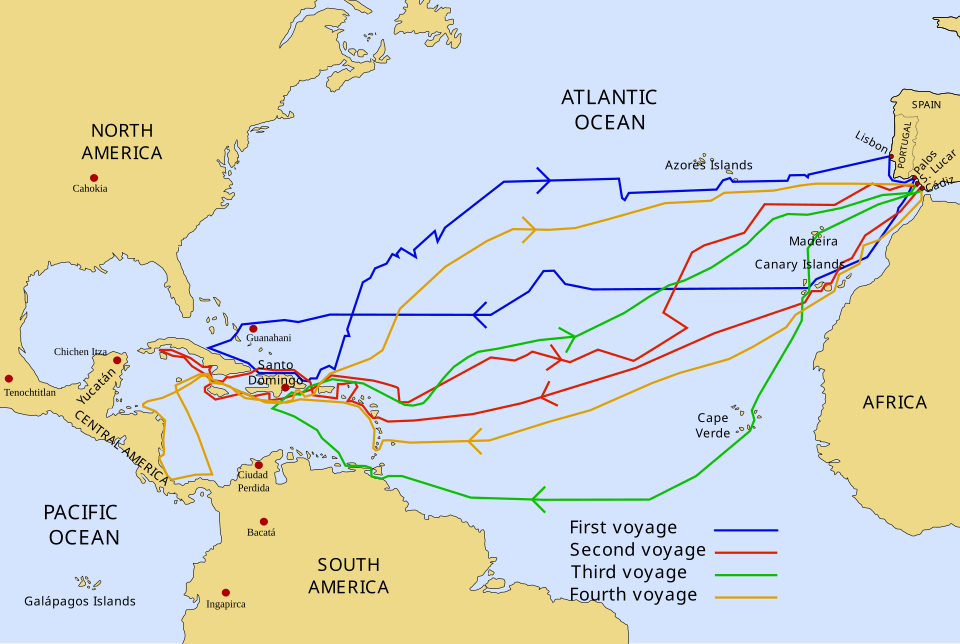
In 1492, Christopher Columbus’s first voyage for Isabella I of Castile and Ferdinand II of Aragon created a durable maritime link between Europe and the Caribbean. It did not “discover” an empty continent: Indigenous peoples had inhabited the Americas for at least 15,000 years, while Norse voyagers reached Newfoundland around 1000 CE. Its historical importance lies in what followed—Spanish invasion, settler colonialism, forced labor, epidemic disease, ecological upheaval and an Atlantic economy increasingly dependent on enslaved African labor.
The year was not a single beginning. It joined the conquest of the Canary Islands, the fall of Granada and the expulsion of practicing Jews from Spain to an outward-moving Catholic monarchy. Follow the wider sequence through the archive’s timeline and its reference guide to colonial history.
Key takeaways
- Columbus’s 1492 voyage created sustained European-Caribbean contact, but Indigenous civilizations and earlier Atlantic crossings long predated his arrival.
- The voyage served the expansionist Catholic Monarchs, who also conquered Granada and ordered practicing Jews expelled in 1492.
- Disease combined with warfare, enslavement, displacement and famine to produce catastrophic Indigenous population loss after European invasion.
- Koch and colleagues estimated in 2019 that the Americas’ Indigenous population fell from 60.5 million in 1492 to 6 million by 1600.
- The post-1492 Atlantic system enabled plantation colonialism and a slave trade that embarked approximately 12.5 million Africans between 1501 and 1866.
The world before 1492
The Americas were populous, politically complex and connected by trade before Columbus arrived. In 1492, the Mexica-led Triple Alliance governed a tributary empire from Tenochtitlan; the Inca state was expanding through the Andes; and Taíno-speaking communities occupied much of the Greater Antilles and Bahamas. Archaeology demonstrates settlement in the Americas by at least 15,000 years before present, although models of earlier entry remain disputed.
No reliable census exists for the hemisphere in 1492. In 1976, geographer William Denevan synthesized estimates ranging from 8.4 million, proposed by Alfred Kroeber in 1939, to 100 million or more, associated with Henry Dobyns’s 1966 work; Denevan proposed 53.9 million for 1492. In 2019, Alexander Koch and colleagues estimated 60.5 million people, with a range of 44.8–78.2 million, in 1492. These are reconstructions, not headcounts.
Across the eastern Atlantic, Portuguese merchants had established fortified commerce at Elmina on the Gold Coast in 1482, buying gold and enslaved people. Castile completed its conquest of the Canary Islands between 1402 and 1496, developing plantation, enslavement and Indigenous dispossession practices later transferred westward. The Atlantic world opened through existing African, European and Indigenous histories—not European action alone.
What happened in 1492 and after
On 3 August 1492, the Niña, Pinta and Santa María left Palos de la Frontera with about 90 men; surviving evidence supports roughly 87–90, not an exact manifest. After resupplying in the Canaries, the expedition made landfall on 12 October on a Bahamian island called Guanahaní by its inhabitants. Its modern identification remains disputed. Columbus then sailed to Cuba and Hispaniola.
“They should be good servants and of quick intelligence.” — Christopher Columbus, 1492, journal of the first voyage, preserved in Bartolomé de las Casas’s abstract.
That sentence exposed an immediate colonial logic: Columbus assessed people for conversion, command and extraction. On 25 December 1492, the Santa María grounded off Hispaniola. Its timbers supplied La Navidad, where 39 Europeans remained. Columbus returned to Iberia on 15 March 1493. His second expedition departed on 25 September 1493 with 17 ships and about 1,200–1,500 people, according to differing contemporary and modern reconstructions; it was an invasion-and-settlement fleet.
| Date | Event | Consequence |
|---|---|---|
| 2 January 1492 | Granada surrendered to the Catholic Monarchs | Castile completed the conquest of the last Muslim-ruled polity in Iberia. |
| 31 March 1492 | The Alhambra Decree was issued | Practicing Jews were ordered to leave Castile and Aragon by 31 July 1492 unless baptized. |
| 17 April 1492 | The Capitulations of Santa Fe appointed Columbus admiral and governor | The Crown pre-authorized rule and profit-taking in lands claimed through the voyage. |
| 3 August 1492 | Three ships departed Palos | A state-backed Atlantic crossing began with about 87–90 men. |
| 12 October 1492 | Landfall at Guanahaní | Sustained Castilian intrusion into the Caribbean began. |
| 28 October 1492 | The expedition reached Cuba | Columbus claimed inhabited territory for Castile. |
| 5 December 1492 | The expedition reached Hispaniola | Hispaniola became Spain’s first major base for Caribbean conquest. |
| 25 December 1492 | The Santa María was wrecked | La Navidad was built, leaving 39 colonists behind. |
| 15 March 1493 | Columbus returned to Palos | Reports, captives and claimed commodities stimulated further expeditions. |
| 4 May 1493 | Pope Alexander VI issued Inter caetera | A papal line supported Castilian claims while disregarding Indigenous sovereignty. |
| 7 June 1494 | Spain and Portugal signed the Treaty of Tordesillas | The monarchies divided prospective claims along a line 370 leagues west of Cape Verde. |
The numbers: populations, deaths and forced movement
No defensible total can assign all post-1492 deaths to a single cause. Smallpox, measles and influenza interacted with warfare, enslavement, displacement, famine and collapsing food systems. Koch and colleagues estimated in 2019 that the Indigenous population of the Americas fell from 60.5 million in 1492 to 6 million by 1600—a decline of about 54.5 million, or 90 percent. Their model remains debated because both endpoints are reconstructed.
Hispaniola’s losses were especially rapid, but its starting population is contested. Estimates for 1492 span roughly 100,000 to more than 1 million in modern scholarship; older claims reached several million. A tribute census reported approximately 60,000 Indigenous people in 1508, while a 1542 estimate reported only about 200, but categories, coverage and colonial incentives make direct comparison hazardous.
From 1501, Spanish royal authorization explicitly permitted enslaved Africans in the Caribbean. The SlaveVoyages database estimates that between 1501 and 1866 approximately 12.5 million captive Africans embarked for the Americas and about 10.7 million survived the Middle Passage. Those figures describe the later system that the post-1492 Atlantic connection enabled, not events aboard Columbus’s first voyage.
What 1492 set in motion
The voyages initiated permanent Spanish colonization in the Caribbean. Columbus governed brutally on Hispaniola during his later expeditions; Francisco de Bobadilla arrested him in 1500 after complaints about his administration. Nicolás de Ovando, governor from 1502 to 1509, expanded settlement, mining and coercive labor. The Crown formalized the encomienda, compelling Indigenous communities to provide labor or tribute under Spanish control.
The Columbian Exchange moved crops, animals, pathogens and people between hemispheres. Horses, cattle, wheat, sugarcane and Old World diseases traveled west; maize, potatoes, cassava, tomatoes and cacao traveled east and onward. Sugar cultivation, tested through Mediterranean and Atlantic-island plantations, became a central engine of Caribbean land seizure and African enslavement.
The consequences of 1492 were neither an equal “exchange” nor an inevitable encounter: military power, legal fictions and coerced labor determined who controlled land, mobility and survival.
European rulers converted arrival into asserted ownership through papal bulls, charters and treaties made without Indigenous consent. Indigenous resistance began immediately and continued for centuries. Taíno leader Caonabo attacked La Navidad by late 1493; Anacaona was executed by Spanish authorities in 1503 or 1504; and Hatuey resisted Spanish invasion in Cuba before his execution in 1512. Explore these connected structures through the archive’s history index and chronological timeline.
How 1492 is remembered
For centuries, European and US commemorations presented Columbus as a heroic discoverer. The United States established the federal Columbus Day holiday in 1937; since 1971 it has been observed on the second Monday in October. That civic story marginalized Indigenous presence and concealed conquest, forced labor and demographic catastrophe.
Indigenous activists and scholars reframed the anniversary. In 1992, the 500th anniversary generated major protests against celebratory “discovery” narratives. Berkeley, California, adopted Indigenous Peoples’ Day in 1992. On 8 October 2021, President Joe Biden issued the first US presidential proclamation recognizing Indigenous Peoples’ Day, while separately proclaiming Columbus Day.
“Opening the Atlantic world” is therefore more precise than “discovering America,” but it still requires care: Atlantic exchange was radically unequal. Columbus crossed an ocean; Indigenous people paid the largest human cost. Memory should identify the institutions that transformed navigation into invasion—the Spanish Crown, the papacy, colonial governors, merchants and coerced-labor regimes—while preserving Indigenous survival, resistance and sovereignty as central history.
Sources & further reading
- Encyclopaedia Britannica: Christopher Columbus
- Koch et al., “Earth system impacts of the European arrival and Great Dying in the Americas after 1492”
- SlaveVoyages: The Trans-Atlantic Slave Trade Database
- Library of Congress: 1492—An Ongoing Voyage
- Yale Avalon Project: Treaty of Tordesillas, 1494
- National Archives: The Constitution of the United States—Columbus Day background
Frequently asked questions
- Why is 1492 considered a turning point in world history?
- In 1492, Christopher Columbus’s Castilian-backed voyage established a durable route between Europe and the Caribbean. It accelerated Spanish conquest, biological exchange, forced labor, Christian mission and transatlantic commerce. Unlike the Norse presence in Newfoundland around 1000 CE, the voyages beginning in 1492 led directly to permanent European colonization and eventually to an Atlantic plantation economy dependent on enslaved Africans.
- Did Christopher Columbus discover America in 1492?
- No. Indigenous peoples had inhabited the Americas for at least 15,000 years, and Norse voyagers reached Newfoundland around 1000 CE. On 12 October 1492, Columbus reached Guanahaní in the Bahamas, where people already lived. His historical significance was not first discovery, but opening sustained Castilian contact that enabled invasion, settlement and imperial rule.
- How many people lived in the Americas in 1492?
- There was no hemisphere-wide census. William Denevan’s 1976 synthesis proposed 53.9 million people in 1492 and discussed estimates from 8.4 million to 100 million or more. In 2019, Alexander Koch and colleagues estimated 60.5 million, with a range of 44.8–78.2 million. All such totals are demographic reconstructions built from incomplete archaeological and colonial evidence.
- How many Indigenous people died after 1492?
- No exact total exists. In 2019, Alexander Koch and colleagues estimated that the Indigenous population of the Americas fell from 60.5 million in 1492 to 6 million by 1600, a decline of about 54.5 million or 90 percent. Epidemics were central, but warfare, enslavement, forced relocation, famine and colonial disruption also caused deaths and reduced births.
- What was the Columbian Exchange?
- The Columbian Exchange was the post-1492 movement of organisms, people and diseases between the Americas, Africa and Eurasia. Horses, cattle, wheat, sugarcane, smallpox and measles moved west; maize, potatoes, cassava, tomatoes and cacao moved east. The term describes biological circulation, but not equality: European conquest, Indigenous dispossession and African enslavement structured the exchange.
Related chapters
Years
- 1519–1521: The Spanish Conquest of the Aztec Empire
- 1652: The Founding of the Dutch Cape Colony
- 1757: Plassey and the East India Company’s Conquest
- 1791–1804: The Haitian Revolution
- 1833–1838: British abolition and slave-owner compensation
- 1857: The Indian Rebellion against Company Rule
- 1884–1885: Berlin Conference and Africa’s Partition
- 1904–1908: The Herero and Nama Genocide
- 1919: Amritsar and the Year the Empire Showed Its Face
Sources & further reading
CC BY 4.0 ·