1519–1521: The Spanish Conquest of the Aztec Empire
How Cortés, Indigenous allies, epidemic disease and siege destroyed Aztec rule in 1519–1521 and established colonial New Spain.
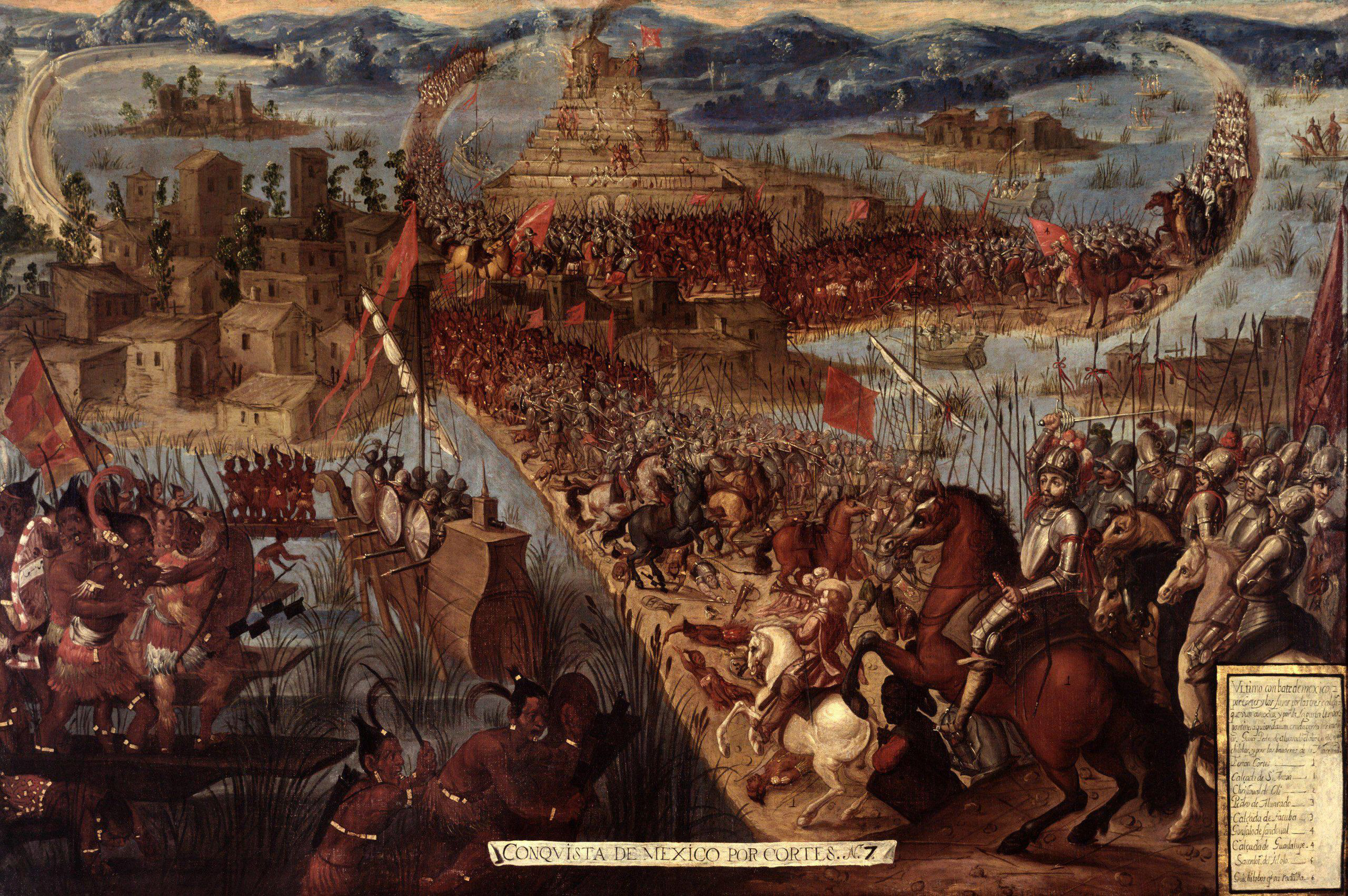
Between 1519 and 1521, Hernán Cortés led several hundred Spaniards and tens of thousands of Indigenous allies against the Aztec Triple Alliance. Their victory depended not simply on steel, guns or horses, but on anti-Mexica coalitions, political coercion, massacre, epidemic disease and the destruction of Tenochtitlan.
The capture of Cuauhtémoc on 13 August 1521 ended organized resistance in the capital, not conquest across Mesoamerica. Spain subsequently built New Spain through warfare, forced tribute, coerced labor, Christianization and appropriation of Indigenous land. See the broader /timeline and archive of colonial /atrocities.
Key takeaways
- Cortés conquered Tenochtitlan in 1521 with several hundred Spaniards and tens of thousands of Indigenous allies, not through European arms alone.
- Tlaxcalan, Totonac and other forces allied with Spain to challenge Mexica power, then faced subordination within the Spanish colonial system.
- Smallpox reached central Mexico in 1520, combining with warfare, famine and displacement to produce catastrophic mortality across subsequent decades.
- The 80-day siege ending on 13 August 1521 destroyed Tenochtitlan through blockade, assault, hunger and disease.
- Spain rebuilt the capital as Mexico City and imposed tribute, coerced labor, Christianization and colonial government across New Spain.
Mesoamerica before Cortés
In 1519, central Mexico was dominated by the Triple Alliance of Tenochtitlan, Texcoco and Tlacopan, established in 1428. The Mexica capital, Tenochtitlan, stood on islands in Lake Texcoco and governed through tribute, warfare and alliances rather than uniform territorial administration. Subject communities delivered textiles, food, cacao, feathers and captives; resentment created openings that the invaders exploited.
Population estimates remain disputed. Archaeologist Eduardo Matos Moctezuma has commonly placed Tenochtitlan at roughly 200,000 inhabitants around 1519, while other modern estimates range from about 150,000 to 300,000. Historical demographer Woodrow Borah estimated approximately 25.2 million people in central Mexico in 1519; later scholars, including Robert McCaa, have stressed the uncertainty and wide variation among reconstructions.
Mesoamerica contained competing states, including Tlaxcala, which had resisted Mexica encirclement. The Totonacs of Cempoala also faced imperial tribute demands. These societies were not passive auxiliaries: their rulers pursued their own survival and regional power.
The conquest was a Spanish-Indigenous war against Mexica imperial power, followed by Spanish domination of victors, enemies and bystanders alike.
Invasion, alliances and destruction, 1519–1521
Cortés sailed from Cuba in 1519 under an expedition initially authorized by Governor Diego Velázquez de Cuéllar, then rejected Velázquez’s control. After founding Veracruz, he scuttled or disabled most of his ships and advanced inland. Fighting with Tlaxcalans in September 1519 gave way to an alliance indispensable to Spanish survival.
| Date | Event | Consequence |
|---|---|---|
| February 1519 | Cortés leaves Cuba with 11 ships and about 500–600 Spaniards, according to contemporary and later narrative estimates | He begins an unauthorized bid for independent command |
| March 1519 | Spanish forces defeat Maya fighters at Centla | Malintzin enters Cortés’s party and becomes translator and political intermediary |
| April 1519 | Cortés lands near present-day Veracruz | Totonac contacts expose opposition to Mexica tribute rule |
| September 1519 | Spaniards fight, then ally with Tlaxcala | Thousands of Indigenous troops and essential supplies reinforce the expedition |
| October 1519 | Spanish and allied troops massacre inhabitants at Cholula | Terror clears the route toward Tenochtitlan; reported deaths range from about 3,000 in Cortés’s 1520 account to 6,000 in later traditions |
| 8 November 1519 | Cortés enters Tenochtitlan and meets Moctezuma II | Spaniards soon hold the ruler under coercive custody |
| May 1520 | Pedro de Alvarado orders the Tóxcatl festival massacre | Mexica resistance erupts across the capital |
| 30 June–1 July 1520 | Spaniards and allies flee during La Noche Triste | Contemporary claims vary; several hundred Spaniards and perhaps thousands of allies die |
| September–November 1520 | Smallpox spreads through the Basin of Mexico | The epidemic kills many inhabitants, including ruler Cuitláhuac |
| 28 April 1521 | Cortés launches 13 brigantines on Lake Texcoco | Spanish-led forces tighten the naval blockade |
| 26 May–13 August 1521 | Tenochtitlan is besieged for 80 days | Hunger, disease and assault devastate the city |
| 13 August 1521 | Cuauhtémoc is captured | Organized defense of Tenochtitlan collapses |
“We attacked them in the city all day long, and drove them from many of their strong positions.” — Hernán Cortés, 1522, Third Letter to Charles V
The quotation comes from a self-justifying report written to secure royal recognition. Indigenous-language accounts preserved by Bernardino de Sahagún’s collaborators describe thirst, corpses and civilians crushed during the siege.
Armies, deaths and demographic collapse
No reliable ledger records the conquest’s total dead. Cortés began in 1519 with roughly 500–600 Spaniards, 16 horses and 10 cannon in commonly cited reconstructions based on sixteenth-century accounts. By the siege in 1521, Spanish forces numbered roughly 900, while allied Indigenous forces fluctuated in the tens of thousands; some campaign claims rise above 100,000, but they are not independently verifiable.
Cortés claimed in 1522 that more than 40,000 people were killed or captured on the final day, 13 August 1521, and that over 67,000 had died in earlier fighting; historians treat these figures cautiously because they served a propagandistic royal report. Bernardino de Sahagún’s Nahua testimony records mass death without producing a dependable total. Modern summaries often suggest tens of thousands died during the 1521 siege from combat, starvation and disease.
Smallpox, introduced in 1520, was decisive but not solitary: warfare, displacement, famine and later epidemics compounded mortality. Borah and Sherburne Cook estimated central Mexico’s population fell from 25.2 million in 1519 to 6.3 million in 1548 and about 1.1 million in 1605. Those 1519, 1548 and 1605 estimates are influential but contested; alternative starting estimates are substantially lower.
Colonial order set in motion
The fall of Tenochtitlan allowed Cortés to establish a Spanish capital, Mexico City, over its ruins in 1521. Charles V appointed him governor and captain general of New Spain in 1522. The Crown created the Viceroyalty of New Spain in 1535 under Antonio de Mendoza, curbing conquistador autonomy while institutionalizing colonial rule.
Conquerors received encomiendas: grants to extract tribute and labor from designated Indigenous communities, formally coupled with Christian instruction. Enslavement also continued, especially through classifications of captives as rebels. The Crown’s New Laws of 1542 attempted to restrict Indigenous enslavement and hereditary encomiendas, but colonists resisted and exploitation persisted through tribute, repartimiento labor and estate expansion.
Franciscan missionaries known as the Twelve arrived in 1524. Churches rose on or beside sacred sites; manuscripts and ritual objects were destroyed, while Indigenous communities preserved and reshaped languages, histories and religious practices. Conquest spread far beyond the capital through campaigns against regions that had never belonged to the Triple Alliance. This longer colonial violence belongs in the archive’s /atrocities record and continental /timeline.
Memory, responsibility and contested narratives
Older imperial histories portrayed Cortés and a few hundred Spaniards as defeating millions through superior civilization. That story erases Tlaxcalan, Texcocan, Totonac and other Indigenous armies. It also turns epidemic disease into an absolution, ignoring deliberate massacres at Cholula in 1519 and Tóxcatl in 1520, hostage-taking, starvation tactics and colonial exploitation.
Malintzin has alternately been condemned as “La Malinche” or recognized as an enslaved Nahua woman whose interpreting shaped negotiations under coercive conditions. Tlaxcalans are likewise miscast as timeless traitors to a Mexican nation that did not exist in 1519. They allied against a regional imperial enemy; Spain later subordinated them despite limited privileges.
Public commemorations remain politically charged. Mexico marked 13 August 2021 as 500 years of “Indigenous resistance,” rejecting triumphalist conquest language. Monuments to Cortés and Columbus, museum labels and school curricula still determine whose agency and suffering enter public memory.
13 August 1521 was not the disappearance of Indigenous peoples. It was the military destruction of a capital and the beginning of a colonial regime resisted for centuries.
Sources & further reading
- Encyclopaedia Britannica: Hernán Cortés
- Fordham University: Cortés, Second Letter to Charles V
- World History Encyclopedia: Fall of Tenochtitlan
- Cambridge University Press: The Cambridge History of the Native Peoples of the Americas, Volume II
- University of California Press: The Population of the Valley of Mexico
Frequently asked questions
- How did the Spanish conquer the Aztec Empire with so few soldiers?
- Cortés had roughly 500–600 Spaniards in 1519, but he secured thousands, later tens of thousands, of Tlaxcalan, Totonac and other Indigenous allies. These forces supplied intelligence, food and most combat manpower. Political divisions within the Mexica tribute system, Spanish hostage-taking, 13 brigantines launched in 1521, and the 1520 smallpox epidemic all contributed to Tenochtitlan’s defeat.
- When did the Aztec Empire fall?
- Tenochtitlan fell on 13 August 1521, when Spanish-led forces captured the Mexica ruler Cuauhtémoc after an 80-day siege begun on 26 May 1521. The date marks the collapse of organized defense in the capital, not the completion of Spain’s conquest of Mesoamerica, which required further wars lasting decades.
- How many people died in the conquest of Tenochtitlan?
- No dependable total survives. Cortés claimed in 1522 that more than 40,000 people were killed or captured on 13 August 1521 and over 67,000 died earlier, but historians consider his royal report self-serving. Modern accounts generally describe tens of thousands dying during the 1521 siege from combat, starvation and disease; exact figures cannot be verified.
- What role did smallpox play in the Spanish conquest?
- Smallpox spread through central Mexico in 1520 after arriving with Europeans. It killed many people with no previous exposure, including the Mexica ruler Cuitláhuac, and disrupted defense before the 1521 siege. Disease was crucial, but it did not act alone: military alliances, massacres, blockade, famine and political fractures also enabled Spanish victory.
- Was Malintzin responsible for the fall of the Aztec Empire?
- No. Malintzin, also called Doña Marina, was an enslaved Nahua woman transferred to Cortés’s party in 1519. She interpreted languages, explained political relationships and participated in negotiations, but she did not command the Spanish invasion or its allied armies. Blaming her obscures Cortés’s decisions, Spanish violence, Indigenous state rivalries and the coercion constraining her choices.
Related chapters
Years
- 1492 and the Opening of the Atlantic World
- 1652: The Founding of the Dutch Cape Colony
- 1757: Plassey and the East India Company’s Conquest
- 1791–1804: The Haitian Revolution
- 1833–1838: British abolition and slave-owner compensation
- 1857: The Indian Rebellion against Company Rule
- 1884–1885: Berlin Conference and Africa’s Partition
- 1904–1908: The Herero and Nama Genocide
- 1919: Amritsar and the Year the Empire Showed Its Face
Sources & further reading
CC BY 4.0 ·