1884–1885: Berlin Conference and Africa’s Partition
How the 1884–1885 Berlin Conference imposed rules for European conquest, accelerated Africa’s partition and enabled colonial violence and extraction.
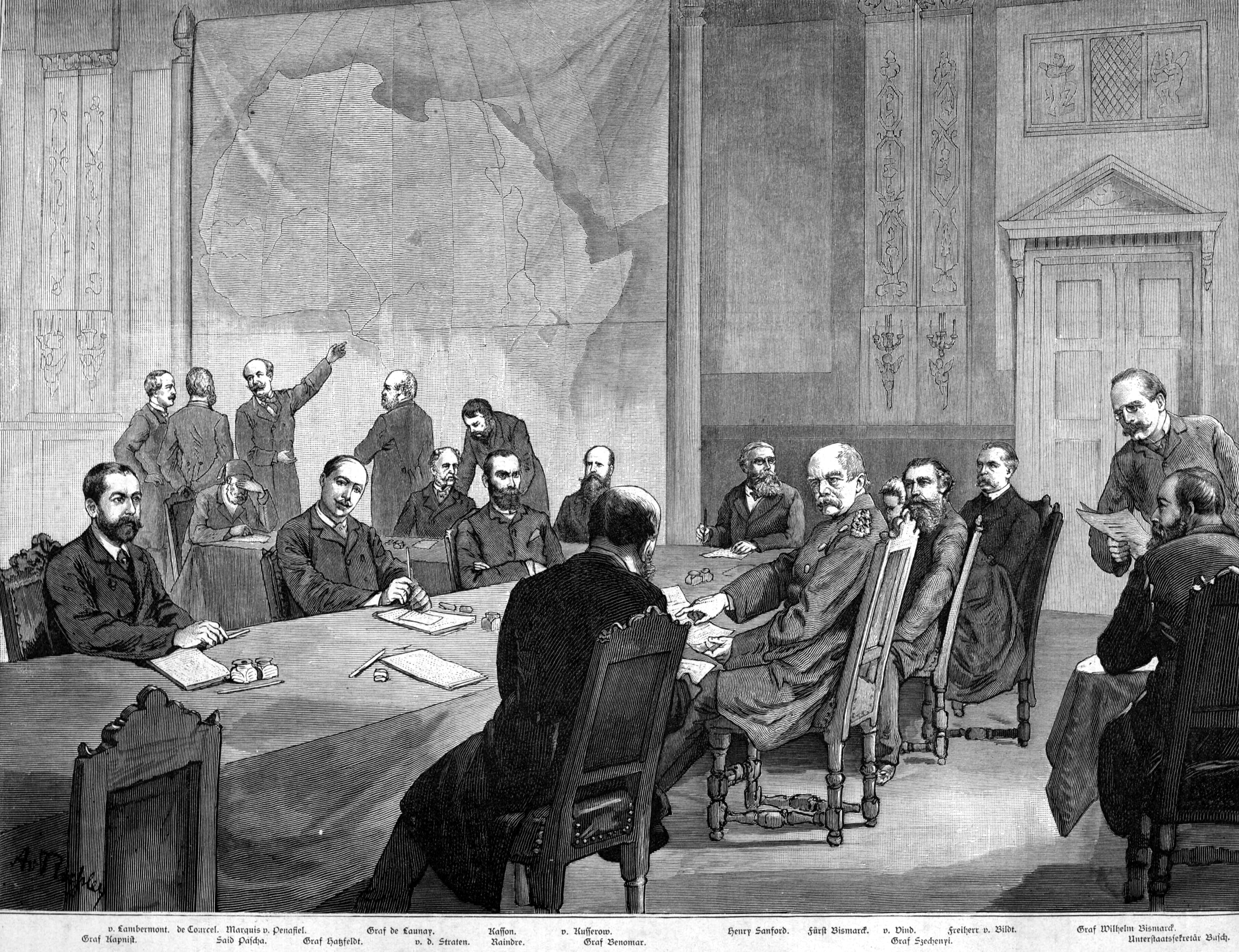
The Berlin Conference, held from 15 November 1884 to 26 February 1885, established rules by which European empires could claim African territory. German chancellor Otto von Bismarck convened representatives of 14 states in Berlin at the urging of Belgium’s King Leopold II. No African ruler, government or community was represented.
The conference did not draw every later colonial border or instantly divide the continent. Its General Act internationalized navigation and trade in the Congo and Niger basins, endorsed Leopold’s Congo project, and required notification and “effective occupation” for new coastal claims. These rules accelerated conquest during the Scramble for Africa, subordinating African sovereignty to agreements made among foreign powers.
Key takeaways
- The Berlin Conference met from 15 November 1884 to 26 February 1885 and excluded every African government and political community.
- Its 38-article General Act regulated trade and navigation while making effective occupation a standard for recognizing new European coastal claims.
- European control expanded from approximately 10% of Africa in 1876 to about 90% by 1900, according to A. H. Keane.
- Berlin did not draw every colonial border, but it accelerated conquests that imposed borders through treaties, coercion and war.
- Leopold II’s recognized Congo project became a forced-labor regime associated with severe killing, famine, disease and demographic collapse.
The world before Berlin
European involvement in Africa long predated 1884. Centuries of Atlantic and Indian Ocean enslavement had displaced millions, while Britain, France, Portugal and Spain held coastal possessions. France invaded Algiers in 1830; Britain occupied Egypt in 1882. Yet African states—including Ethiopia, Asante, Buganda, the Sokoto Caliphate and the Zulu kingdom—still governed most of the continent.
Industrial capitalism intensified demand for rubber, palm oil, ivory, cotton, copper and markets. Steamships, quinine and firearms strengthened European military reach. Leopold II financed Henry Morton Stanley’s Congo expeditions and used the nominally philanthropic International Association of the Congo to obtain hundreds of treaties—documents commonly secured through deception or coercion and then presented as transfers of sovereignty.
“I do not want to miss a good chance of getting us a slice of this magnificent African cake.” — Leopold II, letter to Jules Greindl, 17 November 1877.
Competition sharpened after France claimed territory north of the Congo River and Portugal asserted control over the Congo estuary. Leopold sought international recognition; Bismarck sought to manage imperial rivalry while advancing Germany’s new colonial claims.
What happened in Berlin
Delegates from Austria-Hungary, Belgium, Denmark, France, Germany, Britain, Italy, the Netherlands, Portugal, Russia, Spain, Sweden–Norway, the Ottoman Empire and the United States attended. The United States signed no final agreement. African political authorities received no invitation.
The resulting General Act proclaimed free commerce in the conventional Congo basin, free navigation on the Congo and Niger rivers, opposition to the slave trade, and duties toward Indigenous populations. These humanitarian clauses lacked enforcement and were repeatedly violated. Articles 34 and 35 required powers taking new territory on Africa’s coasts to notify the other signatories and establish authority sufficient to protect existing rights and trade—the doctrine known as effective occupation.
| Date | Event | Consequence |
|---|---|---|
| 17 Nov 1877 | Leopold II writes of seeking a “slice” of Africa | Belgium’s king states his colonial ambition explicitly |
| 10 Sep 1880 | Leopold creates the International Association of the Congo | A private organization becomes the vehicle for territorial claims |
| 11 Jun 1884 | Britain recognizes Portuguese claims at the Congo mouth in the unsigned Anglo-Portuguese treaty | Commercial opposition helps force wider negotiations |
| 5 Jul 1884 | Germany declares a protectorate over Togoland | German colonial expansion becomes overt |
| 14 Jul 1884 | Germany declares a protectorate over Kamerun | Rival claims intensify before the conference |
| 15 Nov 1884 | Bismarck opens the Berlin Conference | Fourteen states negotiate without African representation |
| 8 Jan 1885 | Delegates recognize Leopold’s International Association flag | Recognition of the future Congo Free State advances |
| 23 Feb 1885 | Major powers complete recognition arrangements for Leopold’s Congo project | Leopold gains international standing over a vast territory |
| 26 Feb 1885 | Thirteen participating states sign the General Act | Rules for trade, navigation and future occupation enter imperial diplomacy |
| 1 Aug 1885 | Leopold announces the Congo Free State | A territory about 2.34 million km² becomes his personal sovereign domain |
The numbers behind the partition
At the conference, 14 states were represented and 0 African delegates participated. The General Act contained 38 articles and was signed on 26 February 1885 by 13 states; the United States declined to become a party. Leopold’s Congo Free State covered about 2.34 million km² when proclaimed in 1885—roughly 76 times Belgium’s approximately 30,500 km² area that year.
The most widely cited territorial measure comes from geographer A. H. Keane: European powers controlled about 10% of Africa in 1876 and roughly 90% by 1900. That comparison is approximate because maps treated commercial stations and paper claims inconsistently. By 1914, Ethiopia and Liberia were the principal internationally recognized African states outside formal European colonial rule, although Liberia faced extensive foreign economic control and Ethiopia lost Eritrea and other territories.
No credible death toll exists for the Berlin Conference itself: it was a diplomatic meeting. The conquests and extractive regimes it facilitated killed on a vast scale. For the Congo Free State under Leopold from 1885 to 1908, historian Adam Hochschild estimated in 1998 that population loss may have reached 10 million; demographic historians including Jan Vansina stress that absent reliable censuses make any exact toll unknowable. Population loss includes killing, famine, disease and reduced births—not a count of documented executions.
What the conference set in motion
Berlin converted imperial ambition into a competitive requirement to demonstrate control. Britain, France, Germany, Belgium, Portugal and Italy pursued treaties under duress, punitive expeditions, taxation, forced labor and military occupation. African resistance included Samori Touré’s wars against France from 1882 to 1898, the 1896 Ethiopian victory over Italy at Adwa, and the Maji Maji uprising against Germany from 1905 to 1907.
Leopold’s Congo regime compelled communities to gather wild rubber through hostage-taking, flogging, mutilation and killing. German colonial forces later committed genocide against the Ovaherero and Nama in South West Africa from 1904 to 1908. Germany’s government stated in its 2021 recognition that about 65,000 Ovaherero and 10,000 Nama were killed, figures widely used by descendants and historians.
The conference was not a single act of partition but a framework that made conquest internationally legible to European governments while treating African sovereignty as disposable.
Colonial borders divided political communities and joined others under coercive administrations designed principally for extraction. Railways and ports commonly linked mines and plantations to export routes rather than building integrated local economies. Forced labor, land alienation and cash-crop dependence shaped later inequalities, conflicts and decolonization struggles. The conference belongs in a longer timeline of colonial rule and resistance, not as an isolated diplomatic episode.
How Berlin is remembered
“Berlin Conference” now serves as shorthand for Africa’s partition, but that phrase can obscure African action and the decades of violence required to enforce European claims. Africans resisted, negotiated, survived and rebuilt; conquest was never merely ink on a European map.
The conference is also remembered through disputes over borders, restitution and institutional responsibility. Its rhetoric of free trade and humanitarianism coexisted with monopoly extraction and racial domination. That contradiction remains central to debates about colonial collections, corporate wealth, sovereign debt and unequal commodity chains.
Public memory has increasingly focused on named perpetrators and beneficiaries: Leopold II; Bismarck; Stanley; concessionary companies; and European states whose museums, firms and treasuries accumulated colonial wealth. Accurate commemoration distinguishes the conference’s direct provisions from later crimes while tracing the political permission structure that connected them. Explore the archive’s broader history of empire and resistance.
Sources & further reading
- General Act of the Berlin Conference, 26 February 1885 — Avalon Project, Yale Law School
- Encyclopaedia Britannica: Berlin West Africa Conference
- Office of the Historian: The Berlin Conference, 1884–1885
- Richard Reid, A History of Modern Africa: 1800 to the Present — Wiley
- Adam Hochschild, King Leopold’s Ghost — Macmillan
- German Federal Foreign Office: Recognition of the genocide in Namibia, 2021
Frequently asked questions
- What was the Berlin Conference of 1884–1885?
- The Berlin Conference was a meeting of representatives from 14 states, convened by German chancellor Otto von Bismarck from 15 November 1884 to 26 February 1885. Its General Act established rules for commerce, navigation and recognition of new European occupations in Africa. No African ruler or representative participated.
- Did the Berlin Conference divide Africa and draw its borders?
- Not in one comprehensive map-making session. The conference of 1884–1885 recognized Leopold II’s Congo project and established principles, including notification and effective occupation, that accelerated partition. European governments drew most colonial boundaries later through bilateral agreements, then imposed them through military conquest, coerced treaties and colonial administration.
- Which countries attended the Berlin Conference?
- Fourteen states attended in 1884–1885: Austria-Hungary, Belgium, Denmark, France, Germany, Britain, Italy, the Netherlands, Portugal, Russia, Spain, Sweden–Norway, the Ottoman Empire and the United States. Thirteen signed the General Act on 26 February 1885; the United States did not. No African state attended.
- What did effective occupation mean after the Berlin Conference?
- Articles 34 and 35 of the 1885 General Act required a European power claiming new African coastal territory to notify other signatories and establish sufficient authority to protect rights and trade. The rule encouraged governments to turn paper claims into administrations backed by soldiers, taxation, forced labor and punitive violence.
- How many people died because of the Berlin Conference?
- There is no defensible single toll because the 1884–1885 meeting itself killed no measured population, while subsequent conquests unfolded across decades. In Leopold II’s Congo Free State from 1885 to 1908, Adam Hochschild estimated in 1998 that population loss may have reached 10 million; scholars including Jan Vansina caution that missing censuses prevent an exact figure.
Related chapters
Years
- 1492 and the Opening of the Atlantic World
- 1519–1521: The Spanish Conquest of the Aztec Empire
- 1652: The Founding of the Dutch Cape Colony
- 1757: Plassey and the East India Company’s Conquest
- 1791–1804: The Haitian Revolution
- 1833–1838: British abolition and slave-owner compensation
- 1857: The Indian Rebellion against Company Rule
- 1904–1908: The Herero and Nama Genocide
- 1919: Amritsar and the Year the Empire Showed Its Face
Sources & further reading
CC BY 4.0 ·