1904–1908: The Herero and Nama Genocide
How German colonial forces exterminated Herero and Nama communities in Namibia from 1904 to 1908 through warfare, desert expulsion and camps.
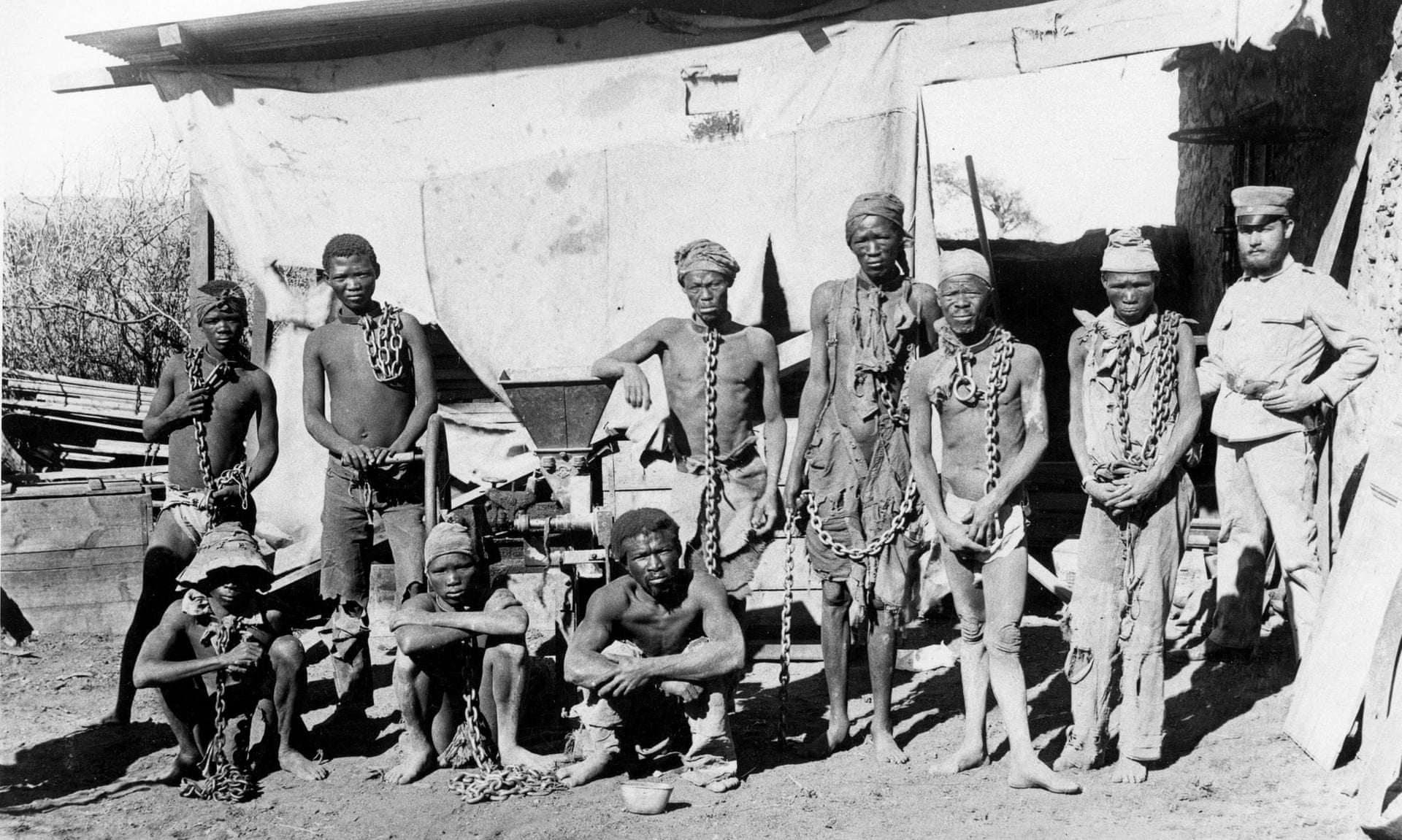
From 1904 to 1908, the German Empire committed genocide against the Herero and Nama in German South West Africa, now Namibia. German forces used mass killing, forced displacement into the Omaheke desert, poisoned or guarded water sources, concentration camps, forced labor, starvation and medical abuse. Estimates commonly cited by historians range from 40,000 to 80,000 Herero deaths and about 10,000 Nama deaths.
The genocide followed decades of land seizure, settler expansion and coercive colonial rule. It destroyed communities, transferred land and cattle to settlers, and established structures of dispossession that survived German colonialism. This period hub complements the archive’s detailed Herero and Nama genocide reference page and wider historical timeline.
Key takeaways
- The German Empire committed genocide against Herero and Nama people in German South West Africa between 1904 and 1908.
- German forces combined battlefield violence, desert expulsion, controlled water access, concentration camps, forced labor, starvation and dispossession.
- Historical estimates place Herero deaths at 40,000–80,000 and Nama deaths at about 10,000 during 1904–1908.
- Lothar von Trotha’s extermination order of 2 October 1904 explicitly authorized shooting every Herero found within the colony.
- Germany recognized the events as genocide in 2021, but affected communities continue to contest representation, restitution and reparations.
Before 1904: conquest, land seizure and settler rule
Germany declared a protectorate over South West Africa in 1884. Through unequal treaties, military campaigns and settler expansion, the colonial government appropriated land and cattle while imposing racialized law. German traders extended credit secured against livestock; settlers fenced grazing land; colonial courts privileged Europeans. The rinderpest epidemic of 1897 killed an estimated 90% of cattle in parts of southern Africa, according to contemporary veterinary reporting synthesized by historian Jan-Bart Gewald, deepening Herero indebtedness and dependence.
By 1903, German South West Africa had approximately 4,682 German settlers, according to German colonial statistics reproduced by historian Jürgen Zimmerer, ruling an African population several dozen times larger. Railway construction, commercial ranching and punitive policing accelerated dispossession. Nama communities had already fought German expansion during the 1893–1894 campaign against Hendrik Witbooi, including the German attack on Hornkranz on 12 April 1893.
“Your peace shall be the peace of the graveyard.” — Hendrik Witbooi, 1894, letter to Governor Theodor Leutwein, in The Hendrik Witbooi Papers.
Witbooi’s warning described a colonial order in which negotiated “protection” meant political subordination. The immediate Herero uprising began in January 1904 after mounting disputes over land, debt, livestock and settler violence.
1904–1908: rebellion, extermination and imprisonment
Herero forces attacked colonial positions on 12 January 1904. Under Samuel Maharero’s orders, fighters generally spared women, children, missionaries and several non-German Europeans. Germany replaced Governor Theodor Leutwein’s containment strategy with General Lothar von Trotha’s annihilation policy. At the Battle of Waterberg on 11 August 1904, German troops drove Herero civilians and fighters eastward toward the waterless Omaheke.
On 2 October 1904, von Trotha issued his extermination order, or Vernichtungsbefehl:
“Within the German borders every Herero, with or without a rifle, with or without cattle, will be shot.” — Lothar von Trotha, 1904, proclamation to the Herero people.
German patrols blocked routes back from the desert and controlled water points. Chancellor Bernhard von Bülow formally countermanded the extermination order in December 1904, but mass death continued through incarceration. Surviving Herero were confined in camps; after Nama resistance expanded under Hendrik Witbooi and Jakob Morenga in October 1904, captured Nama were imprisoned under the same system.
| Date | Event | Consequence |
|---|---|---|
| 24 April 1884 | Germany proclaims protection over Lüderitz’s acquisitions | German South West Africa begins as a formal colonial project |
| 12 April 1893 | German troops attack Witbooi’s settlement at Hornkranz | Nama civilians are killed and German military coercion intensifies |
| 1897 | Rinderpest devastates cattle herds | Herero economic vulnerability and settler land acquisition increase |
| 12 January 1904 | Herero uprising begins | German farms, railways and military posts are attacked |
| 11 August 1904 | Battle of Waterberg | Herero are driven toward the Omaheke desert |
| 2 October 1904 | Von Trotha issues the extermination order | Any Herero found within colonial territory becomes liable to execution |
| December 1904 | Berlin rescinds the order | Survivors are redirected into camps and forced labor rather than freed |
| 22 April 1905 | Hendrik Witbooi is wounded at Vaalgras | He dies on 29 October 1905, weakening organized Nama resistance |
| 1905–1907 | Shark Island and other camps operate | Prisoners endure forced labor, exposure, starvation and disease |
| 31 March 1907 | Germany officially ends the state of war | Nama resistance and colonial repression continue |
| 1908 | Major camp system closes | Survivors remain dispossessed and controlled through labor regulations |
The numbers: deaths, camps and demographic destruction
No complete death register exists. The most widely cited estimate, used by the United Nations’ 1985 Whitaker Report and much subsequent scholarship, is approximately 65,000 Herero—about 80% of an estimated 80,000 population in 1904—and 10,000 Nama—about 50% of an estimated 20,000 population in 1904. Broader historical estimates place Herero deaths between 40,000 and 80,000 during 1904–1908; about 10,000 Nama deaths remains the standard estimate. The ranges reflect uncertain prewar censuses, unrecorded desert deaths and fragmentary camp records.
German official figures cited by Isabel V. Hull recorded 7,682 African prisoners in camps by May 1907. Mortality varied sharply. At Shark Island, Lüderitz, historians including Casper Erichsen and David Olusoga estimate that between 1,000 and 3,000 prisoners died during 1905–1907; surviving German records are incomplete. Prisoners built railways, docks and colonial infrastructure while receiving inadequate food, clothing and shelter.
What the genocide set in motion
The genocide secured a settler economy through confiscation. Imperial ordinances issued in 1905 and 1907 expropriated Herero and Nama land and livestock and restricted African movement. Survivors were registered, compelled to carry identification and distributed as laborers to farms, mines, railways and municipalities. German rule ended when South African forces occupied the colony in 1915 during the First World War, but land ownership remained overwhelmingly concentrated among white settlers under South African administration and, after 1948, apartheid.
The camps also became sites of racial science. Physicians and anthropologists shipped human remains to German institutions. Eugen Fischer studied mixed-ancestry families at Rehoboth in 1908 and published his racial study in 1913; his work later influenced German eugenics, although the direct relationship between colonial genocide and the Holocaust remains a matter of historical analysis rather than simple equivalence.
The genocide was not an accidental excess of war: military orders, desert containment, camp administration and expropriation formed a connected system of destruction.
The events helped establish precedents for concentration, forced labor and racial classification within Germany’s colonial empire. Explore their place among other colonial crimes through the archive’s global timeline and the focused genocide case file.
Memory, recognition and contested repair
For decades, Herero and Nama communities preserved memory through oral history, commemorations and political organizing while German public narratives often reduced the genocide to a colonial “war.” Namibia became independent in 1990. In 2004, German Development Minister Heidemarie Wieczorek-Zeul apologized at Waterberg and acknowledged German moral and historical responsibility, but her statement did not create a legal reparations settlement.
In May 2021, Germany officially described the events as genocide and announced a €1.1 billion development program over 30 years following negotiations with Namibia. Herero and Nama traditional authorities criticized both exclusion from direct negotiations and the framing of the money as development aid rather than reparations. As of 2026, the proposed agreement had still faced sustained political and community opposition and had not resolved demands for direct representation, land restitution and legally recognized reparations.
Human remains continue to embody the dispute. German institutions returned remains to Namibia in ceremonies held in 2011, 2014 and 2018, according to German and Namibian government documentation, but further remains and colonial collections remain under investigation. Commemoration therefore concerns not only language but land, archives, ancestors and material repair. See the archive’s full Herero and Nama genocide overview.
Sources & further reading
- United Nations: Whitaker Report on the Prevention and Punishment of the Crime of Genocide (1985)
- Encyclopaedia Britannica: Herero and Nama genocide
- United States Holocaust Memorial Museum: German South West Africa
- German Federal Foreign Office: Joint Declaration initialled by Germany and Namibia (2021)
- European Center for Constitutional and Human Rights: The Ovaherero and Nama genocide
- Jürgen Zimmerer and Joachim Zeller, Genocide in German South-West Africa
Frequently asked questions
- What was the Herero and Nama genocide?
- The Herero and Nama genocide was the German Empire’s destruction of Herero and Nama communities in German South West Africa, now Namibia, from 1904 to 1908. Under General Lothar von Trotha, German forces expelled Herero into the Omaheke desert and later imprisoned Herero and Nama survivors in lethal camps. Estimates range from 40,000 to 80,000 Herero deaths and about 10,000 Nama deaths.
- Why did the Herero and Nama uprising begin in 1904?
- The Herero uprising began on 12 January 1904 after two decades of German land seizure, cattle loss, debt enforcement, settler violence and political subordination. Samuel Maharero led Herero resistance. Nama resistance expanded in October 1904 under leaders including Hendrik Witbooi and Jakob Morenga after German warfare and dispossession demonstrated that colonial rule threatened their land, autonomy and survival.
- What did Lothar von Trotha’s extermination order say?
- On 2 October 1904, General Lothar von Trotha proclaimed that every Herero found inside German colonial territory, armed or unarmed and with or without cattle, would be shot. The order formalized an exterminatory campaign after the Battle of Waterberg on 11 August 1904. Berlin rescinded it in December 1904, but survivors were then confined in camps and subjected to forced labor.
- How many people died in the Herero and Nama genocide?
- Historians estimate that 40,000–80,000 Herero and about 10,000 Nama died between 1904 and 1908. The United Nations’ 1985 Whitaker Report cited approximately 65,000 Herero, or about 80% of an estimated 80,000 prewar population, and 10,000 Nama, or about 50% of an estimated 20,000. Incomplete censuses and records prevent a definitive total.
- Has Germany paid reparations for the Herero and Nama genocide?
- Germany recognized the killings as genocide in May 2021 and proposed €1.1 billion in development funding over 30 years through an agreement negotiated with Namibia. Herero and Nama representatives rejected its characterization as adequate reparations and criticized their exclusion from direct negotiations. As of 2026, demands for direct participation, legal responsibility, land restitution and reparations remained unresolved.
Related chapters
Years
- 1492 and the Opening of the Atlantic World
- 1519–1521: The Spanish Conquest of the Aztec Empire
- 1652: The Founding of the Dutch Cape Colony
- 1757: Plassey and the East India Company’s Conquest
- 1791–1804: The Haitian Revolution
- 1833–1838: British abolition and slave-owner compensation
- 1857: The Indian Rebellion against Company Rule
- 1884–1885: Berlin Conference and Africa’s Partition
- 1919: Amritsar and the Year the Empire Showed Its Face
Sources & further reading
CC BY 4.0 ·