1757: Plassey and the East India Company’s Conquest
How Robert Clive, Mir Jafar and the East India Company defeated Siraj-ud-Daulah at Plassey in 1757 and converted Bengal’s wealth into empire.
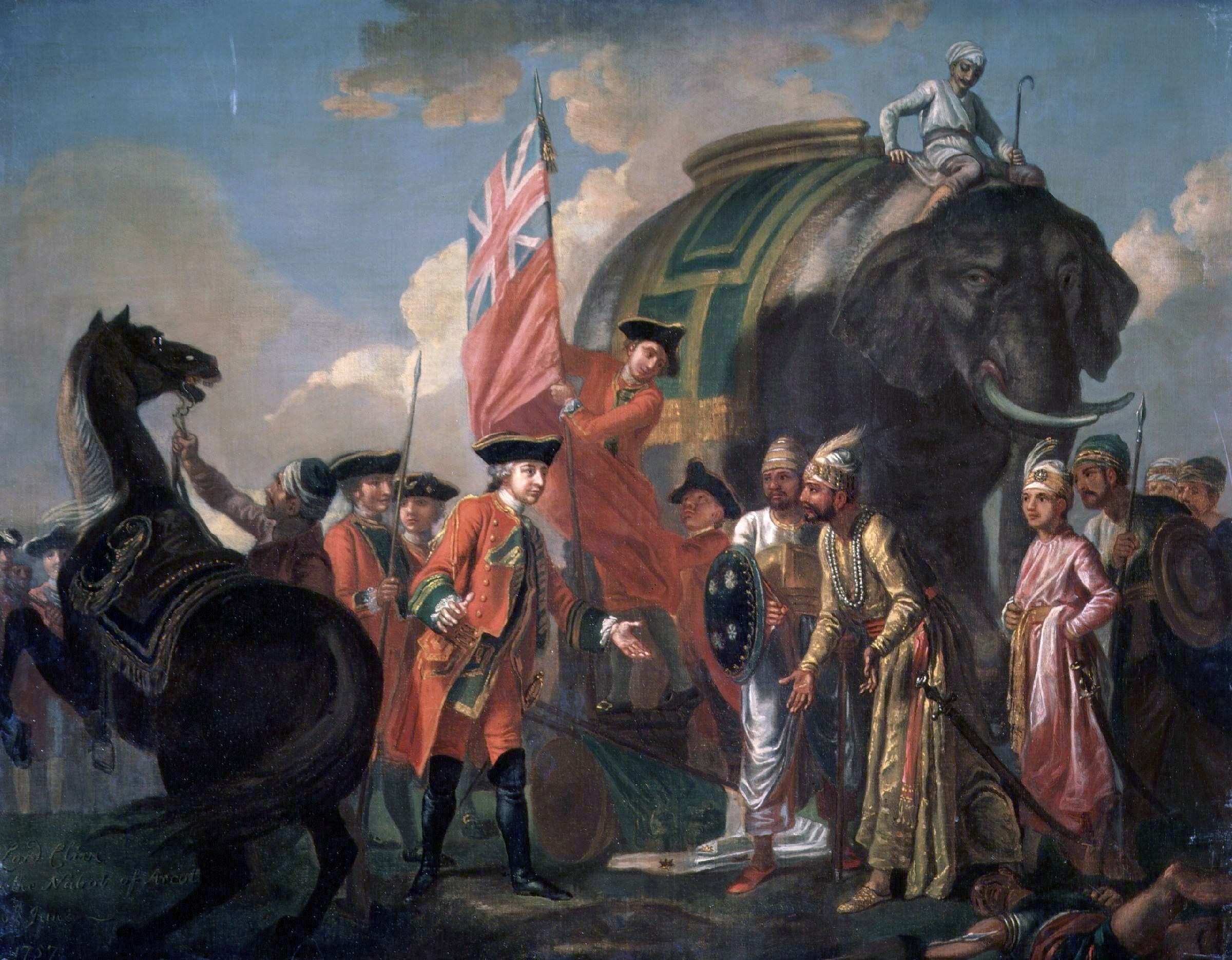
On 23 June 1757, the English East India Company defeated Bengal’s nawab, Siraj-ud-Daulah, at Plassey through conspiracy, bribery and the calculated non-participation of commanders led by Mir Jafar. It was less a straightforward military triumph than an armed corporate coup.
Plassey did not instantly give Britain complete control of Bengal. It installed a dependent nawab and opened Bengal’s treasury to Company officials. The decisive transfer of fiscal sovereignty followed the Battle of Buxar in 1764 and the Mughal grant of the diwani—revenue-collection rights in Bengal, Bihar and Orissa—to the Company in 1765. See the wider histories of the British Empire and the archive timeline.
Key takeaways
- Plassey on 23 June 1757 was an East India Company coup enabled by Mir Jafar’s conspiracy, not simply a battlefield victory.
- Robert Clive’s roughly 3,000 troops faced about 50,000, but most senior nawabi commanders withheld their forces during the battle.
- Mir Jafar’s 1757 settlement transferred approximately £2.34 million to the Company, its forces, Calcutta claimants and individual officials.
- The Company secured Bengal’s revenue rights in 1765, after defeating a regional coalition at Buxar on 22 October 1764.
- Plassey converted a commercial corporation into a territorial power whose armies and expansion were increasingly financed from Indian taxation.
Before Plassey: a wealthy province and competing powers
Bengal in 1757 was a formally Mughal but effectively autonomous province encompassing Bengal, Bihar and Orissa. Its productive agriculture, textiles, silk, saltpetre and river-borne trade made it one of Eurasia’s richest commercial regions. The Mughal emperor still conferred legitimacy, but governors had exercised hereditary regional power since Murshid Quli Khan’s consolidation of the nawabship in the early 18th century.
The English East India Company, chartered in 1600, was one among several armed trading corporations. It held Calcutta, while the French Compagnie des Indes operated at Chandernagore. Company servants exploited Mughal customs exemptions and private trade, creating repeated disputes with Bengal’s government. Europe’s Seven Years’ War, fought from 1756 to 1763, turned this competition into an imperial conflict.
Siraj-ud-Daulah became nawab in April 1756. In June 1756 his forces captured Calcutta after the English strengthened its fortifications without authorization. British accounts later centered the “Black Hole” story: John Zephaniah Holwell claimed in 1758 that 146 prisoners entered a cell and 23 survived. Historian Brijen Gupta concluded in 1959 that about 64 people were confined and 21 survived; the exact number remains disputed, and Holwell’s account became imperial propaganda.
“The Company are sovereigns in Bengal, and merchants everywhere else.” — Philip Francis, minute in the Bengal Council, 1776.
By 1757, Company officers were not merely defending trade. They were negotiating to remove Bengal’s ruler.
The conspiracy and the Battle of Plassey
Robert Clive and Company officials allied with disaffected Bengali elites, including commander Mir Jafar, financier Jagat Seth, merchant Omichand and administrator Rai Durlabh. A secret agreement promised Mir Jafar the nawabship. Clive deceived Omichand with a false version of the agreement after the merchant demanded payment for silence; Admiral Charles Watson refused to sign it, and his signature was reportedly forged.
On 23 June 1757, near the village of Palashi—anglicized as Plassey—the armies faced one another beside the Bhagirathi River. Modern histories commonly give Siraj’s force as about 50,000 infantry and cavalry with roughly 50 cannon, against approximately 3,000 Company troops, including about 800 European infantry and 2,100 Indian sepoys, with 8 field guns and 2 howitzers. Exact muster figures vary among contemporary reports.
The numerical imbalance concealed the conspiracy. Mir Jafar, Rai Durlabh and Yar Lutuf Khan withheld most of their formations. Only contingents led by Mir Madan and Mohan Lal fought seriously. Rain soaked inadequately protected nawabi powder, while Company ammunition remained usable under tarpaulins. Mir Madan was killed, Siraj’s command disintegrated, and the army withdrew. Siraj fled, was captured and was killed on 2 July 1757 by Muhammad-i-Beg, acting for Mir Jafar’s son Miran.
| Date | Event | Consequence |
|---|---|---|
| April 1756 | Siraj-ud-Daulah becomes nawab | Conflict with Company fortification and privileges intensifies |
| 20 June 1756 | Nawabi forces take Calcutta | Company personnel retreat; British retaliation follows |
| 2 January 1757 | Clive retakes Calcutta | Company restores its Bengal base |
| 9 February 1757 | Treaty of Alinagar is signed | Siraj temporarily confirms Company privileges |
| 23 March 1757 | Company forces capture French Chandernagore | Siraj loses a potential European counterweight |
| 5 June 1757 | Company concludes its secret compact with Mir Jafar | The nawab’s commander agrees to defect |
| 23 June 1757 | Battle of Plassey | Siraj’s army collapses after senior commanders stand aside |
| 29 June 1757 | Mir Jafar is installed at Murshidabad | The Company gains a dependent nawab |
| 2 July 1757 | Siraj-ud-Daulah is killed | Organized restoration becomes far less likely |
| 22 October 1764 | Company wins the Battle of Buxar | Military supremacy extends beyond Bengal |
| 12 August 1765 | Shah Alam II grants the diwani | Company receives revenue rights over Bengal, Bihar and Orissa |
| 1772–1773 | Warren Hastings reforms rule; Regulating Act passes | Revenue government is centralized and Parliament begins oversight |
The numbers: casualties, payments and revenue
Plassey’s battlefield losses were small relative to its consequences. Clive’s dispatch of 26 July 1757 reported Company losses of 22 killed and 50 wounded, totaling 72 casualties. He estimated the nawab’s losses at about 500 killed, although this was a victor’s estimate rather than an audited count.
The post-battle transfer was enormous. Company records summarized by historian P. J. Marshall in 1987 place the settlement imposed on Mir Jafar at approximately £2.34 million in 1757 money, distributed among the Company, its army and navy, Calcutta’s European inhabitants and individual officials. Marshall calculated that Clive personally received £234,000 in 1757, besides a later jagir yielding about £27,000 annually. Conversion into modern currency depends on whether prices, wages or economic share are measured, so a single present-day equivalent is misleading.
The sums mattered because the victors could reinvest Bengal’s resources in warfare. Indian revenues increasingly financed Company armies, administration and purchases of export goods. Britain’s imperial expansion was no longer dependent solely on capital remitted from Europe.
What Plassey set in motion
Mir Jafar could not satisfy continuing Company demands. The Company replaced him with Mir Qasim in 1760, restored Mir Jafar in 1763, and defeated Mir Qasim’s coalition with Mughal emperor Shah Alam II and Awadh’s ruler Shuja-ud-Daula at Buxar on 22 October 1764. On 12 August 1765, Shah Alam II granted the Company the diwani. A joint regime followed: Indian officials nominally governed while the Company extracted revenue without accepting full public responsibility.
Plassey was “a transaction in which the British East India Company became a political power.” — P. J. Marshall, Bengal: The British Bridgehead, 1987.
Revenue pressure, administrative disruption, war and grain-market failures formed the political economy in which the Bengal famine of 1769–1773 became catastrophic. Contemporary administrator Henry Verelst wrote in 1772 that roughly one-third of Bengal’s inhabitants had died; later scholarship treats this as an uncertain contemporary estimate, often expressed as about 10 million deaths, not a census result. Company land revenue nonetheless rose from about £1.52 million in 1768–1769 to about £1.57 million in 1770–1771, according to figures reproduced by historian Romesh Chunder Dutt in 1902.
Parliament’s Regulating Act of 1773 created a governor-general at Fort William and subjected the Company to limited state oversight. The India Act of 1784 established further government control. Corporate conquest thus helped generate a hybrid imperial system: private shareholders collected returns while British institutions protected and supervised territorial rule. Follow its expansion through the archive timeline.
How Plassey is remembered
British imperial histories long presented Plassey as Clive’s audacious victory over an oriental despot. That version minimized forged agreements, purchased defections and the extraction that followed. In South Asian memory, the name Palashi commonly marks the beginning of British political domination, although treating 23 June 1757 as a complete conquest obscures the resistance, negotiation and warfare extending through 1765 and beyond.
Siraj has often been recast as either a nationalist martyr or an incompetent tyrant. Neither label fully captures an 18th-century succession struggle in which bankers, commanders, merchants, European companies and Mughal authorities pursued their interests. Mir Jafar’s name became a byword for betrayal in Bengali, Urdu and Hindi political speech; that cultural memory accurately registers the conspiracy but can conceal the Company’s authorship, money and coercive force.
Robert Clive defended himself before Parliament in 1773 by declaring that he was “astonished at my moderation,” referring to the wealth available after Plassey. He was acquitted of formal wrongdoing, while the House of Commons resolved in 1773 that he had acquired £234,000 through powers entrusted to him, but had rendered “great and meritorious services” to Britain. The contradiction captures Plassey’s imperial legacy: conduct recognized as corrupt could still be honored when it enriched and enlarged the state.
Sources & further reading
Frequently asked questions
- Why was the Battle of Plassey important?
- The battle on 23 June 1757 allowed the East India Company to depose Siraj-ud-Daulah, install Mir Jafar and gain access to Bengal’s treasury and government. It did not complete the conquest immediately. Victory at Buxar in 1764 and the Mughal grant of revenue rights in 1765 converted political influence into durable fiscal power.
- Who betrayed Siraj-ud-Daulah at Plassey?
- Mir Jafar, Siraj’s commander, secretly agreed in June 1757 to support the East India Company in exchange for becoming nawab. Rai Durlabh and Yar Lutuf Khan also withheld their formations on 23 June 1757. The conspiracy was organized with Company officers under Robert Clive and involved powerful financiers and political intermediaries.
- How many soldiers and casualties were there at Plassey?
- Common estimates place Siraj-ud-Daulah’s army at about 50,000 troops and the Company force at roughly 3,000 on 23 June 1757. Robert Clive’s dispatch reported 22 Company personnel killed and 50 wounded. He estimated about 500 nawabi troops killed, but this was a contemporary enemy-loss estimate rather than an independently verified total.
- Did Britain conquer Bengal in 1757?
- Not completely. Plassey made the East India Company the decisive kingmaker in Bengal in 1757, but a dependent nawab still formally governed. The Company defeated Mir Qasim, Shah Alam II and Shuja-ud-Daula at Buxar in 1764, obtained the diwani in 1765, and centralized direct revenue administration under Warren Hastings in 1772.
- How much money did Robert Clive receive after Plassey?
- Historian P. J. Marshall’s 1987 account calculates that Robert Clive received approximately £234,000 from the 1757 settlement, while total promised distributions reached about £2.34 million in contemporary money. Clive later obtained a jagir worth roughly £27,000 annually. Modern equivalents vary radically according to whether comparison uses prices, earnings or national economic share.
Related chapters
Years
- 1492 and the Opening of the Atlantic World
- 1519–1521: The Spanish Conquest of the Aztec Empire
- 1652: The Founding of the Dutch Cape Colony
- 1791–1804: The Haitian Revolution
- 1833–1838: British abolition and slave-owner compensation
- 1857: The Indian Rebellion against Company Rule
- 1884–1885: Berlin Conference and Africa’s Partition
- 1904–1908: The Herero and Nama Genocide
- 1919: Amritsar and the Year the Empire Showed Its Face
Sources & further reading
CC BY 4.0 ·