1791–1804: The Haitian Revolution
How enslaved people overthrew French rule in Saint-Domingue, abolished slavery and founded independent Haiti between 1791 and 1804.
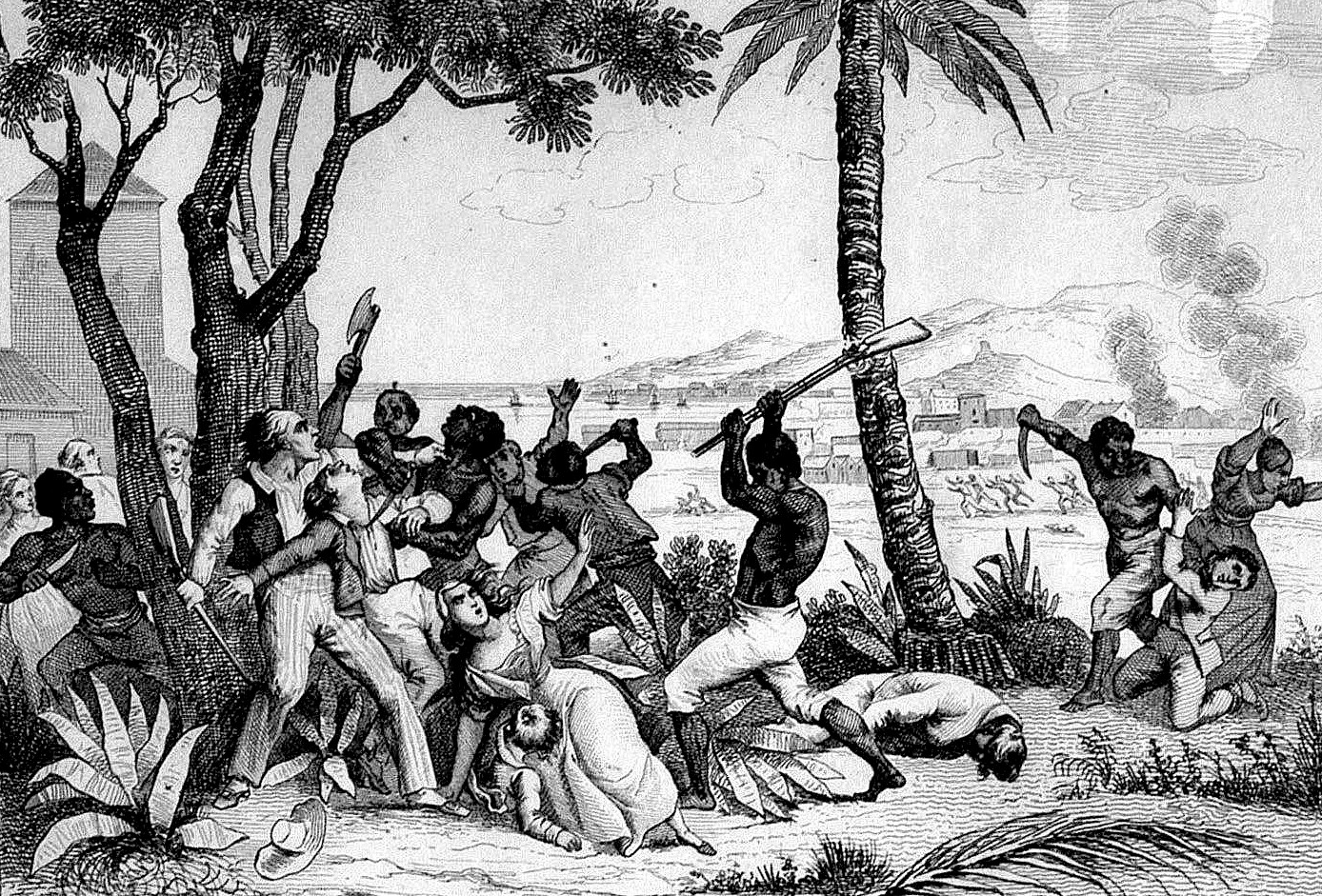
The Haitian Revolution of 1791–1804 destroyed slavery and French colonial government in Saint-Domingue and created Haiti, the first independent state founded by formerly enslaved people. Its Black armies defeated local slaveholders, British and Spanish forces, and Napoleon Bonaparte’s expedition before independence was proclaimed on 1 January 1804.
The revolution transformed the Atlantic world but at immense human cost. It ended the plantation regime in France’s richest colony, disrupted slave empires and provoked an international campaign to isolate Haiti. Explore its wider setting through the archive’s history hub and chronological timeline.
Key takeaways
- Between 1791 and 1804, enslaved people defeated colonial and expeditionary armies, destroyed slavery in Saint-Domingue and founded sovereign Haiti.
- France abolished colonial slavery in 1794 only after the 1791 uprising and Sonthonax’s 1793 emancipation proclamation forced the issue.
- David Geggus estimates that approximately 100,000 Black people and 24,000 white people died during the revolutionary wars of 1791–1804.
- Napoleon’s 1802 expedition failed after combat, resistance and disease killed roughly 50,000 French and allied personnel, according to Philippe Girard.
- France recognized Haiti in 1825 only after imposing a 150-million-franc indemnity benefiting former colonists and burdening the new state.
The world before 1791
Saint-Domingue occupied the western third of Hispaniola and generated extraordinary wealth through coerced labor. In 1789, French official Moreau de Saint-Méry counted about 30,826 whites, 27,548 free people of color and 465,429 enslaved people; historians warn that colonial returns undercounted mobile and recently imported populations. In the late 1780s, the colony supplied roughly 40% of Europe’s sugar and about 60% of its coffee, according to historian Laurent Dubois.
This prosperity rested on kidnapping, sale, forced migration, corporal punishment and lethal work. French merchants transported approximately 1.1 million captive Africans to Saint-Domingue between 1664 and 1791, according to the SlaveVoyages database; about 685,000 arrived between 1781 and 1790 alone. The enslaved population therefore remained predominantly African-born when rebellion began.
The 1685 Code Noir regulated French slavery while legally entrenching racial domination. Free people of color could own property—and some owned enslaved people—but faced discriminatory restrictions imposed by whites. The French Revolution began in 1789, and competing groups invoked its language of rights while colonial representatives resisted racial equality and emancipation.
“Men are born and remain free and equal in rights.” — French National Constituent Assembly, 1789, Declaration of the Rights of Man and of the Citizen
The contradiction was immediate: France proclaimed universal rights in 1789 while maintaining slavery in its Caribbean colonies.
Revolution, emancipation and independence
An organized uprising erupted in the northern plain during the night of 22–23 August 1791, following earlier planning meetings and the Bois Caïman ceremony associated with Dutty Boukman and Cécile Fatiman. Insurgents attacked plantations, destroyed machinery and confronted a system built to keep them enslaved. Their aims varied, but the struggle developed into a war for emancipation.
French civil commissioner Léger-Félicité Sonthonax proclaimed freedom for enslaved people in the northern province on 29 August 1793. France’s National Convention abolished slavery throughout its colonies on 4 February 1794. Toussaint Louverture, previously aligned with Spain, joined France in May 1794 and became Saint-Domingue’s dominant commander. His forces expelled Britain’s expedition in 1798 and defeated André Rigaud’s southern forces in the 1799–1800 War of the South.
Louverture’s Constitution of 1801 abolished slavery permanently and made him governor for life, while formally retaining French sovereignty. Napoleon sent an expedition commanded by his brother-in-law Charles Leclerc in 1802 to restore metropolitan control. French officers seized Louverture on 7 June 1802 and deported him to France, where he died at Fort de Joux on 7 April 1803. Napoleon restored slavery in Guadeloupe in 1802, confirming Saint-Domingue’s leaders’ fears.
| Date | Event | Consequence |
|---|---|---|
| 1789 | Revolution begins in France | Colonial factions dispute citizenship, race and imperial authority |
| 22–23 Aug 1791 | Northern slave uprising begins | Plantation rule collapses across much of the north |
| 4 Apr 1792 | France grants political equality to free men of color | White monopoly on colonial citizenship is legally broken |
| 29 Aug 1793 | Sonthonax proclaims emancipation in the north | Enslaved people there become legally free |
| 4 Feb 1794 | National Convention abolishes colonial slavery | Emancipation becomes French republican law |
| May 1794 | Louverture joins France | His army turns against Spain and supports emancipation |
| 1798 | British forces evacuate Saint-Domingue | A costly British occupation attempt ends |
| 1801 | Louverture promulgates a constitution | Slavery is prohibited and his autonomy expanded |
| 7 Jun 1802 | French forces arrest Louverture | He is deported and imprisoned in France |
| 18 Nov 1803 | Haitian army wins at Vertières | France’s final major force is defeated |
| 1 Jan 1804 | Jean-Jacques Dessalines declares independence | Haiti becomes sovereign and slavery remains abolished |
“In the end we must live independent or die.” — Jean-Jacques Dessalines, 1804, Haitian Declaration of Independence
At Vertières on 18 November 1803, forces commanded by Dessalines defeated Rochambeau’s army. Dessalines proclaimed Haiti’s independence at Gonaïves on 1 January 1804. See the archive timeline for the revolution’s place within Atlantic emancipation.
The numbers and the human cost
The evidence is incomplete because war, epidemic, flight and administrative collapse disrupted enumeration. Estimates must therefore be attributed rather than presented as exact totals.
Historian David Geggus estimated that about 100,000 Black people and 24,000 white people died during the revolution between 1791 and 1804. Philippe Girard estimates that Napoleon’s 1802–1803 expedition lost roughly 50,000 French and allied personnel, overwhelmingly to yellow fever and other diseases as well as combat. Britain deployed approximately 20,000 troops to Saint-Domingue between 1793 and 1798; historian David Geggus calculates around 12,000 British military deaths, chiefly from disease.
In 1804, Dessalines ordered the killing of most remaining French whites, excluding selected groups. Scholarly estimates commonly range from 3,000 to 5,000 people killed in the 1804 massacres; Philippe Girard gives approximately 3,000–5,000. The violence followed 13 years of warfare and French atrocities, including Rochambeau’s use of mass executions and attack dogs, but that context does not erase the victims or the state-directed nature of the killings.
What the revolution set in motion
Haiti’s victory permanently abolished slavery within the new state and shattered claims that enslaved populations could not defeat European armies or govern themselves. It accelerated refugee movement to Cuba, Jamaica, the United States and Louisiana. Approximately 10,000 Saint-Domingue refugees arrived in New Orleans from Cuba in 1809, according to historian Nathalie Dessens, nearly doubling that city’s population.
The collapse of French power contributed to Napoleon’s sale of Louisiana to the United States in 1803. The Louisiana Purchase transferred about 828,000 square miles for $15 million in 1803, figures recorded by the US National Archives. Slaveholders across the Americas responded to Haiti with censorship, military preparations and harsher racial controls, while abolitionists and enslaved people treated it as proof that plantation power could be broken.
France recognized Haitian independence only after King Charles X’s ordinance of 17 April 1825 demanded 150 million francs as compensation for former colonists, backed by warships. France reduced the principal to 90 million francs in 1838. Haiti completed associated French debt payments in 1883, while refinancing obligations to French banks continued into the 20th century; a 2022 New York Times investigation estimated that payments and lost growth cost Haiti between $21 billion and $115 billion in 2021 US dollars.
The indemnity made enslavers’ claimed property rights—not the freedom of the formerly enslaved—the basis of diplomatic recognition. It constrained public finance and entrenched foreign leverage. Follow these structures across the archive’s broader history of colonial power.
Memory, argument and erasure
Haitians remember 1 January as both Independence Day and the day associated with soup joumou, a dish symbolically reclaimed from colonial exclusion. National commemoration has often centered Louverture and Dessalines, but the revolution depended on thousands of less-recorded African-born organizers, soldiers, cultivators and women, including Sanité Bélair, Marie-Jeanne Lamartinière and Cécile Fatiman.
Outside Haiti, accounts long reduced the revolution to racial violence or treated emancipation as a French gift. The chronology disproves that framing: mass insurgency began in 1791; Sonthonax’s limited proclamation followed in 1793; national abolition followed in 1794. Enslaved people forced the question before legislators ratified freedom.
The revolution was neither a peaceful morality tale nor an inexplicable catastrophe. It was a successful antislavery revolution fought against a colonial order maintained by systematic violence. Its legacy includes emancipation and sovereignty, authoritarian labor policies under Louverture and Dessalines, civil conflict, the 1804 massacres and the punitive international order imposed afterward.
Sources & further reading
- Laurent Dubois, Avengers of the New World — Harvard University Press
- David Patrick Geggus, Haitian Revolutionary Studies — Indiana University Press
- The Haitian Declaration of Independence — Duke University Libraries
- The Trans-Atlantic Slave Trade Database — SlaveVoyages
- The Ransom: France’s indemnity imposed on Haiti — The New York Times
- Haitian Revolution — Encyclopaedia Britannica
Frequently asked questions
- What was the Haitian Revolution?
- The Haitian Revolution was the 1791–1804 struggle in the French colony of Saint-Domingue through which enslaved people destroyed plantation slavery, defeated French, British and Spanish forces, and established Haiti. Jean-Jacques Dessalines proclaimed independence on 1 January 1804 after the Haitian victory over Rochambeau’s French army at Vertières on 18 November 1803.
- Who led the Haitian Revolution?
- No single person led all 13 years from 1791 to 1804. Early leaders included Dutty Boukman, Biassou and Jean-François Papillon. Toussaint Louverture became dominant after joining France in May 1794. Following his arrest on 7 June 1802, Jean-Jacques Dessalines led the independence army, alongside commanders including Henry Christophe and Alexandre Pétion.
- How many people died in the Haitian Revolution?
- No complete death register survives. Historian David Geggus estimates approximately 100,000 Black deaths and 24,000 white deaths between 1791 and 1804. Philippe Girard estimates roughly 50,000 French and allied expeditionary deaths in 1802–1803, mostly from disease. These categories and periods overlap, so they cannot be combined into one reliable total.
- Why did Napoleon fail to retake Saint-Domingue?
- Napoleon sent Charles Leclerc’s expedition in 1802 to restore French control. Haitian resistance revived when France’s conduct, including slavery’s restoration in Guadeloupe in 1802, exposed the threat to emancipation. Yellow fever devastated European troops; Philippe Girard estimates roughly 50,000 French and allied deaths in 1802–1803. Dessalines’s army won decisively at Vertières on 18 November 1803.
- What was the Haitian independence debt to France?
- On 17 April 1825, King Charles X recognized Haiti while demanding 150 million francs to compensate former French colonists for lost land and enslaved people. The principal was reduced to 90 million francs in 1838. Haiti finished paying the French government-linked indemnity in 1883, although refinancing debts continued; a 2022 investigation estimated losses of $21–115 billion in 2021 dollars.
Related chapters
Years
- 1492 and the Opening of the Atlantic World
- 1519–1521: The Spanish Conquest of the Aztec Empire
- 1652: The Founding of the Dutch Cape Colony
- 1757: Plassey and the East India Company’s Conquest
- 1833–1838: British abolition and slave-owner compensation
- 1857: The Indian Rebellion against Company Rule
- 1884–1885: Berlin Conference and Africa’s Partition
- 1904–1908: The Herero and Nama Genocide
- 1919: Amritsar and the Year the Empire Showed Its Face
Sources & further reading
CC BY 4.0 ·