1857: The Indian Rebellion against Company Rule
A documented history of the 1857–59 Indian Rebellion: causes, chronology, contested death tolls, British reprisals and the creation of Crown rule.
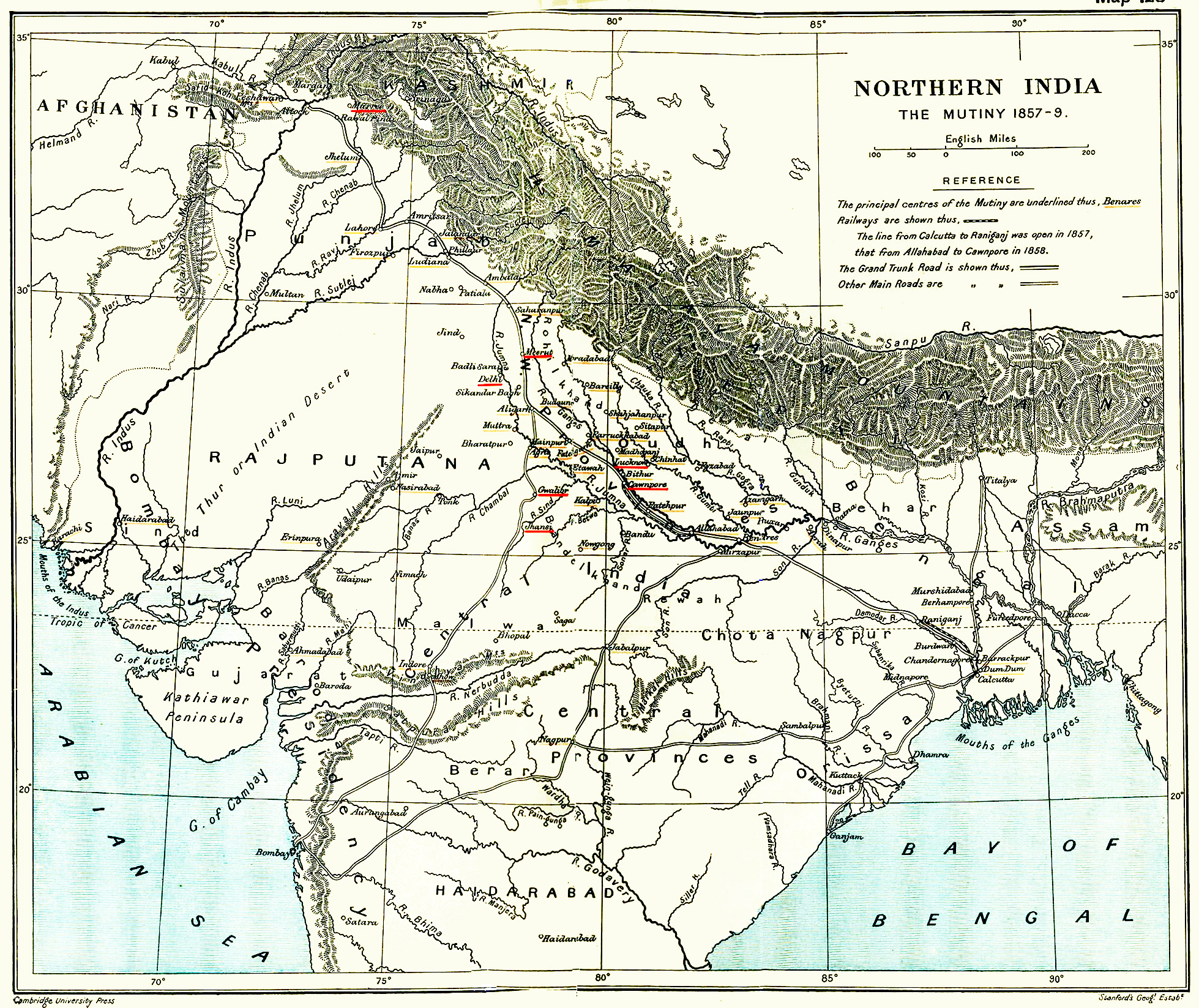
The Indian Rebellion of 1857 was the largest armed challenge to the British Empire in nineteenth-century South Asia. Beginning with a sepoy mutiny at Meerut on 10 May 1857, it became a broader, uneven war against the British East India Company across northern and central India. Rebels seized Delhi and recognized the Mughal emperor Bahadur Shah II; major campaigns followed at Kanpur, Lucknow, Jhansi and Gwalior.
The revolt grew from military grievances, territorial annexation, disrupted political and landholding orders, racial discrimination and fears of coerced religious change. British forces and their allies suppressed it through siege warfare, summary execution and collective punishment. Parliament abolished Company government under the Government of India Act 1858, transferring India to direct Crown rule.
Key takeaways
- The rebellion began at Meerut on 10 May 1857 and expanded into military and civilian resistance across northern and central India.
- Company annexation, land disruption, racial inequality, religious fears and military grievances created the conditions in which the cartridge dispute became explosive.
- No reliable all-India death toll exists, although Rudrangshu Mukherjee estimated that British reprisals killed more than 100,000 people in Awadh alone.
- The Government of India Act 1858 ended East India Company government and transferred its Indian territories directly to the British Crown.
- Remembering 1857 as only a sepoy mutiny conceals civilian participation, while calling it wholly national exaggerates its unity and geographic reach.
Before 1857: conquest, annexation and military grievance
By 1857, the East India Company had changed from a trading corporation into a territorial power with its own taxation system, courts and armies. Its forces contained roughly 232,000 Indian troops and 45,000 European troops in 1857, according to historian Saul David; the Bengal Army alone had about 139,000 Indian sepoys and 26,000 Europeans. This dependence on Indian soldiers made Company rule powerful but vulnerable.
Governor-General James Andrew Broun-Ramsay, Marquess of Dalhousie, applied the Doctrine of Lapse to annex states where the Company rejected an adopted heir. Satara was annexed in 1848, Jhansi in 1854 and Nagpur in 1854. Awadh was annexed separately in 1856 on the stated ground of misgovernment, displacing its court and threatening landholders whose families supplied many Bengal sepoys. The Mughal dynasty was also marked for extinction after Bahadur Shah II's death.
Sepoys received lower pay and status than European soldiers, faced declining allowances and feared overseas service would violate caste obligations. The General Service Enlistment Act 1856 required new Bengal Army recruits to accept service overseas. The immediate crisis concerned cartridges for the new Pattern 1853 Enfield rifle: soldiers believed their paper casings were greased with cow and pig fat and had to be bitten open, offending Hindu and Muslim religious practice. Officials disputed the composition and introduced alternatives, but mistrust was already entrenched.
“The real cause of the mutiny was the apprehension that the Government intended to convert the people to Christianity.” — Syed Ahmad Khan, 1858, The Causes of the Indian Revolt (contemporary analysis, not an uncontested verdict).
What happened: revolt, sieges and reconquest
On 29 March 1857, sepoy Mangal Pandey attacked British officers at Barrackpore; the Company hanged him on 8 April 1857. At Meerut, 85 troopers who rejected cartridges were sentenced on 9 May 1857. Their comrades revolted the next day, killed European officers and civilians, freed prisoners and rode to Delhi. On 11 May 1857, rebels entered the imperial capital and proclaimed the 81-year-old Bahadur Shah II their sovereign.
Revolt spread through Awadh, Rohilkhand, Bundelkhand and parts of Bihar and central India. Nana Sahib led resistance around Kanpur; Begum Hazrat Mahal became a central authority in rebel-held Lucknow; Kunwar Singh fought in Bihar; and Rani Lakshmibai defended Jhansi before joining Tantia Tope. There was no unified national command, program or territorial reach: the Bombay and Madras armies largely remained under British control, while Sikh, Punjabi Muslim, Pathan, Gurkha and princely-state forces helped the British reconquest.
| Date | Event | Consequence |
|---|---|---|
| 29 March 1857 | Mangal Pandey attacks officers at Barrackpore | He is hanged on 8 April 1857; unrest intensifies |
| 9 May 1857 | 85 troopers are imprisoned at Meerut | Their punishment precipitates the garrison revolt |
| 10 May 1857 | Sepoys and civilians rise at Meerut | Rebels march approximately 64 km to Delhi |
| 11 May 1857 | Rebels seize Delhi | Bahadur Shah II becomes the revolt's symbolic sovereign |
| 27 June 1857 | Kanpur evacuation ends in killings at Satichaura Ghat | British propaganda makes Kanpur a rationale for vengeance |
| 16 July 1857 | British forces retake Kanpur | Summary executions and reprisals follow |
| 20 September 1857 | British troops complete Delhi's recapture | Mass displacement, executions and imperial reconquest begin |
| 19 March 1858 | British forces retake Lucknow | Organized resistance in Awadh shifts toward guerrilla war |
| 3 April 1858 | British troops capture Jhansi | Lakshmibai escapes and continues fighting |
| 18 June 1858 | Lakshmibai dies near Gwalior | A principal rebel commander is killed |
| 20 June 1858 | British forces secure Gwalior | The last major rebel field position collapses |
| 1 November 1858 | Queen Victoria's proclamation announces qualified clemency | Crown government replaces Company sovereignty |
| 8 July 1859 | Britain formally declares peace | The official end follows continued resistance |
Follow the wider chronology on the archive's global timeline.
The numbers: deaths, famine and disputed estimates
No complete casualty register exists. Military deaths, massacres, executions, village destruction, epidemic disease and famine were recorded inconsistently; colonial authorities had incentives to document British victims while obscuring Indian losses. A frequently repeated estimate of 6,000 British deaths in 1857–58 includes soldiers, civilians and deaths from disease, but category totals differ across regimental and historical accounts.
Indian deaths were vastly greater but remain disputed. Historian Rudrangshu Mukherjee estimated that British reprisals in Awadh alone killed more than 100,000 people during 1857–58. In 2007, historian Amaresh Misra proposed 10,000,000 Indian deaths across the decade 1857–67, combining warfare with famine and demographic loss; most scholars regard that figure as unproven because the surviving census and mortality evidence cannot sustain such precision. The responsible conclusion is not that losses were small, but that no defensible all-India total can currently be calculated.
The arithmetic is asymmetrical: individual British deaths were often named, while Indian civilians killed by reprisals, displacement, hunger and disease frequently disappeared into administrative silence.
What 1857 set in motion
The Government of India Act 1858 dissolved the Company's governing role and vested its territories in Queen Victoria. A secretary of state for India, assisted by a 15-member council in 1858, directed policy from London; the governor-general also became viceroy. Queen Victoria's proclamation of 1 November 1858 promised religious non-interference, equal legal protection and respect for princely treaties, while excluding people convicted of murdering British subjects from clemency.
The colonial state abandoned aggressive annexation and relied more heavily on princes and landlords. It reorganized the army to increase the European proportion and control artillery. The European-to-Indian troop ratio changed from roughly 1:5 before 1857 to about 1:2 after reorganization in the 1860s, as summarized by historian Thomas Metcalf. Recruitment shifted toward communities classified by British racial theory as “martial races,” especially Sikhs, Gurkhas and some Punjabi groups. Units were deliberately mixed to inhibit solidarity.
British authorities intensified racial separation and represented rebel violence—particularly the killing of British women and children at Kanpur in 1857—as proof that Indians required authoritarian rule. That narrative minimized indiscriminate British vengeance: prisoners were blown from cannon, suspected rebels summarily hanged, neighborhoods cleared and villages burned. The Raj that followed was not a liberal correction to Company abuse; it was a more centralized phase of British imperial rule, secured through surveillance, military restructuring and selective alliances.
How the rebellion is remembered
Names encode political judgment. British imperial writers called it the “Sepoy Mutiny,” reducing a geographically broad social and political revolt to military insubordination. V. D. Savarkar's 1909 book popularized “The Indian War of Independence,” a nationalist interpretation that treated 1857 as a united anticolonial struggle. “Indian Rebellion,” “Great Revolt” and “Uprising” acknowledge wider participation without claiming uniform motives or nationwide coordination.
Commemoration has elevated Mangal Pandey, Rani Lakshmibai, Begum Hazrat Mahal, Kunwar Singh, Tantia Tope and Bahadur Shah II. It has also selectively forgotten uncomfortable evidence: rebels killed British civilians and Indian Christians; British troops, loyalist forces and colonial officials conducted collective reprisals on a much larger military scale. Hindu–Muslim cooperation occurred in major rebel centers, but later nationalist and communal histories often recast 1857 for twentieth-century political needs.
Bahadur Shah II was tried by a British military commission in Delhi in 1858 and deported to Rangoon, where he died on 7 November 1862. Lakshmibai's death near Gwalior on 18 June 1858 became an enduring symbol of resistance. Understanding those memories requires separating later nation-building from the documented coalitions, contradictions and regional limits of 1857. Compare this turning point with other imperial crises on the Unsilenced timeline.
Sources & further reading
- Encyclopaedia Britannica: Indian Mutiny
- British Library: India and the 1857 Rebellion
- JSTOR: Rudrangshu Mukherjee, Awadh in Revolt, 1857–1858
- Cambridge University Press: Thomas R. Metcalf, The Aftermath of Revolt
- Internet Archive: Syed Ahmad Khan, The Causes of the Indian Revolt
- UK Parliament: Government of India Act 1858
Frequently asked questions
- What caused the Indian Rebellion of 1857?
- The rebellion had no single cause. Company annexations between 1848 and 1856 displaced rulers and landholders; Awadh's annexation in 1856 alienated a major sepoy recruiting region. Soldiers also faced unequal pay, overseas-service fears and racial discrimination. The immediate trigger in 1857 was the belief that Enfield cartridges contained cow and pig fat, violating Hindu and Muslim religious obligations.
- When and where did the Indian Rebellion begin?
- The main uprising began at Meerut on 10 May 1857, after 85 cavalrymen were punished on 9 May for refusing cartridges. Mutineers freed prisoners and traveled approximately 64 km to Delhi, entering it on 11 May. Earlier unrest included Mangal Pandey's attack at Barrackpore on 29 March 1857, but Meerut transformed localized military resistance into a regional rebellion.
- How many people died in the Indian Rebellion of 1857?
- No reliable total exists. About 6,000 British soldiers and civilians are often estimated to have died during 1857–58, including deaths from disease. Indian losses were far higher but poorly recorded. Historian Rudrangshu Mukherjee estimated more than 100,000 deaths from British reprisals in Awadh alone. Amaresh Misra's 2007 claim of 10,000,000 deaths across 1857–67 remains unsubstantiated and is not scholarly consensus.
- Who were the principal leaders of the 1857 rebellion?
- Bahadur Shah II became the symbolic sovereign in Delhi from 11 May 1857. Other prominent leaders included Nana Sahib and Tantia Tope around Kanpur and central India, Begum Hazrat Mahal in Awadh, Rani Lakshmibai of Jhansi, and Kunwar Singh in Bihar. Their forces pursued overlapping but not identical aims, and no unified national command existed.
- What changed after the rebellion was defeated?
- The Government of India Act 1858 ended East India Company rule and transferred administration to the British Crown. Queen Victoria's proclamation followed on 1 November 1858. Britain reorganized the army, increased the relative number of European troops, restricted Indian control of artillery, strengthened alliances with princes and landlords, and developed recruitment around the racist colonial category of “martial races.”
Related chapters
Years
- 1492 and the Opening of the Atlantic World
- 1519–1521: The Spanish Conquest of the Aztec Empire
- 1652: The Founding of the Dutch Cape Colony
- 1757: Plassey and the East India Company’s Conquest
- 1791–1804: The Haitian Revolution
- 1833–1838: British abolition and slave-owner compensation
- 1884–1885: Berlin Conference and Africa’s Partition
- 1904–1908: The Herero and Nama Genocide
- 1919: Amritsar and the Year the Empire Showed Its Face
Sources & further reading
CC BY 4.0 ·