1943: The Bengal Famine
How British wartime policy, inflation, crop damage and unequal access to food turned Bengal’s 1943 subsistence crisis into mass death.
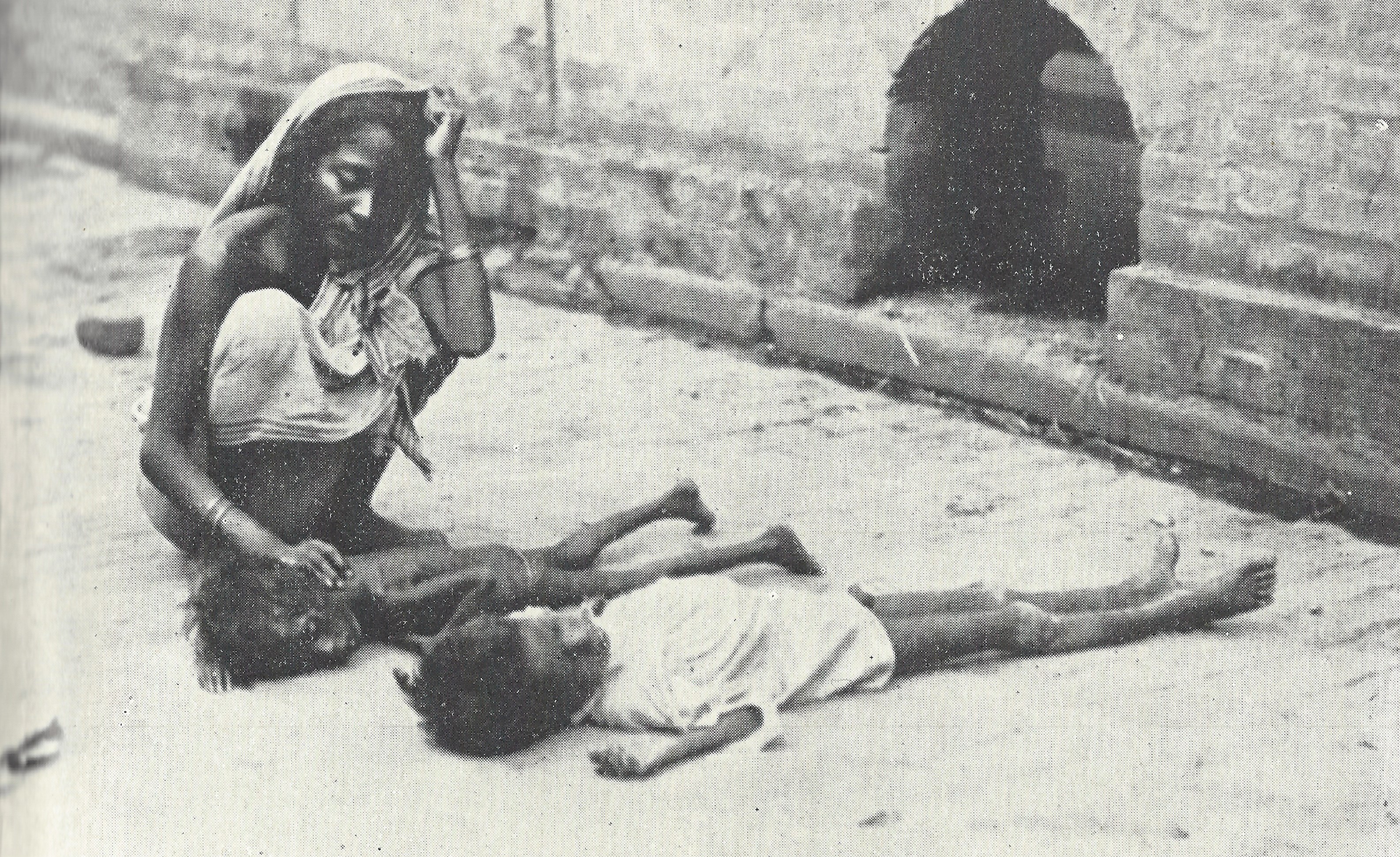
The Bengal famine of 1943 was a human-made wartime catastrophe in British India. Hunger and associated epidemics killed about 3 million people in Bengal, according to the 1945 estimate of anthropologist K. P. Chattopadhyay; later estimates range from roughly 2.1 million deaths in 1943–1944, calculated by demographer Arup Maharatna in 1996, to 3.0–3.8 million excess deaths in 1943–1946, estimated by economist Utsa Patnaik in 2017. Colonial procurement, inflation, transport priorities, market speculation and delayed relief converted local crop and supply shocks into famine.
This year hub places the catastrophe within World War II and links its chronology to the archive’s detailed Bengal famine investigation and wider historical timeline.
Key takeaways
- The Bengal famine killed roughly 2.1–3.8 million people across differing scholarly estimates and measurement periods from 1943 to 1946.
- British wartime procurement, inflation, transport controls and delayed relief transformed crop and supply shocks into mass starvation and epidemic disease.
- The 1942 boat-denial policy removed more than 46,000 vessels, damaging fishing, trade and mobility across vulnerable coastal districts.
- Malaria, dysentery, diarrhea, cholera and smallpox killed malnourished people after hunger, migration and inadequate sanitation weakened resistance to infection.
- The famine discredited British rule and became central to later theories explaining how loss of purchasing power can cause mass hunger.
The world before the famine
Bengal entered 1943 under British colonial rule and wartime emergency powers. Its densely populated countryside depended heavily on rice, while millions of landless laborers, fishers, artisans and small cultivators bought part or all of their food. Their survival therefore depended not merely on grain existing, but on wages and possessions retaining enough value to buy it.
After Japan occupied Burma in March 1942, British India lost a rice supplier whose exports had normally amounted to about 15% of India’s imported rice in the prewar period, according to the official 1945 Famine Inquiry Commission. This was nationally modest but psychologically and regionally disruptive. Military expenditure, procurement and monetary expansion drove inflation; army personnel, industrial workers and other priority groups received protection that rural laborers did not.
A cyclone and tidal waves struck coastal Bengal on 16 October 1942. The 1945 commission reported about 14,500 human deaths and the loss of approximately 190,000 cattle. Flooding, saltwater and the fungal disease brown spot damaged the winter rice crop, particularly in Midnapore. Yet Bengal’s total 1942 rice shortfall remains disputed: Nobel laureate Amartya Sen argued in 1981 that food availability was not exceptionally low enough to explain famine, whereas historian Cormac Ó Gráda concluded in 2015 that scarcity mattered but cannot explain who was abandoned to die.
Famine was not an automatic consequence of one failed harvest. It emerged because wartime power determined whose demand counted, where grain moved and who received public protection.
What happened in 1942–1944
Fear of a Japanese invasion produced the “denial” policies of 1942. Under boat denial, officials confiscated or destroyed boats capable of carrying at least 10 people in vulnerable coastal districts; the 1945 Famine Inquiry Commission recorded the removal of more than 46,000 boats in 1942. Rice denial removed surplus stocks from selected coastal zones. Officials described both as military precautions, but they disrupted fishing, ferrying, trade and access to markets.
Prices accelerated during late 1942 and 1943. Provincial controls were inconsistent, interprovincial trade barriers impeded supplies, and the Government of India did not secure adequate imports soon enough. Rural households sold land, tools, jewelry and livestock. Destitute people moved toward Calcutta, whose war industries and protected population made food appear more obtainable than in the countryside.
| Date | Event | Consequence |
|---|---|---|
| 7 December 1941 | Japan enters the wider Pacific War | British India becomes a military supply base; defense spending and procurement intensify. |
| 8 March 1942 | Rangoon falls to Japan | Burma’s rice exports to India are cut off. |
| April 1942 | Boat and rice denial begin in coastal Bengal | More than 46,000 boats are removed during 1942, according to the 1945 commission, damaging transport and livelihoods. |
| 16 October 1942 | Cyclone and tidal surges hit coastal Bengal | About 14,500 people and 190,000 cattle die, according to the 1945 commission; crops and stores are destroyed. |
| December 1942 | Damaged aman rice harvest reaches markets | Scarcity fears and speculation compound wartime inflation. |
| March 1943 | A. K. Fazlul Huq’s Bengal ministry falls | Khawaja Nazimuddin forms a ministry as the food crisis deepens. |
| May–June 1943 | Acute distress spreads across rural districts | Asset sales, migration, starvation and epidemic disease accelerate. |
| August 1943 | Leopold Amery publicly acknowledges famine conditions | Official recognition comes after widespread mortality and displacement. |
| 20 October 1943 | Field Marshal Archibald Wavell becomes Viceroy | Wavell presses London for grain imports and stronger relief. |
| November–December 1943 | Army-assisted relief and imports expand | Rice prices ease and visible starvation declines, though disease deaths continue. |
| July 1944 | Famine Inquiry Commission is appointed | The colonial government begins an official investigation. |
| May 1945 | Commission report is published | It identifies administrative and distribution failures but avoids assigning full imperial responsibility. |
Photographs by Indian photojournalist Sunil Janah and drawings by artist Chittaprosad Bhattacharya exposed skeletal bodies, abandoned children and deaths on Calcutta’s streets. Chittaprosad’s 1943 pamphlet Hungry Bengal was suppressed and most copies were seized and destroyed by colonial authorities.
“The British Government’s attitude was a disgraceful one.” — Field Marshal Archibald Wavell, reflecting on Bengal policy in his wartime journal, published in The Viceroy’s Journal (1973).
The numbers: death, price and dispossession
No complete death registration existed, and estimates use different periods and counterfactual baselines. The official Famine Inquiry Commission calculated approximately 1.5 million excess deaths during 1943–1944 in its 1945 report, while acknowledging uncertainty. K. P. Chattopadhyay estimated about 3 million deaths in 1945. Arup Maharatna’s demographic reconstruction produced roughly 2.1 million excess deaths for 1943–1944 in 1996. Utsa Patnaik estimated 3.0–3.8 million excess deaths across 1943–1946 in 2017. The frequently repeated range of 800,000–3.8 million combines unlike methods and periods; it should not be mistaken for a single consensus interval.
Most victims did not die solely from literal starvation. Malaria was the largest recorded killer, followed by diseases including dysentery, diarrhea, cholera and smallpox, all made deadlier by malnutrition and displacement. The gendered damage included trafficking, abandonment and survival sex; families separated and children entered institutions or lived on the streets. For supporting documents and testimony, see Bengal famine records.
What the famine set in motion
The catastrophe destroyed confidence in the Raj’s claim to competent, protective rule. The Indian National Congress leadership had been imprisoned after the August 1942 Quit India movement, while Bengal’s provincial government and the central government disputed responsibility. Prime Minister Winston Churchill’s War Cabinet repeatedly prioritized shipping and military requirements over requested grain deliveries. Secretary of State for India Leopold Amery and Viceroy Wavell both pressed for additional imports during 1943–1944, but relief came after mass mortality had begun.
Amartya Sen’s 1981 analysis made Bengal central to modern famine theory. He argued that agricultural laborers, fishers and other groups suffered an “exchange entitlement” collapse: food could remain in markets while people lost the means to command it. Subsequent scholarship has restored production shocks, imperial shipping, speculation and provincial fragmentation to the explanation without displacing the central fact of unequal access.
Politically, the famine strengthened anti-colonial arguments before British India became independent on 15 August 1947. It also sharpened agrarian conflict in Bengal, including demands that sharecroppers retain two-thirds of harvests during the Tebhaga movement of 1946–1947. Partition on 14–15 August 1947 then divided Bengal between India and East Pakistan, imposing another mass displacement on communities already damaged by famine. Explore that sequence in the archive’s global chronology.
Memory, responsibility and denial
The 1945 Famine Inquiry Commission blamed crop damage, wartime disruption, inflation, hoarding and administrative failures, but its institutional language dispersed responsibility. Later historians have examined decisions by Churchill’s War Cabinet, the Government of India, Bengal’s ministries, traders and local officials. Responsibility was layered, but power was not equal: the imperial government controlled shipping, military priorities, currency and the capacity to transfer grain at scale.
Public memory survives through Janah’s photographs, Chittaprosad’s art, oral histories, fiction and scholarship. Satyajit Ray’s 1973 film Distant Thunder portrayed rural hunger without treating it as a natural disaster. Debate continues over Churchill’s personal culpability and the feasibility of particular shipping alternatives, but there is no serious basis for reducing the famine to weather alone.
The famine belongs in the history of colonial extraction and wartime rationing, not as an isolated Bengali tragedy. The archive’s Bengal famine reference page follows the evidence on policy, mortality and responsibility; the timeline of colonial violence locates it among connected imperial crises.
Sources & further reading
- Famine Inquiry Commission, Report on Bengal (1945), Internet Archive
- Amartya Sen, Poverty and Famines (Oxford University Press, 1981)
- Cormac Ó Gráda, “The Bengal Famine of 1943,” University College Dublin working paper
- Janam Mukherjee, Hungry Bengal (Oxford University Press, 2015)
- Madhusree Mukerjee, Churchill’s Secret War (Basic Books, 2010)
Frequently asked questions
- How many people died in the Bengal famine of 1943?
- Estimates differ by method and period. The 1945 Famine Inquiry Commission estimated about 1.5 million excess deaths in 1943–1944; K. P. Chattopadhyay estimated 3 million in 1945; Arup Maharatna calculated roughly 2.1 million in 1996; and Utsa Patnaik estimated 3.0–3.8 million across 1943–1946 in 2017.
- Was the Bengal famine caused by food shortage or British policy?
- Both supply shocks and policy mattered, but neither weather nor crop disease alone explains the deaths. The October 1942 cyclone, rice-crop damage and Burma’s loss reduced supply. British military procurement, inflation, boat and rice denial, trade barriers, inadequate price control, unequal rationing and delayed imports then prevented millions from obtaining food during 1943.
- What was Churchill’s role in the Bengal famine?
- Winston Churchill headed the British War Cabinet, which controlled imperial shipping and strategic priorities during 1943. His government rejected or delayed several requests for major grain imports while prioritizing military needs and other theaters. Provincial failures and speculation also contributed, but ultimate shipping and wartime authority rested in London and with the Government of India.
- What was the boat-denial policy in Bengal?
- Beginning in April 1942, British authorities confiscated, disabled or destroyed boats capable of carrying at least 10 people in coastal areas considered vulnerable to Japanese invasion. The 1945 Famine Inquiry Commission recorded more than 46,000 boats removed during 1942. The measure damaged fishing, ferrying, trade and rural access to food and employment.
- Why did disease kill so many famine victims?
- Malnutrition weakened immune systems while displacement crowded destitute people into roads, stations, relief sites and Calcutta during 1943–1944. Malaria became the largest recorded cause of famine-related mortality; dysentery, diarrhea, cholera and smallpox also surged. Inadequate medical care and sanitation meant people often died from infections that hunger made lethal.
Related chapters
Years
- 1492 and the Opening of the Atlantic World
- 1519–1521: The Spanish Conquest of the Aztec Empire
- 1652: The Founding of the Dutch Cape Colony
- 1757: Plassey and the East India Company’s Conquest
- 1791–1804: The Haitian Revolution
- 1833–1838: British abolition and slave-owner compensation
- 1857: The Indian Rebellion against Company Rule
- 1884–1885: Berlin Conference and Africa’s Partition
- 1904–1908: The Herero and Nama Genocide
Sources & further reading
CC BY 4.0 ·